In Acadian Footsteps: 1
Continuing the Acadia article about that unique, lost-and-found land, this story traces the travels and travails of my Doucet ancestors, starting in the 1600s with an extraordinary man, my x-times pépère (grandfather) Pierre and his wife Henriette nine generations ago, in times both bright and dark.
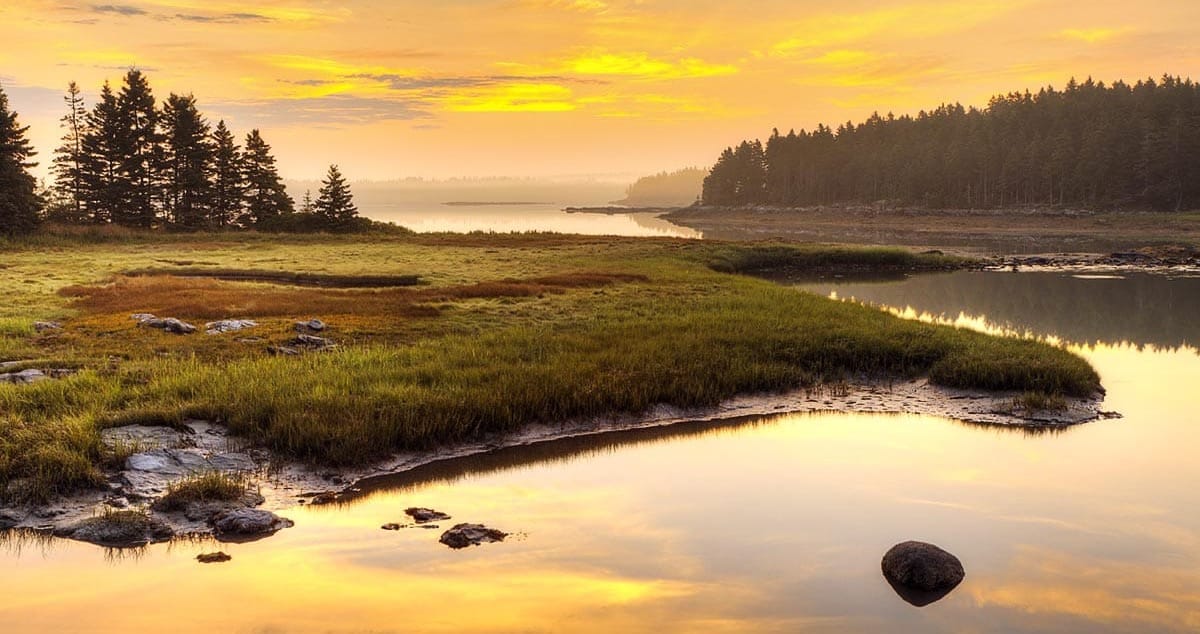
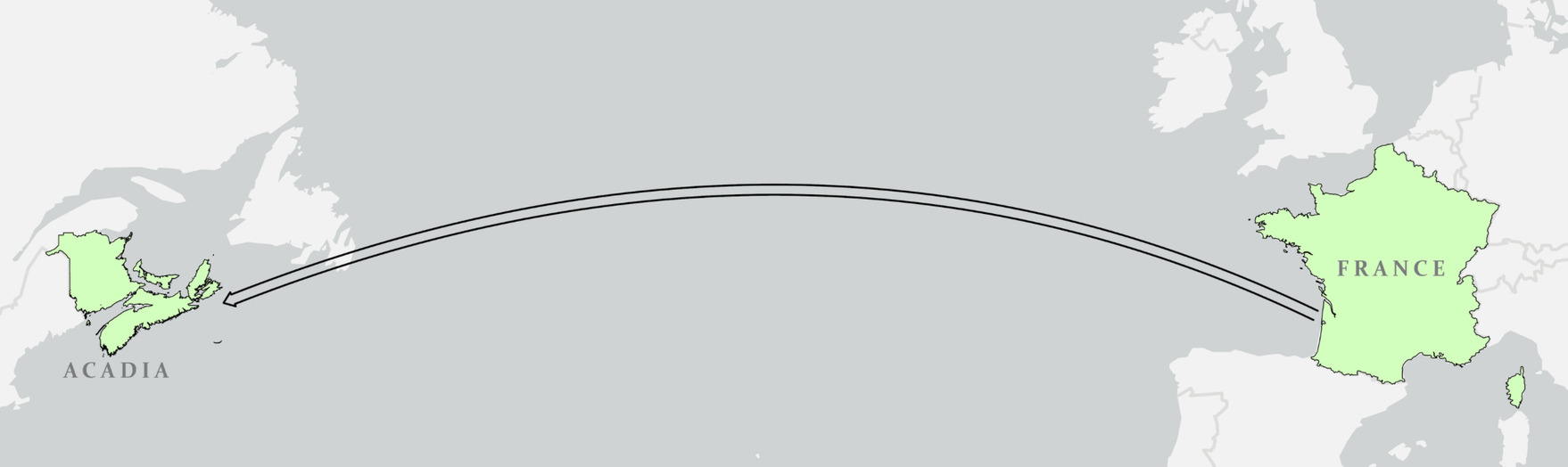
The footsteps started in France, long ago, in the 1600s. They led to a land called Acadia on old maps, where a few families settled and prospered despite hardship and attack. The land was fertile and free, they were healthy, had many children and the population grew quickly. A new national identity came about, a distinctive new ethnicity, Acadian.
Germain Doucet, Pierre Doucet, Marguerite Doucet, and a girl whose name has been lost, were one of the handful of founding families of Acadie. Pierre, born in 1621, was my great-great-great-great-great-great-great-grandfather. He lived to almost 100 years of age, the last survivor of the founding families of Acadie. He had a hell of a life.
1. From feudal France to free Acadie
Pierre Doucet, 1621-1713
Henriette Pelletret, 1641-1686/1693
As children, Pierre, his sister Marguerite and another sister may have sailed with their uncle Germain in 1632 on the long, hazardous and often stormy journey from the Atlantic coast of France to the new-found-lands of North America.
What they, and other French migrants, endured in crossing the Atlantic in the 1600s can stagger our imagination today. A French captain is quoted as saying that even the easiest cross-Atlantic voyage he made, starting in the notoriously stormy Bay of Biscay, gave him more white hairs than anything else in his life: "it is a continual torment of the mind and the body" [translated]. One adventurer told of his fear of sailing through "the unstable sea, every moment a hairsbreadth from death... aloft upon mountains of water, and thence down as it were into the most profound depths" [tr].
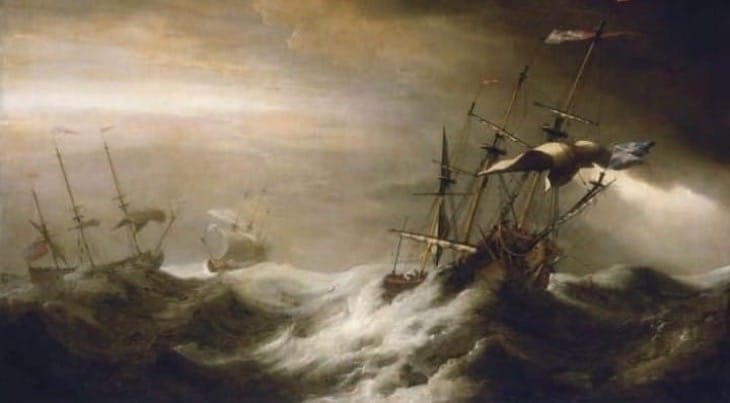
Even restricted to spring and summer, crossings were often tempestuous, uncertain and several months long, gales blowing ships off course and some foundering in the storms.
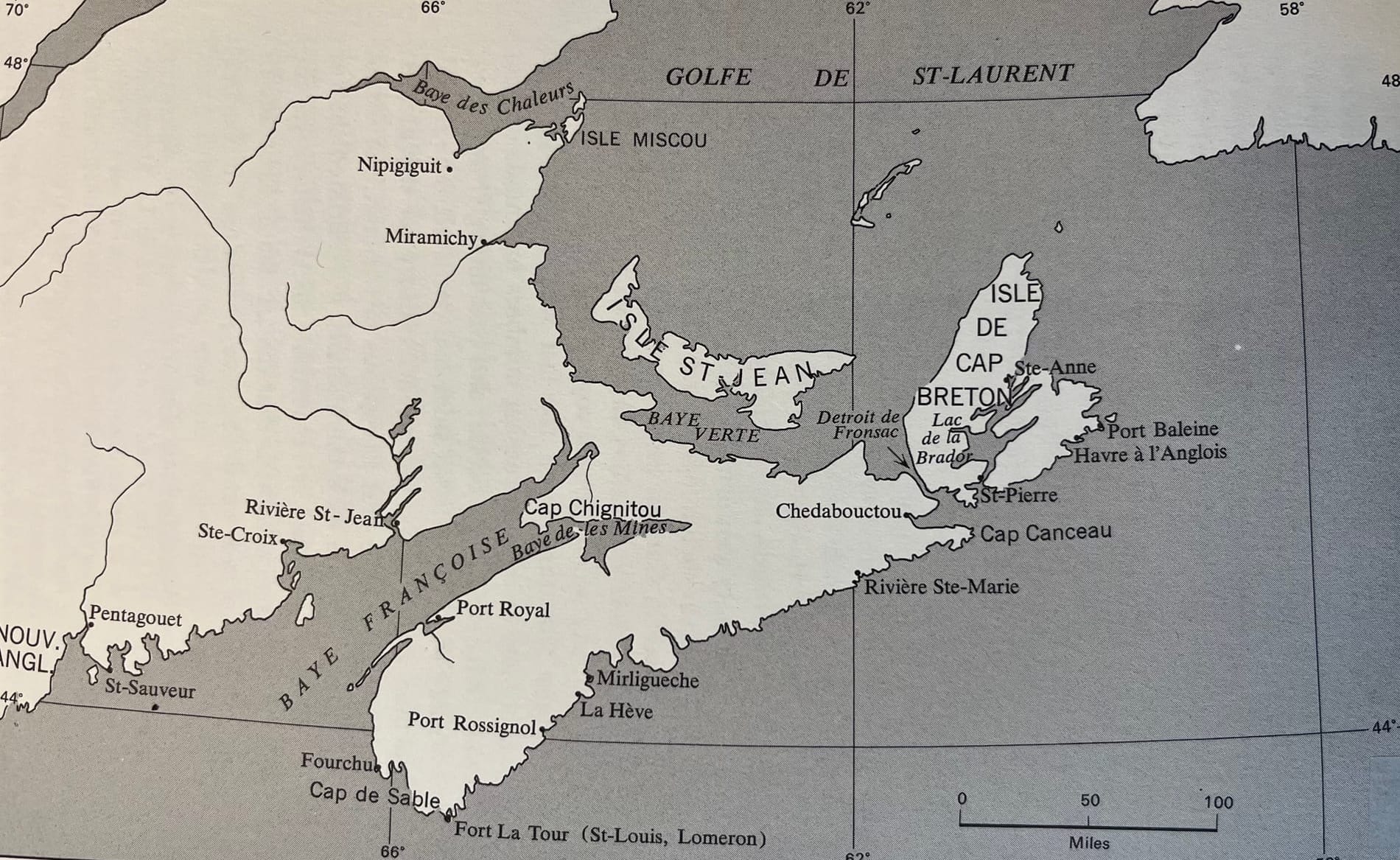
Germain was one of the "300 elite men" sent to lay claim to this part of the unexplored North American coast. They came first to Pentagouët on the Penobscot River where Germain helped strengthen a small fort first built in 1625. This was long before modern national borders were established; Pentagouët is now in the U.S. state of Maine, near Castine. Acadie once encompassed all of what is now northern Maine and the Canadian provinces of Nova Scotia, New Brunswick, and Terre-Neuve (now Newfoundland), Île Saint Jean (Prince Edward Island), Île Royale (Cape Breton Island), and St Pierre et Miquelon.
Modern boundaries do not define Acadie.
The position of Pentagouët was vulnerable to attacks by pirates, by English colonists from further south and by English naval forces, at a time when France and England were often at war. Another French base was developed at La Hève (LaHave) further north along the Atlantic coast of what is now Nova Scotia; this was a busy trading and fishing station. Germain was stationed there briefly; his nephew Pierre and two nieces may have been with him.
"These migrants were both pushed from their homeland and pulled to l'Acadie. Pushed out by the religious wars and accompanying epidemics that devastated their region in the 1630s... And pulled abroad by the hope of a more peaceful and prosperous life."
This was said of one group of migrants, and surely applies to all. But what they were pulled to, and had to adapt to, was altogether new.
"It is difficult to exaggerate the physical and psychological distance that separated the Old World from the New in the seventeenth and eighteenth centuries".
Acadie was quite different from the France they had left, although on the same latitude. The summers were cooler, the winters much colder, with deep snow cover and rivers frozen well into spring. Rain was heavier and fogs were common.
"Wild animals had long been rare in France, to be hunted or snared [only] on private estates or parks... In Acadia, game, hunted directly or bartered from the Indians, was plentiful, free to all... The abundance of animal protein and fat in their diet (they were producing surpluses of livestock and barnyard fowl very early as well) must have been one of the greatest contrasts with the experience of their French forefathers."
Wild and strange it was indeed, a great effort to adapt to. But its wildness and difference was also an opportunity: the France they had fled was largely deforested, wood for fuel and building had become a precious commodity, but in Acadie virgin forests provided conifer and broadleaf timber freely available, as were the abundant fowl and fish.
Acadie was an unspoilt paradise - to those who were physically fit, strong and determined to endure the rigours of making their lives in a harsh climate, where others had failed before. French officials, arriving in Acadie, recognised this; one, searching for an area of woodland for milling in the upper reaches of the rivière Dauphin, named it Paradis terrestre; the town there today is still named Paradise.
In about 1636 the capital of Acadia became Port-Royal. The location of Port-Royal is quite different from Pentagouët and LaHève; it is not on the exposed Atlantic coast but further inland, hidden away along a river which branches off the Baie Française (now known as the Bay of Fundy), sheltered from the worst Atlantic storms and, it was hoped, from unwelcome visitors. Although the anchorage was safer, even just sailing from the Baie into the river between high cliffs was hazardous with strong currents, tidal surge and often contrary winds.
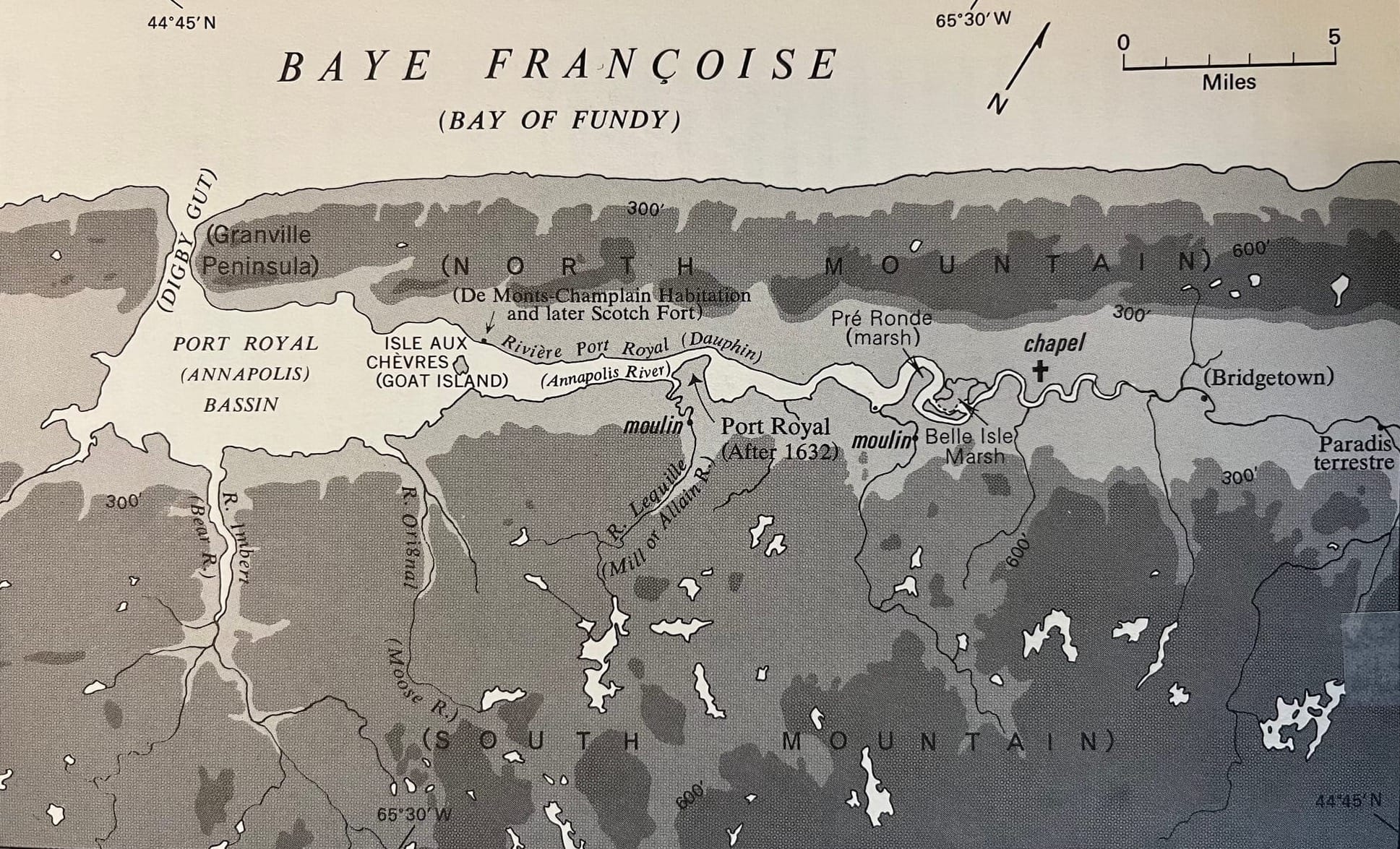
Germain became commander of the fort at Port-Royal; this was a small earth and wood fortification, where a tributary stream joins the main river; it was in regular need of repair and strengthening. Around the fort was a very small settlement, probably less than 200 people with few resources in a vast, unexplored, undeveloped land.
Pierre and his sisters, arriving as teenagers, then spent all their adult lives in the Port-Royal area. Pierre's family farm is shown clearly on old maps, directly across the river from the rudimentary fort, so in full view of the many events of Acadia's turbulent first century. His sisters lived nearby.
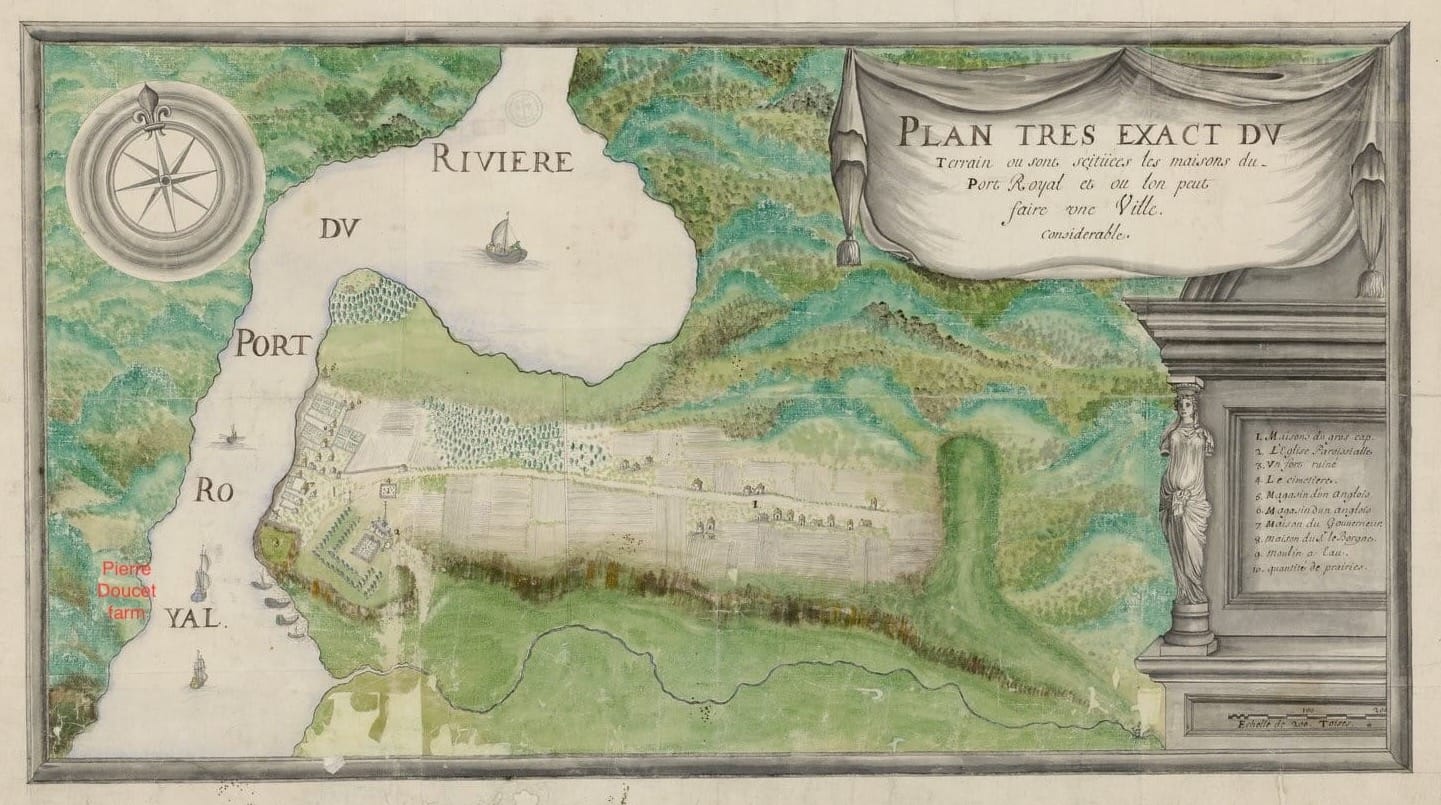
This map dates from forty years after Port-Royal became the capital of Acadie. Its title translates as “Very exact plan of the land where the houses of Port Royal are located and where a considerable town can be made, Franquelin, Jean-Baptiste, 1686.”
With conflict often breaking out around them during Pierre's long life, it is remarkable that they managed to remain and survive there for so long.
Two ways in which Acadians settled and farmed were distinctive, enabling them to lead healthy, well-fed lives, and also created a special Acadian 'character' based on family bonds, interdependence - and obstinacy.
First, unlike anywhere else in the European settlement of the North American coast, they did not fight and compete with the indigenous peoples; this is remarkable. The local Mi'kmaq, Abenaki and other tribes were nomadic and non-agricultural; settling there, the Acadians were not taking away anyone's land. In fact, there were few Acadians, lightly armed if armed at all - not much of a threat. The Mi'kmaq and Abenaki were welcoming, benefited from trading with the Acadian settlers, and showed them how to survive the harsh winters, how to forage, use animal furs and skin to clothe themselves against the cold, how to make canoes from birch bark and travel.
There was no sense of European 'conquest' in Acadie, in contrast to the English (primarily) colonisation to the south in so-called New England. The numbers of European settlers were also very different - in Acadie, a few hundred initially, only a thousand or more by 1700, while in Massachusetts alone there were five times as many Europeans.
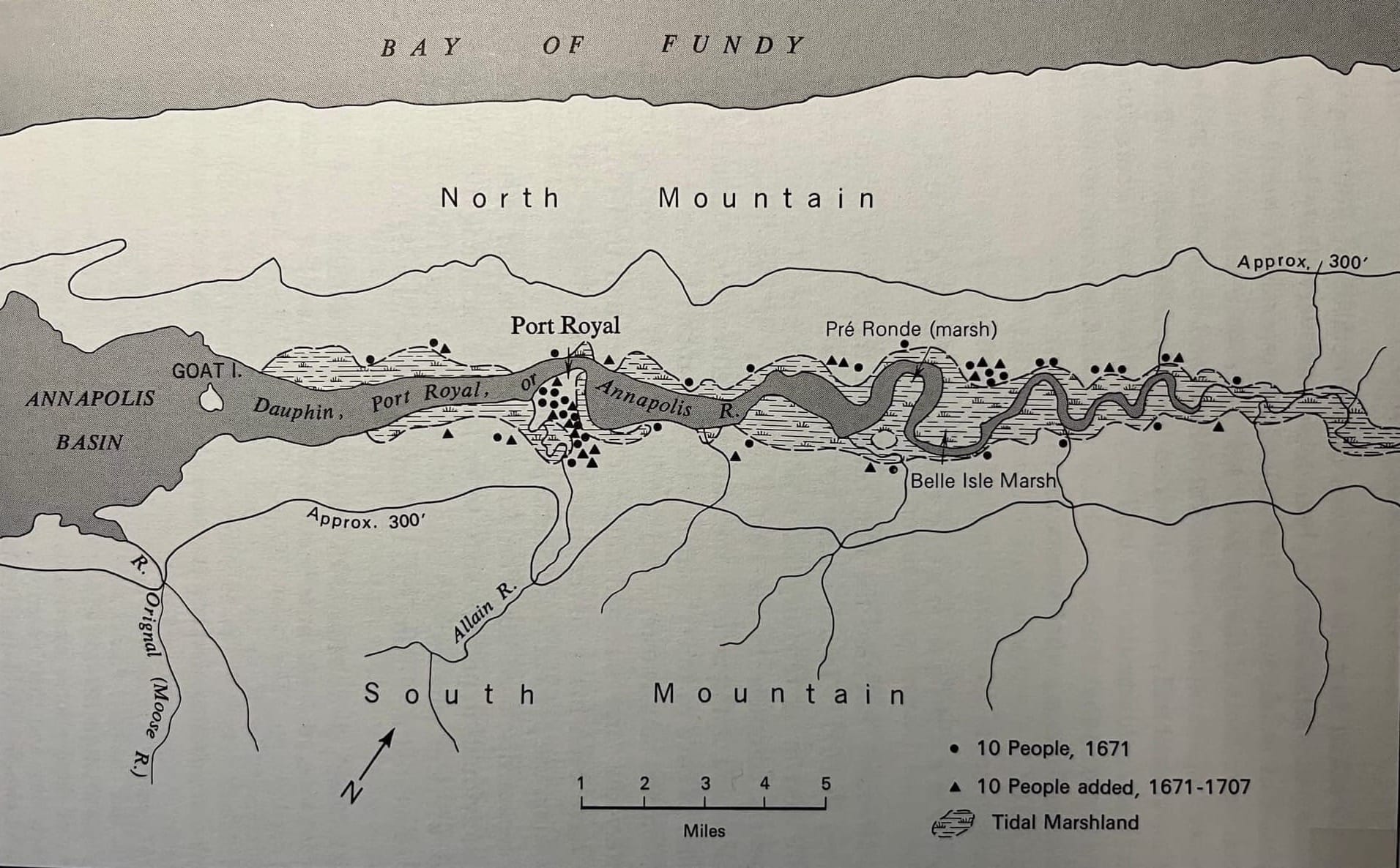
The Acadian settlement pattern may have also helped foster good relations with the Mi'kmaq. Instead of grouping together in towns, each family chose a plot of land along the rivière Dauphin where there were mudflats and marshes to dyke, lived and farmed there in family hameaux or hamlets. This map shows the exent of tidal marshland along the river, and the early stages of Acadian settlement which in later years would spread upriver; where Pierre's farm was established around 1650 is shown as a place of recent settlement.
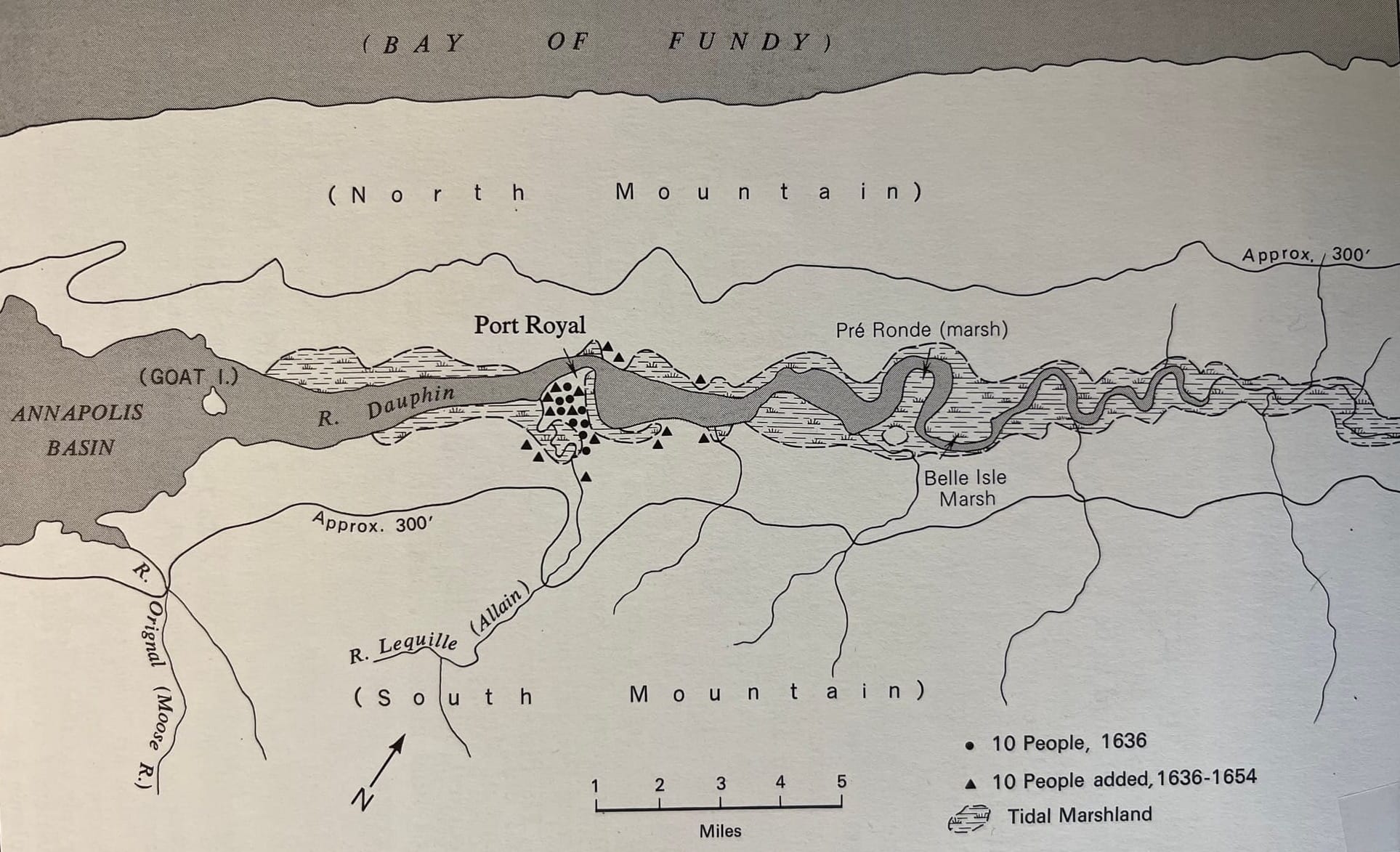
The second feature which is unique in North American settlement is that Acadians created much of their own land for farming. They reclaimed land from the sea, using digues (dykes) to make use of the huge tidal range (about 16 metres or 50' between high and low tide) in the Baie.
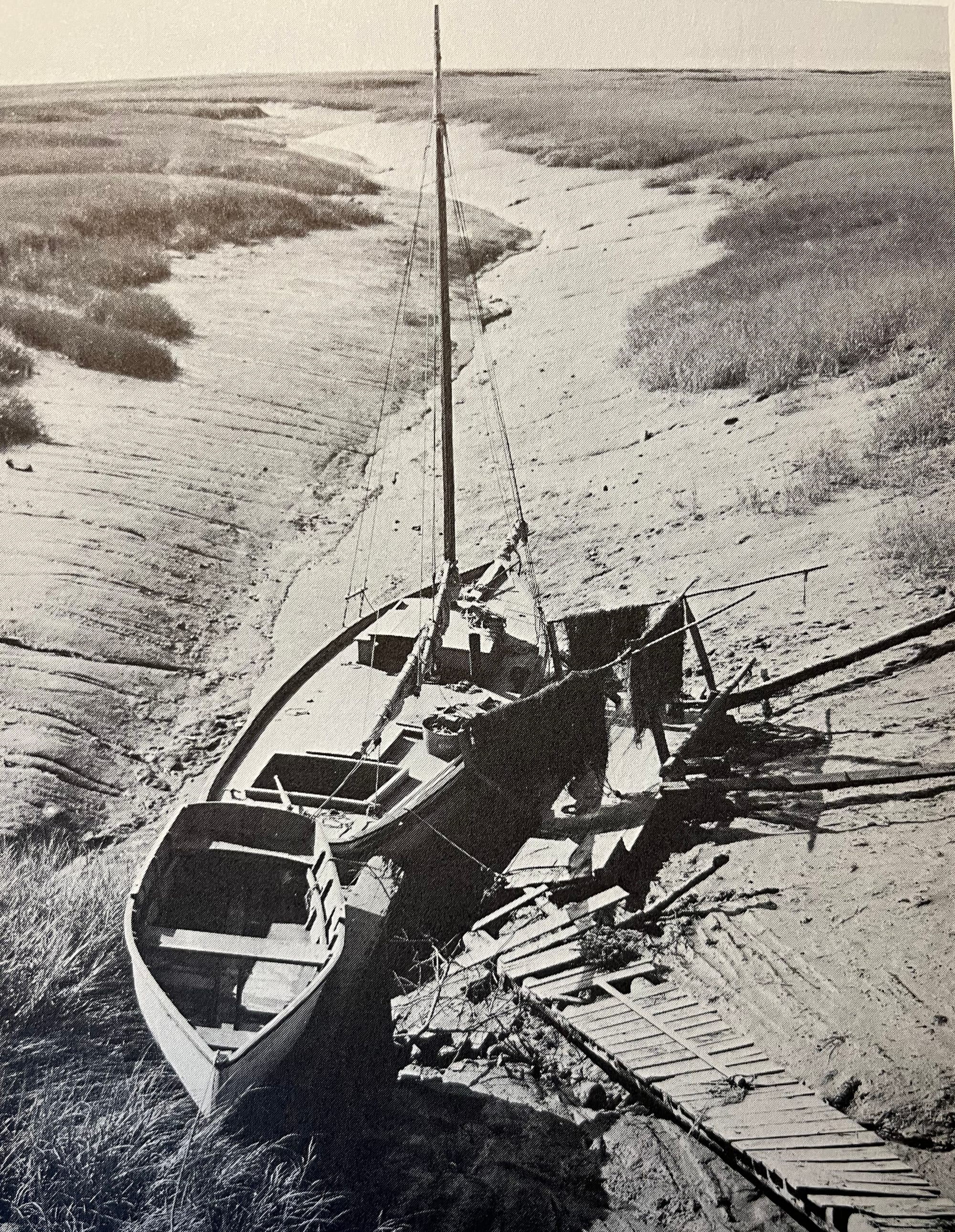
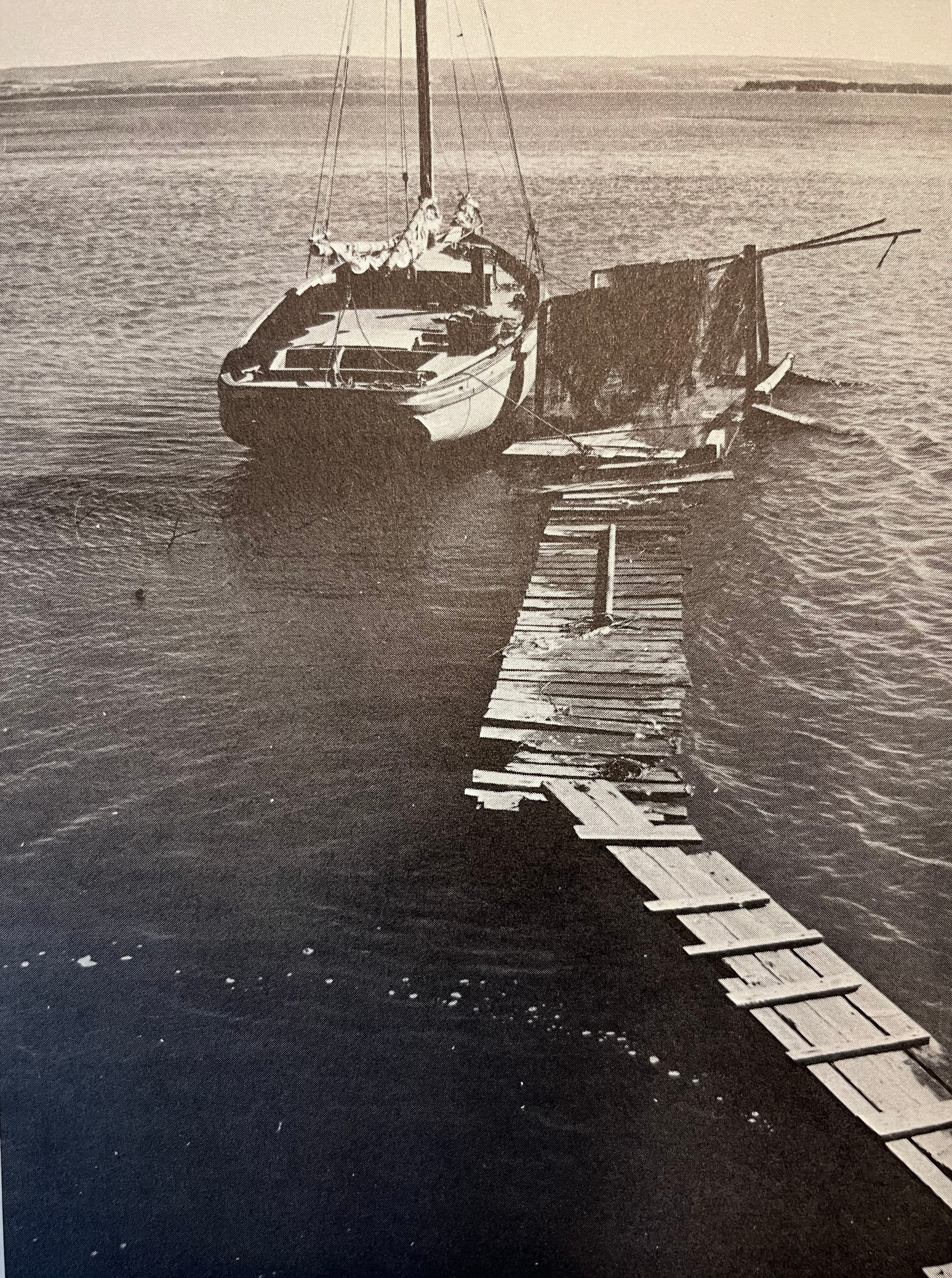
Nova Scotia Information Service
This shows the great difference between low and high tide in the Port-Royal marshlands.
When the tide was out they laboriously built dykes with one-way traps in them (aboiteaux) - an Acadian invention, adapting to their new environment. The dykes could be several metres high and wide; they had to be very strong in order to resist winter storms. This took a lot of communal effort, and surely contributed to the emerging sense of a collective identity among what was a mixed collection of relatively few migrants who arrived at different times from different places in France (mainly) - as opposed to being one organised settlement operation involving a few large migrant groups. Creating dykes needed planning, gathering of timber and reeds, an investment of time and effort for benefit three or more years later, by which time rain had washed salt out of the reclaimed land and crops could be sown in the very fertile soil. It fostered interdependence, and gave rise to a common, new identity.
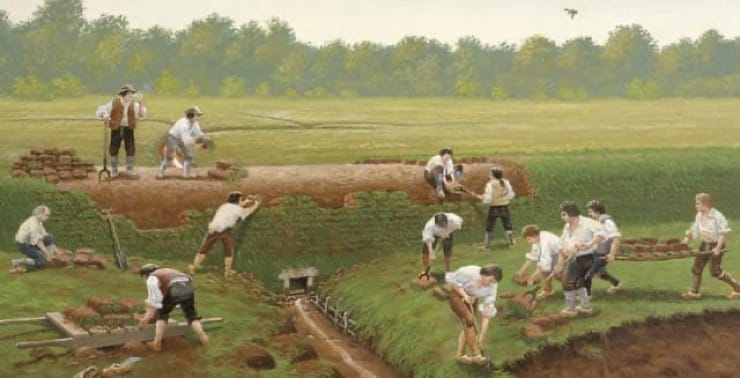
This is a modern imagining of Acadians constructing a dyke. Accurate, from what we know of their dyke-building. But did they really wear nice white shirts for this wet, muddy work? More on dyke-building in later chapters.
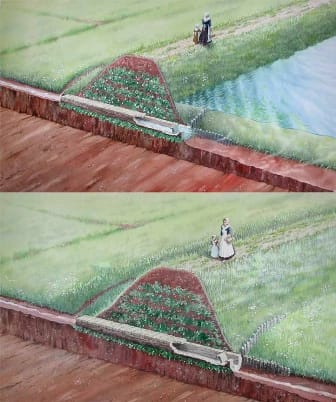
Visitors were astonished by the abundance of Acadian farms and the diligence of Acadian farmers. One, Dièreville, described Acadia as "fertile and produces all kinds of vegetables, enough fruit, and sufficient amount of wheat; there is meat and fish and poultry, and every variety of game...." [tr]
Others described the wide variety of what grew in Acadie and sustained this small, young settlement of migrants:
"choux, betteraves, oignons, carottes, cives, es-chalottes, navets, panets et touttes sortes de salades (cabbages, beets, onions, carrots, chives, shallots, turnips, parsnips and all sort of salads) ...Port Royal is a little Normandy for apples" [tr]
"This district... produces wheat, rye, Indian corn, every kind of legumes and pot herbs, especially headed cabbages. Fruit trees also thrive there very well, among others apple trees and pear trees. Grain is sown about 15 of April, and is reaped towards the end of August." [tr]
There was honest admiration for what these first Acadians achieved in a few years, and the communal hard work required. These are comments from three more visitors:
"The marshes which are inundated by the sea at high tide must be drained ... what labour is needed to make them fit for cultivation... The ebb and flow of the sea cannot easily be stopped but the Acadians succeed in doing so" [tr]
"They undertook the heavy task of dyking and draining more willingly because the fertility of the marshlands guaranteed nearly perpetual annual harvests if unusually high tides did not break down the dykes" [tr]
"There is a great extent of meadows which the sea used to cover... It bears now fine and good wheat ...on the upper part of the river they have again drained other lands which bear wheat in much greater abundance than those which they cultivated round the fort, good though those were." [tr]
But these first Acadians had arrived with very little to establish a settlement, France sent virtually no supplies, and in recent history would-be settlers had died from cold, starvation and disease. Without cooperation from the local indigenous people the first Acadians may well have perished. A French governor arriving in Port-Royal was shocked at the primitive state of affairs. The houses, he wrote, were wretched affairs of mud and wood. There were no tools. Masons, brickmakers, bakers, weavers, tailors - virtually every kind of tradesman - were needed. And this was in 1687 - not the first years of settlement. Another French official on a year-long visit was at first shocked by the very basic conditions in which the first Acadians lived and how much they resembled the indigenous people (so-called sauvages) in the way they lived. He wrote:
"To what wild country, oh heaven, have I come! Nothing before my eyes but streams and forests, huts of mud and cottages... How one can live here I do not know. What a scene of poverty!" [tr]
This was in 1699, over half a century since first permanent settlement. But he soon came to love the simplicity and honesty of life in Acadie, writing later:
"...each one in peace beneath a rustic roof... keeps himself warm without a farthing spent on wood; where else could such advantage be found? This country from a thousand vexing cares has set them free; no taxes burden them, and so they only work that they may live" [tr]
As a result, Acadians in general were well-fed and healthy, leading productive hard-working outdoor lives. Unsuprisngly, Acadians themselves were fertile, with many children and very low infant mortality. In contrast, in France at that time 25 out of 100 children died in their first year, another 25 never reached 20 years. French peasants led very limited lives in poor conditions, at the bottom of a strict social hierarchy in a country ruined by civil and religious conflicts, disease and poverty. Acadians, however, were free and independent, in charge of their daily lives, except when external forces imposed themselves, which did happen periodically, and then once disastrously when almost all records were lost, property destroyed, and many died.
Although some settlers arrived with their French titles and status as seigneurs, the backwardness of early Acadian life, the everyone-starting-from-scratch, ensured that there was "a great social levelling... the children of the original elite married the children of those who worked for their fathers, a situation that would have been unlikely in France" - or England of that time.
"Their constant and essential interdependence was of a far stronger kind" [than the feudal class-distinctions of 'old' France].
That 'frontier equality' included the acceptance of individuals and families of other nationalties and religions who arrived peacably in Acadie - Protestants as well as Catholics (Huguenots were being persecuted in France at that time), some Irish, Scottish, Spanish even English adventurers washed up in Acadie, where they could make a life.
In 1654 Port-Royal, the main Acadian settlement, was still very small - about 270 people. It was captured by English forces greater in number and better equipped than the 130 defending the fort. Germain eventually surrendered on terms which allowed safe passage for him and his soldiers to France, and allowed the civilians to remain provided they swore loyalty to the English Crown. The Doucets - Pierre, Marguerite and the other sister - were among the 34 families that did choose to remain in Acadie. In years to come, swearing loyalty to England, and what that came to mean in practice, was a constant bone of contention, but for the next few decades the remaining Acadians were basically left to get on with their lives.
The English presence at Port-Royal was light in numbers, confined itself to the fort area, and it was dependent on nearby Acadian farms for supplies. Unlike some others, the Doucets, including Marguerite in the Dugas family she married into, remained in the Port-Royal area, suggesting that by 1654 Pierre though unmarried had already established his farm across the river from the fort.
According to one author:
"During the years of British rule, most of the Port-Royal population moved upriver away from the town. ...the Acadians dyked and cultivated extensive salt marshes along the river and raised livestock. Through necessity, residents had reached an accommodation with New England traders who had become their sole source for the goods that they could not produce themselves... New England traders exchanged their goods for Acadian produce and furs... There were seventy to eighty families in the Port-Royal area in 1665."
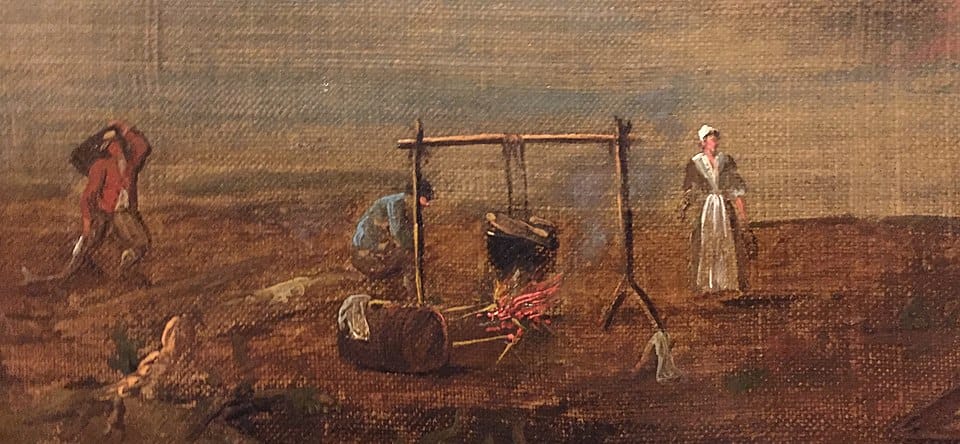
What did Acadians look like? The only known painting that is near-contemporary - from a century later - is this. Was it painted in situ and is accurate, or is it imagined?
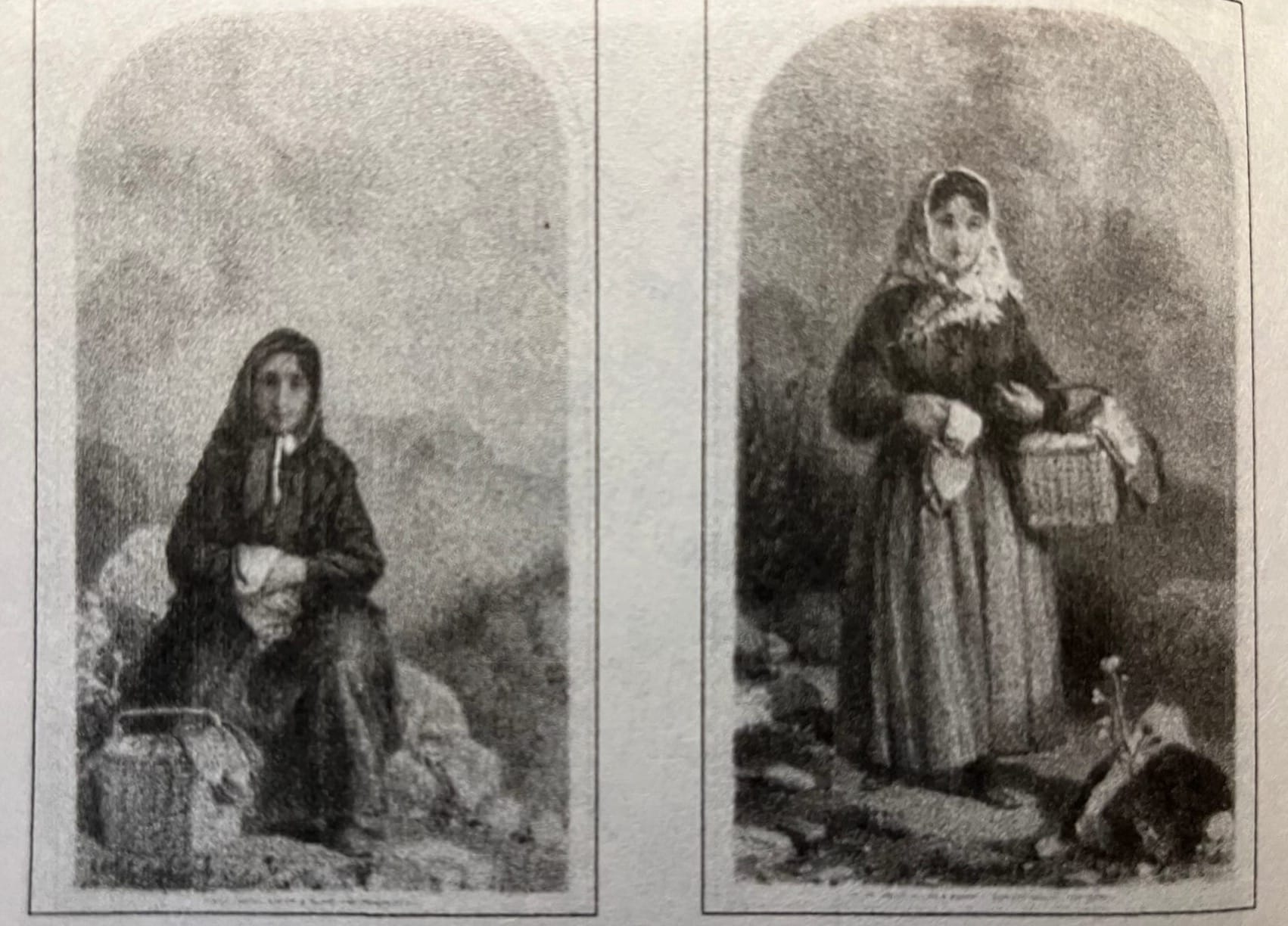
This is what Acadian women looked like, as imagined 200 years later.
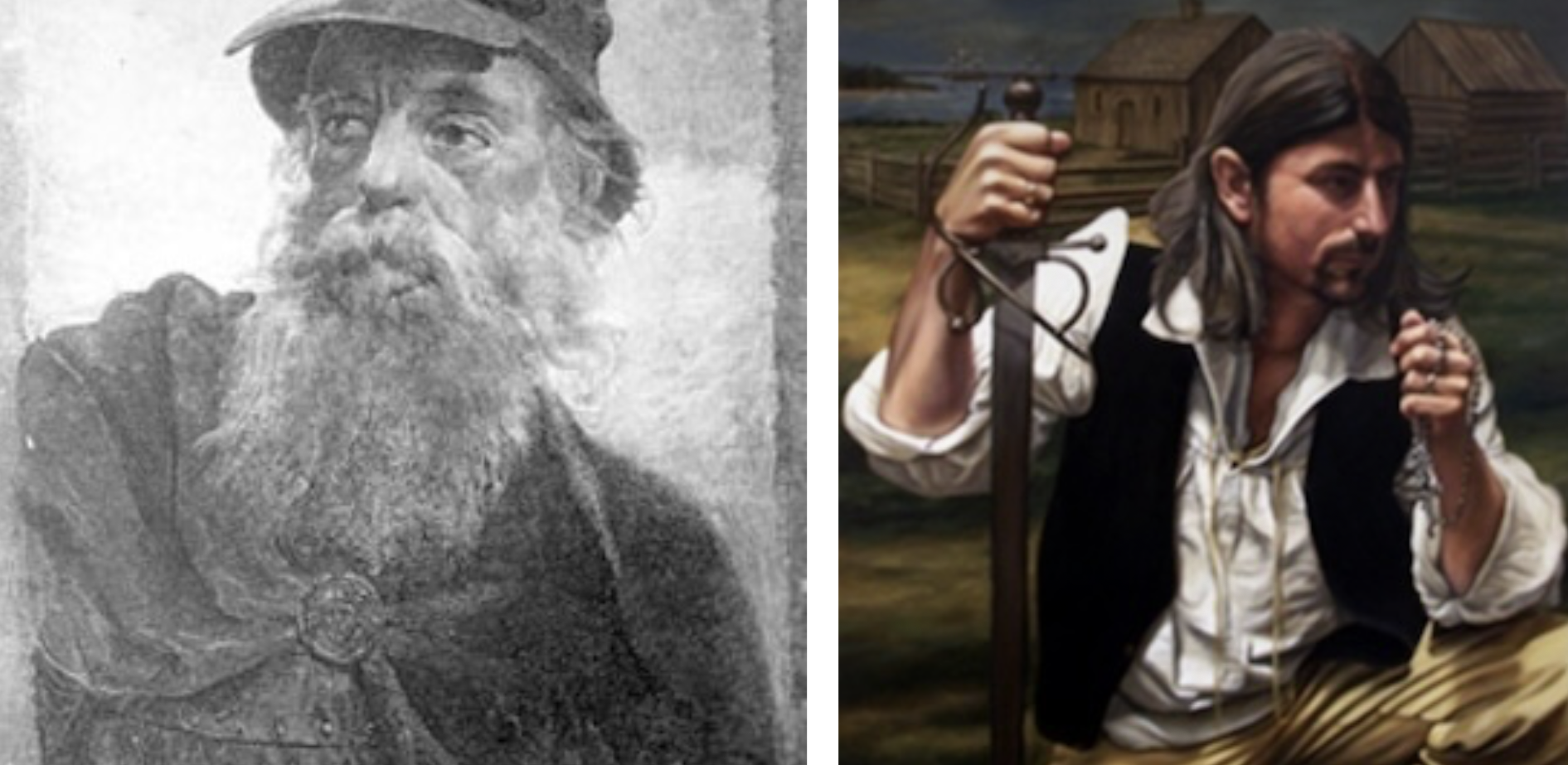
We do not know what Pierre looked like. Possibly like the first man pictured here (at a much later date, so imagined), who was an Acadian living at Pentagouët; or like the second picture, even more recent (and romanticized?). Only noblemen of the time usually had their portraits painted.
Pierre Doucet married Henriette Pelletret in about 1660. She was 19, he was 38 or 39. Most of the people to arrive in Acadie in the early years were men so the opportunities to marry were few. In many cases the first settlers, men, did not marry until the first daughters born in Acadie to the founding families were of marriageable age. This meant that in the first generations there were often big age disparities between marriage partners, resulting in the older male partner often dying first and the younger female partner quickly re-marrying. Marriages were economic units essential to survival, always pragmatic, sometimes romantic. For Pierre and other men like him, marrying and having a family would likely have been vital parts of farming and surviving in this new land.
So it is not surprising that Marguerite had married about 13 years before her older brother Pierre. In 1647 Marguerite married Abraham Dugas who was ten to twenty years older than her. He had come to Port-Royal as a soldier; he was not the only soldier or contracted artisan to prefer making his life in Acadie instead of returning to France. Years later, in 1671, the French governor wrote that when their term of service ended "...nearly all the soldiers wished to settle, and even get married... already twenty-two (fourteen soldiers and eight engagés) have settled at one league from the fort."
By the time of the English capture of Port-Royal in 1654 Marguerite and Abraham already had three children, had two more by the time Pierre got married, and continued to farm and have more children in the same area for the rest of their lives.
Pierre's wife Henriette was born in Port-Royal in 1641, the oldest daughter of Simon Pelletret and Perrine Bourg. Perrine was born about 1626 in France, and a teenager when she married the much older Simon around 1640; he died five years later and she remarried within months. It is unknown when they arrived in Acadie, separately or together.
In 1661 Henriette gave birth to their first daughter Marie Anne and two years later to their first son Toussaint, soon followed by two more, Jean in 1665 and Pierre in 1667.
The English capture of Port-Royal had cut off the arrivals of small groups of migrants from France, and England made little effort to introduce settlers. But during this period random individuals - seemingly 'at a loose end', without jobs, contracts or positions, and termed 'wayfarers' by one modern source - arrived in Acadie and added diversity as well as numbers to the small community; such 'loose end' individuals continued to arrive randomly. Many of them married and joined Acadian families; for example Lawrence Granger, a sailor from Plymouth married Marie Landry, and maps show farms of the Granger family near Pierre's farm; John Peters, a Channel Islands blacksmith married Marie Pessely; Roger Casey, a labourer from Ireland married Marie-Francoise Poirier (theirs became one of the major families in Beaubassin, the locale of the next Footsteps story). Joining a francophone community, over time their surnames became Pitre, Caissie - and Granger acquired no re-spelling from French pronunciation.
By 1670 Acadians had become firmly settled at Port-Royal, most of them born in the country and with a generation of experience of farming in the special environment of Acadie, dyking to use the tidal marshlands, cutting wood, hunting and grazing the wooded uplands. In that year the light touch of British rule was replaced by French rule, when a complex treaty arising from the recurrent conflict between Britain, France and the Netherlands ceded Acadie back to France. Acadian life continued to prosper largely unaffected by the change of regime; recensements (censuses) introduced in 1671 record the continued growth of the population in Port-Royal and its expansion to other areas.
The first census revealed young families with high birthrates, some parents young and healthy enough to still be producing more children while their first children had started to marry and have their own children. Acadian families had quickly become multigenerational and 'extended'. The population of Port-Royal had increased to 392 people in 68 families including 125 sons and 91 daughters; there were about 650 cattle and 430 sheep, and about 400 arpents (about an acre) cultivated. There were small family-communities elsewhere; some settlements were un-surveyed in the census and some Acadians evaded it.
Port-Royal was youthful, it had 114 children under 10 years, 162 under 15 in 1671. A French visitor wrote later that "the swarming of brats is a sight to behold".
Pierre gave his occupation as a mason in the first census; almost all men were farmers and had other trades and skills shared within the community. He was 50 years of age, Henriette 31 years (her family name mis-spelled as Peltret) in 1671; they had 4 arpents of cultivated land, with 7 cattle and 6 sheep (so presumably with more land for grazing; probably the farms stretched from the fertile riverside fields into rougher wooded uplands). There were five children in the household; Henriette had just had another baby, Madeleine who was 3 months at the time of the census. Twenty-seven years later, Pierre's family farm had grown to 16 arpents of cultivatable land, and 12 cattle, 8 sheep and 5 hogs on other land.
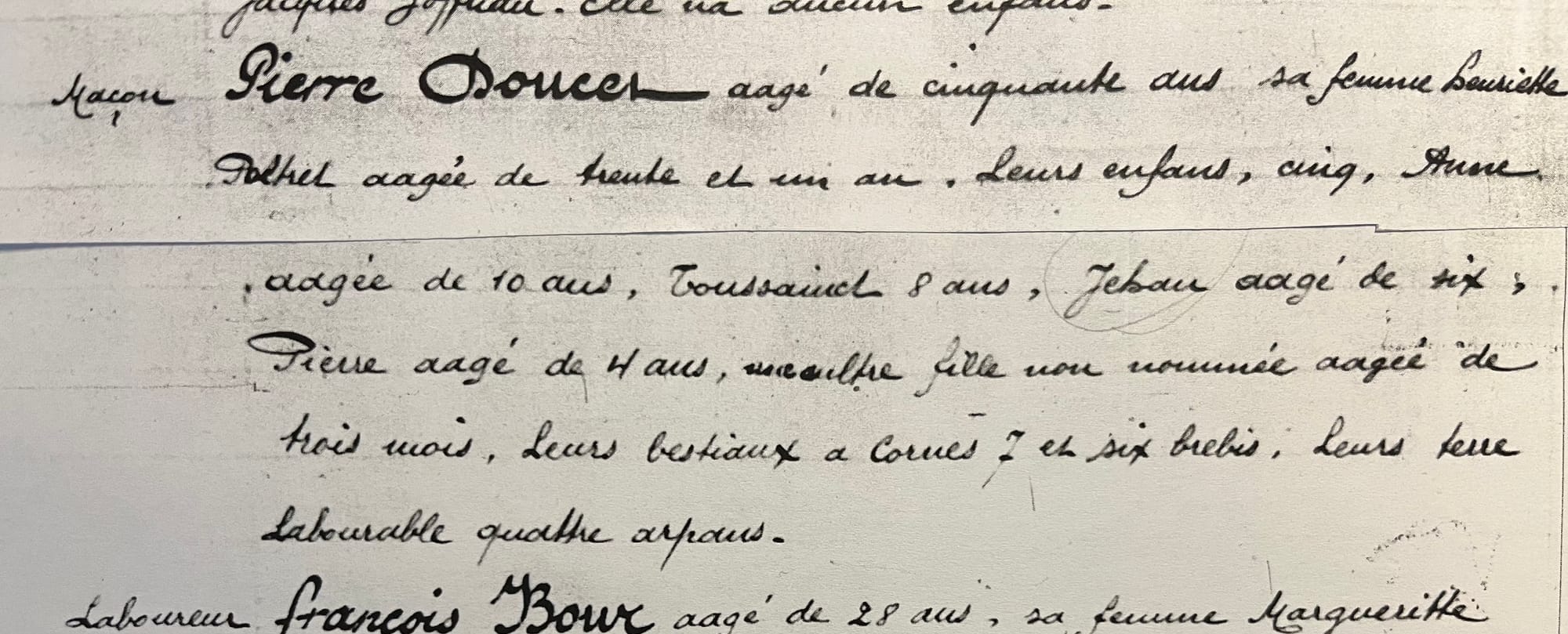
Pierre's entry is spread over two pages of the original 1671 census, combined here. This is the only census to include occupations. Pierre was a macon - a mason - or was he? - that mark below the word looks a bit like a question-mark.
The next census in 1678 recorded Pierre and Henriette with five sons aged 17, 12, 14, 6 years, and 3 months, two daughters aged 10 and 3, 1.5 arpents of land, 10 cattle and 1 gun. Why the land area had reduced in seven years is unknown - storms, flooding?
Across the river, on the same side as the fort, Abraham Dugas and Marguerite Doucet's farm was larger than Pierre's, 16 arpents of cultivated land with 19 cattle and 3 sheep in 1671; this reduced to 12 arpents in 1678 when Pierre's farm had also reduced - so there was some adverse event affecting their farms and probably others between those years.
By 1686 the surveyed population of Acadie had almost doubled and there were 95 families still in the Port-Royal area; many had spread further upriver, with others in more distant, newly settled places.
Pierre and Henriette had continued to have children: Louis in 1674, Louise in 1676, René in 1678, Marguerite in 1680, and finally Matthieu in 1685 through whom I descend (and my daughter, grandchildren and now great grandchildren) and, of course, many others.
That Acadians typically had large families and low infant mortality is positive - evidence of healthy living conditions, abundant food and a cohesive, functioning society, albeit small. But the burden on women producing children almost year on year from a young age may suggest another story, untold. A burden on maternal health and happiness in some cases; such intangibles are not recorded in the censuses, nor are stillbirths and early infant deaths, and seldom considered in commentaries. How long mothers lived would give some indication if a survey based on successive censuses was made; Henriette died at about age 50 (between the 1686 and 1693 censuses), over twenty years before her much older husband Pierre died, and even before her twice widowed mother, Perrine Bourg, who died between the 1693 and 1698 censuses.
With the big age disparities between marriage partners in the first generations, how did young women feel about marrying much older men? Was Pierre and Henriette's seventh child, 14-year old Louise, happy to marry 44-year old Pierre Chênet in 1691? Or was there also pressure and expectation in that small Acadian society, a recognised need to keep reproducing in order to survive as a settlement? Children were surely needed to help with the farming and put to work at a young age. Even so, there were certainly younger men around and available to girls like Louise. Was there a grimmer side to all this, unmarried older men (patriarchs of the small community) having a prior call on young women as soon as they were 'available' for child-bearing? Not a pleasant thought.
Or, from the point of view of the young woman and her family, there may have been considerations of security, prospects and advantage in marrying an older man. It may be a modern Western habit to consider marriages mainly in terms of romance and attraction between two individuals. Pragmatism probably was a major factor in early Acadie; there had surely been younger, unattached men for Henriette's mother Perrine Bourg to ally with, but Simon Pelletier being older may have offered better material prospects; he had land-holdings. It is unknown whether she inherited from him when he died. She married again, into the well-established Landry family; possibly her deceased husband's land-holdings were part of her attractions as a marriage partner.
For Acadian men as well as women, life was hard work and hazardous; building dykes day after day in the few hours between high and low tides, often in very cold as well as wet conditions (barefoot?), cutting the timber and reeds needed, repairing the dykes in stormy weather, as well as the daily grind of wholly manual agriculture and animal husbandry needed for the family's next meal; this unremitting toil must have led to exhaustion, accidents and injuries on a regular basis. These are not recorded in censuses. And not to forget the rigours and risks of childbirth at that time. Occasionally a census records a birth name as "anonyme", indicating the baby died before being baptized (usually the day after birth). But there may well have been many more infant deaths; a glimpse of the reality can be gleaned from the only burial registers to have survived for Port-Royal, and these are only from May 1702; the St Jean-Baptiste parish register includes amongst the daily list of burials many "enfants", with their names if they had been baptized. One Louis Doucet "enfant baptisé et mort hier" (yesterday) was buried on 27 August 1708 at the St Laurent chapel; it is hard to read the rest of the writing. The large Acadian families came at a cost.
Even travelling around was hazardous; the dykes provided walkways between neighbouring farms but would have been treacherous in all but the best weather. Most travel was by birch-bark canoes on rivers and the Baie Française subject to strong currents and sudden storms; on ice when the rivers were frozen over winter months, which was even more hazardous as thaws set in. Winters were longer and harsher than in Europe. Travel was dangerous for everyone: the seigneur Menou d'Aulnay who had become governor of Acadie drowned in the icy water when his canoe capsized in 1650.

Without the censuses we would know very little about life in the early years of Acadie, and they are almost all that has survived from the early years. But they are often inconsistent in details - ages, names, spellings. The information was gathered door-to-door verbally, and unchecked. The 1686 census records Pierre as being 55 years old (he was about 65) with Henriette (Pelletret mis-spelled as Peltret) aged 40, and their nine children: Toussaints [sic] 23, Jean 20, Pierre 18, Magdelaine (this was Madeleine) 16, Louis 12, Jeanne (this was Louise) 10, Pierre (this was René) 8, Marguerite 6, and Mathieu 1. The family owned 2 guns and lived on 5 arpents of cultivatable land with 8 cattle, 12 sheep and 6 hogs.
Dates of births and marriages calculated from the censuses are approximate. No parish or civic records with precise dates (and names) have survived from the 1600s for Port-Royal. Commentators assume none existed, but I disagree. Acadians retained their Catholic faith and passed it on to their children; at a time of religious intolerance, this was one reason for English and New Englanders' abiding distrust of Acadians. Mass was celebrated, a church built then re-built after it was destroyed (several times), and priests were present; they would have recorded and sanctified births, baptisms, marriages and deaths. Civil records were kept; there was a court clerk in Port-Royal and other officials, a civil infrastructure albeit a very small one; and where there are bureaucrats there are documents!
The censuses show that women retained their family names after marriage, which seems very modern; it suggests women were not regarded as secondary, and that connections between families were very important - a sense of mutual responsibility and obligation within this small population struggling to survive in a new land beset by hostile foreign forces. Children were given family forenames: Pierre named a daughter Marguerite after his sister, had a son he named Pierre, and Marguerite named a daughter after herself. Other children were given names which succeeding generations carried forward - Pierre named one son Louis which is repeated through the generations to my grandfather and as a middle name to myself and to one of my grandsons. All with the sense of these first Acadians binding themselves together, a quality which a century later just about saved them from the complete obliteration intended.
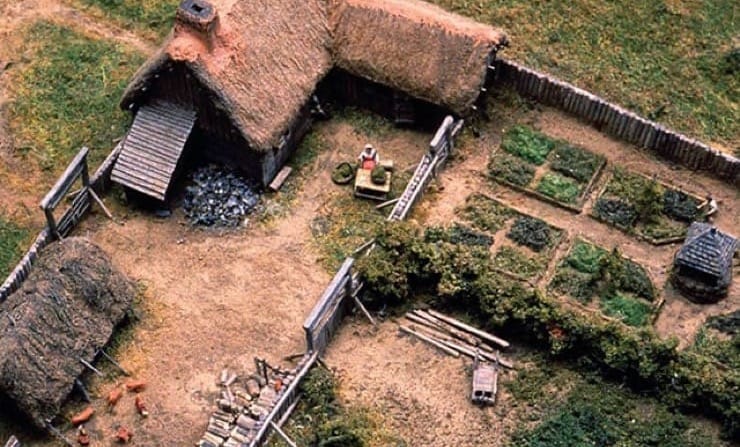
Their housing and locations were not recorded in the censuses, but officials' and visitors' accounts of the time refer to small houses built from the abundant timber available and from clay, with stone firelaces and chimneys. In the 1680s the governor of Acadie referred to "wretched dwellings of mud and wood" and another official described low houses built of logs laid "pièce sur pièce", roofed with thatch, only the governor's house being covered with planks. Even by 1699, according to a French visitor, their houses were very basic and unimpressive.
The original Acadian houses have not survived time and destruction. Modern renderings of Acadian houses and homesteads are just that, and should be taken as impressionistic. Archeology in the Belle Isle area of Port-Royal has given some evidence of construction materials and dimensions. Likely, windows were small and unglazed with paper or cloth coverings; at Belle Isle, broken glass was discovered so it may be that some homes (the more prosperous? in later years?) had glazed windows).
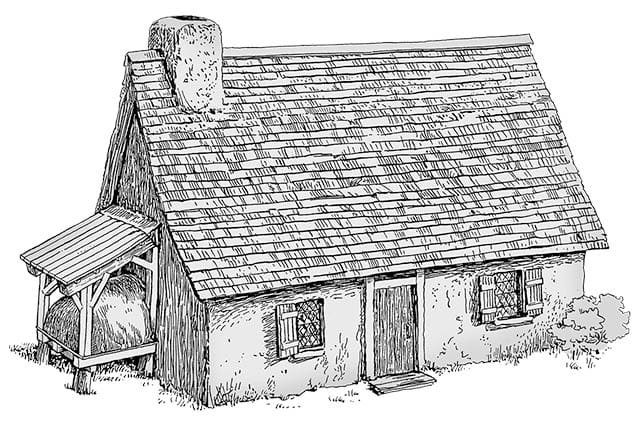
Parents with many children and the home-labour of weaving, spinning, making of clothes, cooking and preserving foodstuffs, etc etc, all in a small one-room cottage in often cold, wet weather, paints the picture again of intense family bonds holding Acadian society together. Kinship as a necessity for survival, like it or not.
The arrival of more migrant families from France had ceased with the English capture of Port-Royal in 1654, and few if any English or other settlers were introduced at that time, so Acadie grew at first from within its origins without external additions.
Inward migration did resume after Acadie was ceded to France in 1670, with family names that appeared in censuses and would become recognised as typically Acadian: Allain, Arsenau, Babineau, Bastarache, Benoit, Bernard, Brassaud, Broussard, Cyr, Dorion... Little is known of specific ships and passengers; one exception is the arrival in 1671 of L'Oranger with 60 people on board including four girls and one woman (all unnamed).
Pierre could not write; this is known from one of the few other surviving documents of this time, the October 1687 declaration in favour of the deceased governor Charles de Menou d'Aulnay. Several Acadians supported this, including Pierre as one of the earliest Acadians and closely associated with d'Aulnay through his uncle Germain who d'Aulnay had put in charge of the Port-Royal fort. Pierre signed the document by leaving his mark, and someone else wrote his name beside it. We have no picture of Pierre, but to see the mark he made 350 years ago to 'sign' his name is quite something.

Spellings were not yet fixed, so people's names were often spelled in a variety of ways, in what was a largely non-literate society. But some Acadians who traded regularly with New Englanders were or became both literate and numerate; one, Barthélemy Petitpas (1687-1745) is known to have been fluent in Mi'kmaq and English as well as his native French. Pierre may not have done much trading or had other contact with English-speakers, and instead had all his time taken up with farming, feeding the family. The children of this first generation of Acadians in the Port-Royal area were more likely to know how to read and write, as a priest set up a school for boys during the 1670s, and later there was a school for girls.
Across the river, on the Dugas farm, Marguerite's husband Abraham died some time between the 1693 and 1700 censuses, after about fifty years of marriage. Marguerite continued living there with her son Claude, his second wife Marguerite Bourg and ten children from both his marriages. Marguerite died before her older brother Pierre, on 19 December 1707, aged over 80. She was buried the next day at Saint-Laurent Chapel further up-river from Port-Royal; she was buried as Marguerite Dugast, widow, mother of Claude Dugast. This is one of the few parish registers from 1702 (none at all earlier for Port-Royal) to have survived, and it is an unusual entry as most of the records for women gave their family name, not that of their husband.
Henriette had died before Marguerite, between 1686 and 1693, and before her own mother Perrine. With any civil or church records of births, marriages and deaths in the 1600s having been lost or destroyed on the occasions that Acadie was attacked, we only know that someone has died when they do not appear in the next census.
Henriette's sister Jeanne Pelletret lived longer, dying in January 1706, aged 63, outliving one husband and possibly the second one.
Women did not always live longer than their older husbands, perhaps due to the burden of bearing so many children. In Henriette's case, she may have died soon after giving birth to Mathieu, or a later child we know nothing about, or... Her death is sadly unrecorded.
She seems invisible, wrongly, our grandmother Henriette of nine generations ago: no record of her being born, nor baptised, married, no record of giving birth to ten children, or of when or why she died and was buried; no gravestone. Yet I and many Doucet descendants come from her as much as from Pierre, and from all the other wives down the generations; they should not be forgotten as one half of our origins. They were the heart of the home, pregnant or nursing most of their lives while ever-busy with all the work of a peasant life. 'Henriette' does not seem to have been passed on as a favoured family forename, and her father's name Pelletret does not feature much in future years. Her mother's name Bourg does become prominent in Acadian history.
By the 1690s Pierre had reached his 70s, after a life of unremitting hard work to establish a house, a family and a farm on land he'd dyked to reclaim from the river, making this productive to feed his large family. All this in the uncertain and dangerous context of English and New England hostility, and the competing claims on Acadie by England and France. He and the other Acadian founders had established settlements in very unsettling times.
And then, for his last years, life got harder for him.
Life got worse for Pierre with the death of Henriette, his wife (beloved? we cannot know, but certainly his 'other half' in the busy business of living there and then). There were still nine of his ten children living at home, some still very young, others forming relationships which would take them to new settlements far from Port-Royal (and take away their labour on the Doucet farm). His second son Toussaint (known as François) married in 1690 and moved far up the Baie Française to Beaubassin. Jean, Madeleine and Louis also moved there around this time and the oldest, Anne-Marie, had already moved to Les Mines in the upper reaches of the Baie. The others stayed in the Port-Royal area when they married but elsewhere, on their own farms. His name-sake son Pierre had disappeared god knows where (no later record of him). Pierre was surely pleased to see his kids marrying, starting to set up their own families, sad that Henriette was not seeing this, but he was being left to manage with far less help - this was unmechanised, wholly manual farming - and with far less company in his old age. René was still living there as was Mathieu, still in boyhood.
Life also got worse for Pierre in his last 20 years because there were more and more attacks on the Port-Royal area by New England forces, pirates and privateers. It may be that Henriette and Pierre (the son) were killed in the attacks of 1690. The Doucet farm was literally in the firing line, across the river from the fort.
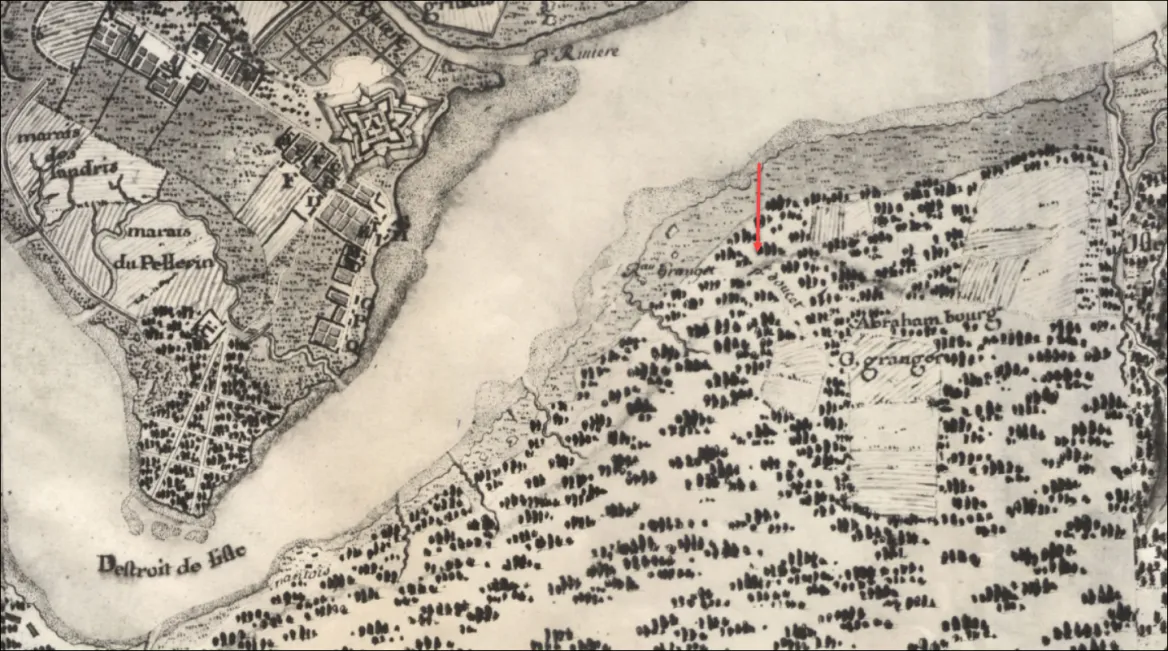
Below is an enlarged section of a map drawn by Pierre-Paul de Labat, a French military engineer, at a later date. It shows the Acadian farms including Pierre's (his name oddly mis-spelled as Piere), close to the Port-Royal fort, so in full view of the New England attacks, and vulnerable to attack themselves. This map although very difficult to enlarge in its online version is excellent in showing the actual Acadian houses, including Pierre's and his Granger and Bourg neighbours and their cultivated fields. Another section when enlarged shows the clustering of houses near the starshaped fort.
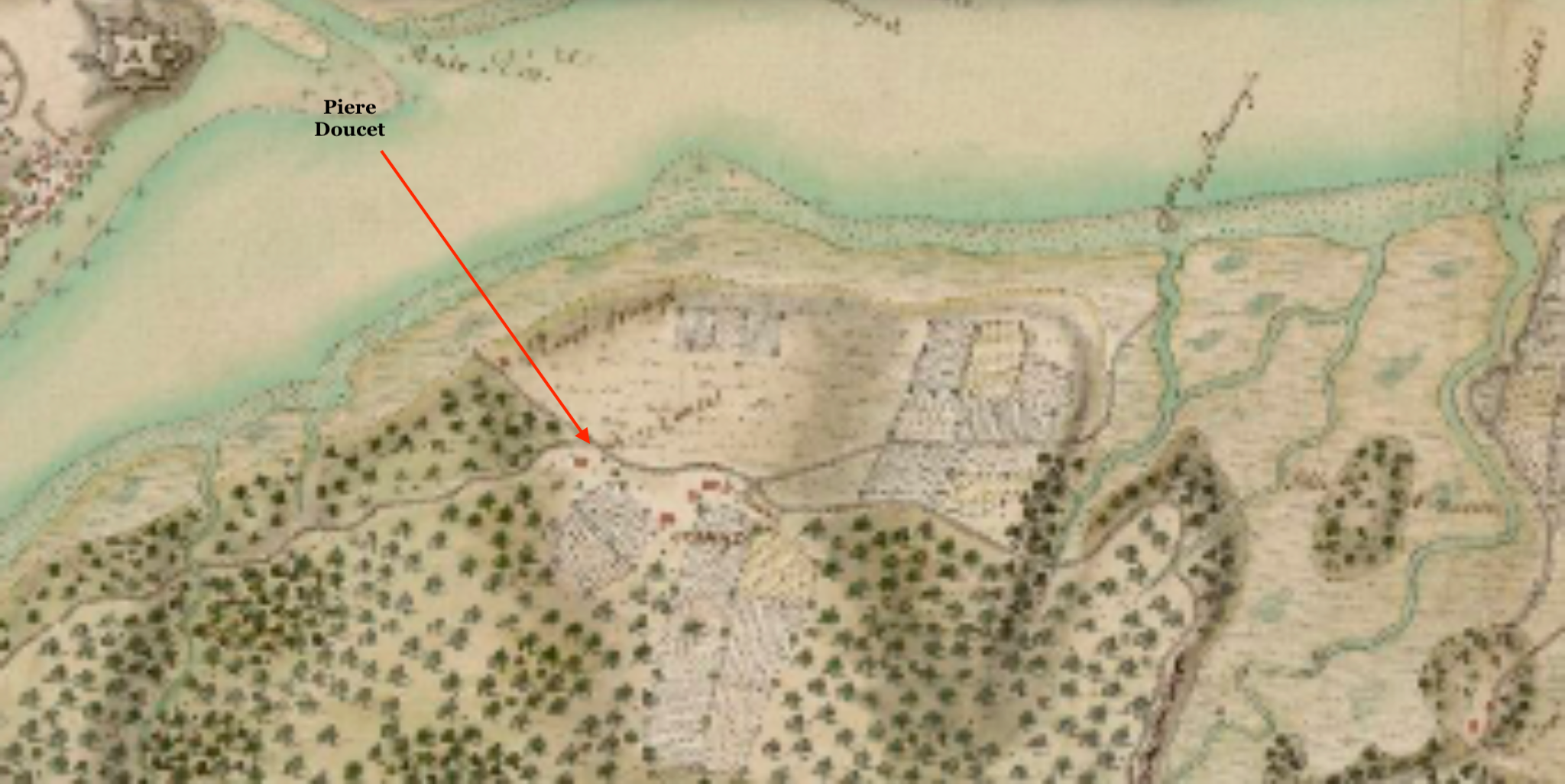
It thrills me to see Pierre and Henriette's house pictured there in red, with the fields they had cultivated, and their neighbours. Labat must have walked by to get these location details and add them to his map.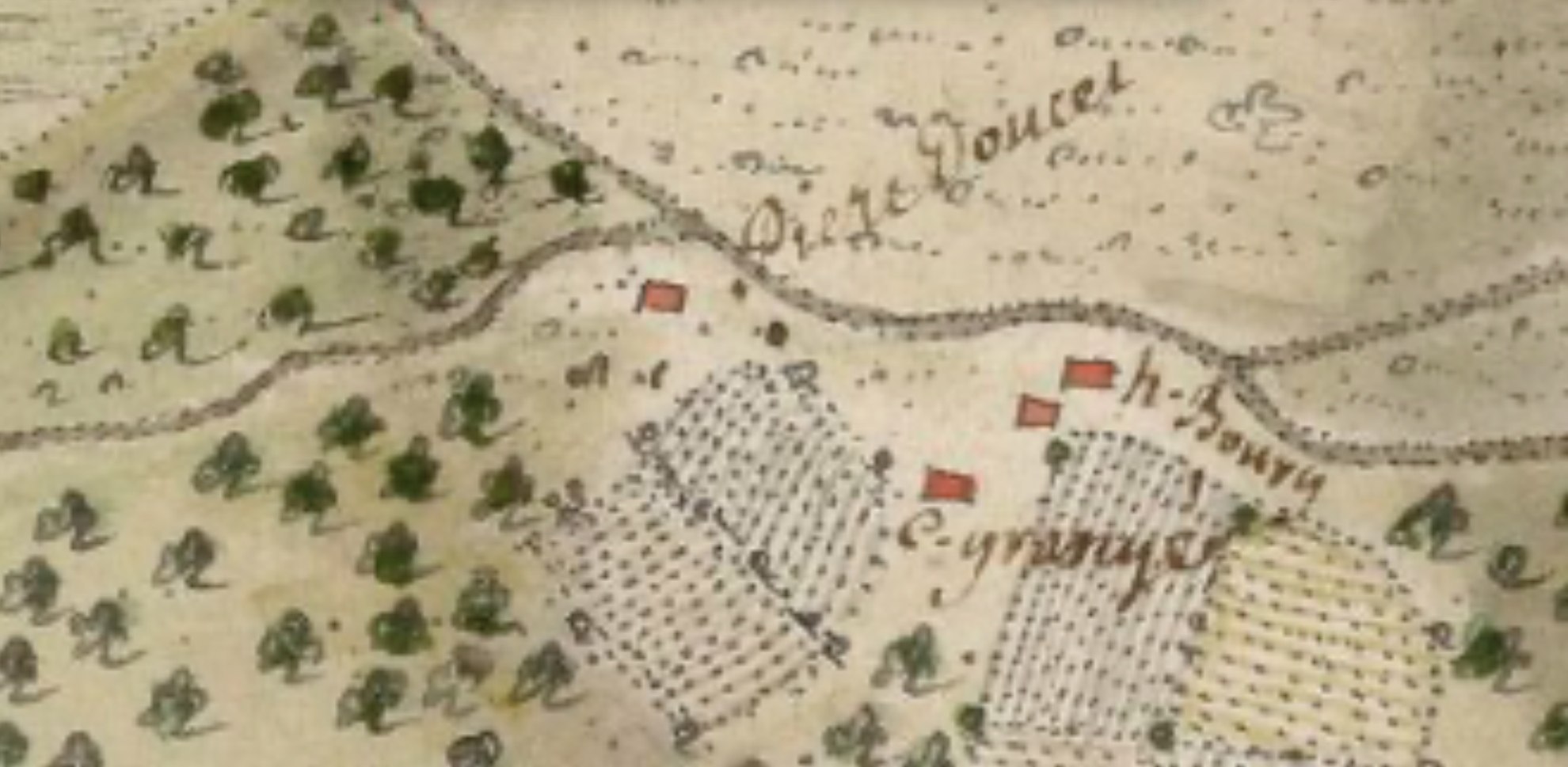
War had broken out again in Europe between England and France, and the English colonies to the south regarded francophone Acadie more belligerantly as an enemy - no matter that the New England population was many times greater, the Acadians were no threat, traded with the English colonies to mutual benefit and had only a handful of French officials and military at Port-Royal.
In 1690 Massachusetts (ceded by the Netherlands to England only 30 years earlier - all of the European-settled coastline of North America was in a state of changing ownership and boundaries) sent a force of over 700 men led by Sir William Phips to capture the decrepit Port-Royal fort. The French governor de Meneval agreed terms of capitulation in order to protect the local population; as soon as the New England forces occupied the fort, Phips broke the agreement and "unleashed his men... Over several days the New Englanders methodically slaughtered livestock, burned barns, and ransacked the homes of inhabitants..." About 30 homes and the parish church were looted and burnt, many belongings stolen, the fort was left "a smoking ruin" and an oath of allegiance to the English Crown was demanded of Acadians in the area, again.
Having wreaked this pointless destruction the New England forces soon left Acadie, taking with them de Meneval and other hostages including Catholic priests, who they kept imprisoned in Boston. In the same year two pirate ships raided Port-Royal, burning more houses (one with a family inside), killing cattle and hanging two men.
A year later French naval forces entered the Baie Française - unhelpfully because they left within days and only prompted another marauding Massachusetts force to arrive. Called on to provide support by both sides, the Acadians in Port-Royal stated that "they themselves would remain neutral" between the English and the French.
These, and the worse and more frequent raids in following years, must have been awful for the younger Doucet kids to witness, and helped prompt the moves away to safer settlements by the older children.
In 1693 - when there was yet another raid ("...burned 10 or 12 houses, killed some cattle and burned three barns full of unthreshed grain") - the census records Pierre Doucet as a widower, at Port-Royal, aged 56 (he was about 72) living with his sons Louis 19, René 13 and Mathieu 8. They owned 1 gun and lived on 8 arpents of cultivatable land with 10 cattle, 12 sheep and 10 pigs. That's less farmed land than before; this may well be because of the New England raids. When Pierre set up his farm decades earlier it probably seemed a very favourable location directly across the river from Port-Royal, close to his uncle Germain in the fort. But those days were long gone, and farms near Port-Royal were surely ripe for plunder and destruction.
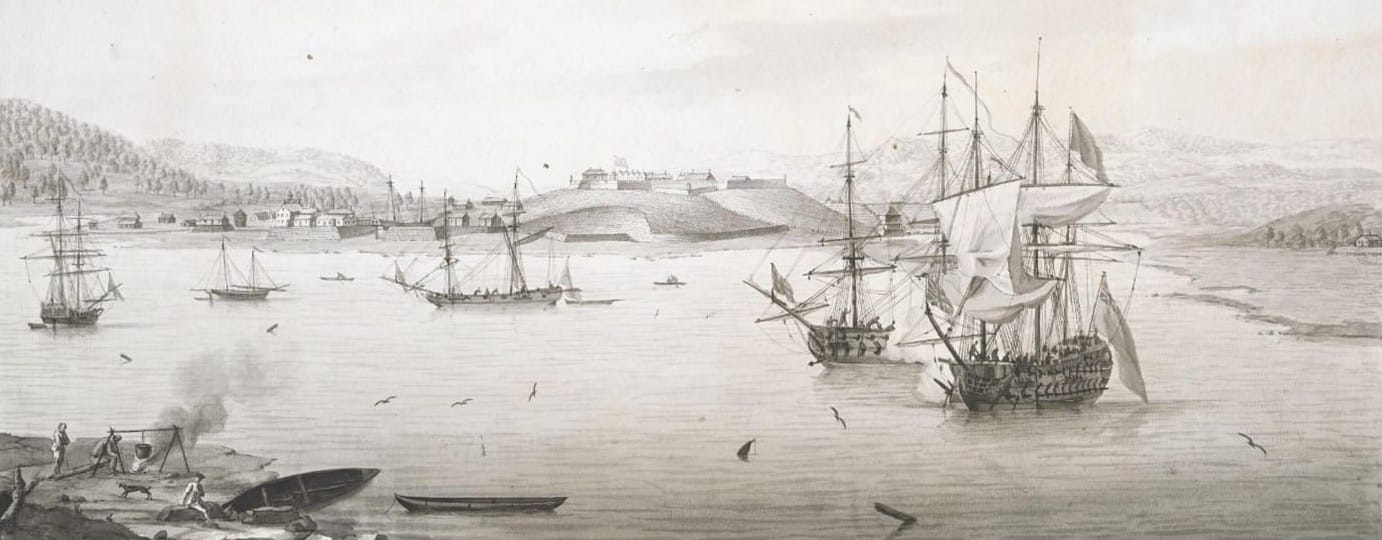
Did ships from New England moor by the dyked land of Pierre's farm, just out of cannon range from the fort? And then did soldiers land, loot his house, burn it? Armies in those days 'lived off the land' i.e. they took what they needed, robbed houses and barns, slaughtered farm animals for food, abused the population...
These were bad times in Acadie. There were several years of bad harvests during which grain stores were used up; in other years, the annual harvesting was interrupted by the presence of invading soldiers. In 1698, the people were reported by French officials to be "sans bled ny farine à cause de la mauvaise récolte des bleds et pois de l'année dernière" (without wheat or flour due to the bad harvest of wheat and peas [staples of Acadian agriculture] the previous year).
The topsy-turvy world of international treaties between England and France continued, with Acadie again a bit-part to be thrown into negotiations: in 1697 another treaty restored Acadie to France. And the next year's census recorded Pierre still at Port-Royal, now a widower aged 80 (he was probably 77) with four of his children: Louis 24, René 18, Mathieu 10 (he was 13) and Margueritte 12 (her name mis-spelled, and she was 18). The family owned 1 gun and their farm had 16 arpents of cultivatable land with 12 cattle, 8 sheep and 5 hogs.
The total Acadian population had tripled or quadrupled in four decades, with most of the increase in settlements such Beaubassin and Les Mines on the upper reaches of the Baie Française. In contrast, the Port-Royal population of around 500 people in the 1670s had grown by about a half by 1700.
In the census of 1701, Pierre was already the oldest person in Acadie, the survivor of the first generation of Acadian settlers.
For the last year he had been living with only René and Mathieu at home to help him on the farm, the acreage they cultivated had decreased. René married in 1702; the following year's census shows him as a householder in his own right with his wife and one child; Pierre is shown separately on the census, with one girl (an error, must have been Mathieu) but, jumping ahead, he is not included in the 1707 census. René and his wife and two children are there in 1707, on a farm and with animals similar to Pierre's listing in the 1700 and 1701 censuses so it seems that René had taken over the Doucet farm and was regarded as the head of household.
In 1702 war had broken out yet again between France and England. Port-Royal was blockaded two years later with prisoners taken. New England attackers broke down the dams and dykes to flood fields with seawater and ruin them. Houses and one of the two churches were looted.
France supplied some support to strengthen Port-Royal's defences. Led by a military engineer, Pierre-Paul de Labat, work was started to replace the old fort with a more modern and defensible, star-shaped construction; this involved demolition of four original houses in 1702, and one source stated that work was slow and never completed. This is an aerial shot of the earthwork remains of what later became known as Fort Anne.
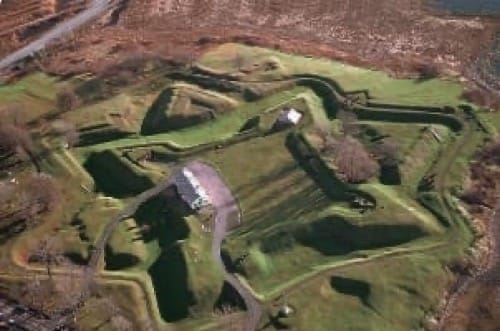
Labat went on to produce a very detailed map of the area in the years up to 1710, which shows the Doucet home and farm and surroundings. In its online form (see below), Labat's map is unclear except in enlarged sections. On his map, Labat uses the term Les Anglois which had become the common, collective term for foreigners, whether English or New Englanders, visiting Acadie to trade or destroy.
In 1704 two New England warships sailed past Port Royal and attacked the Melanson family settlement, burning the houses and crops, slaughtering livestock and taking a woman and her four children hostage, with a demand that the fort capitulate. It did not capitulate, and the New Englanders were forced to retreat (what happened to the woman and her children seems unrecorded).
In November 1705 there were great storms and flooding covered "tous ceux du pays sans exception" (all this countryside without exception). There may be no connection with those events, but on 2 December Pierre Doucet and François Robichaud acquired a piece of land "au bord du fossé du vieux fort" (on the track to the old fort) adjoining the Dugas farm; that may refer to the remains of a fort built and briefly occupied by Scottish settlers in 1629, which was on the same, northern side of the river as Pierre's farm; this transaction needs more investigation.
In 1707 a New England force attempted to capture Port-Royal again, with soldiers occupying the surrounding area from early June to August. From camps on either side of the river, several attacks on the fort were made over the summer months. From the fort "the French saw the British burning the houses on the other side of and up the Annapolis River. On the night of June 13-14 the English came out and advanced along the marsh south of Troop Point. There they burned 9 houses on the west side of the point near the water..."
By the end of August Acadian and Mi'kmaq fighters had forced the English soldiers to withdraw, but the governor reported that they "did not fail to commit great damage, having burnt several settlements". Houses in the small town surrounding the fort were built close to each other; Labat's map shows the houses of Bernard and Charles Doucet (sons of Pierre's métis brother Germain - see later) and Claude Landry, with many others; it is not recorded if these burnt down. Some houses were burnt defensively by the French governor presumably to prevent les Anglois using them as cover and to give the fort's cannons a clear field of fire. Many others were burnt down by the invading forces, including those of the governor, other French officials and the house in which Pierre's daughter Louise was living with her second husband; many of their possessions were burnt leaving them homeless and destitute. He, the court clerk Jean Loppinot, wrote later of his "maison qui a brûlé, de ses pertes (losses), et sa réduction à la mendicité (beggary)" and his efforts to save the court papers as well as his wife and children.
Initially, les Anglois had disembarked from their ships a short distance downriver from Pierre's farm, near the old Scottish fort ("Débarquement des Anglois" as marked on the right of Labat's map below), marched through his land (and other farms) to a point up-river opposite and just past the Port-Royal fort where they established Camp des Anglois (on the left of the map) both in 1707 and again in 1710; they also disembarked at a point across the river, close to the Isle aux chèvres and marched along the south side towards the fort.
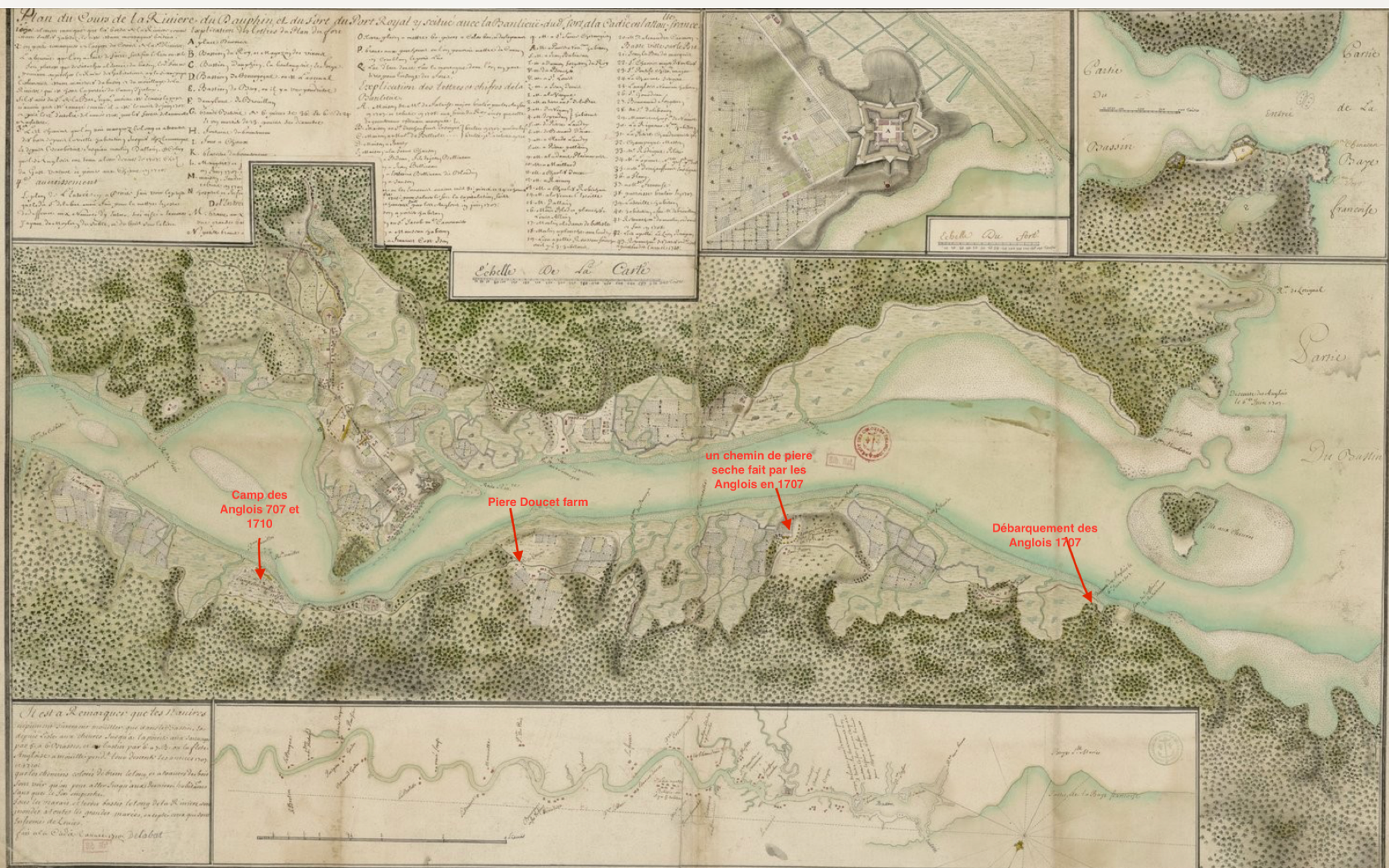
Labat's map lists the destruction caused in 1707 in the area around the fort, including "parroisses brulée" (parish churches burnt) and the buildings close to each other. It also shows a dry-stone path made by the invading forces close to Pierre's farm and his neighbours' presumably to get cannon across waterlogged ground ("un chemin de piere seche fait par les Anglois en 1707").
The map has one section which explains that "les chemins colorés de brun" (the circuitous brown lines seen more clearly on enlarged sections) on the north and south shores show the routes taken by the New Englanders in 1707 and 1710 from their disembarkation points towards the fort. On the north side, these routes pass right by Pierre's house and his neighbours'.
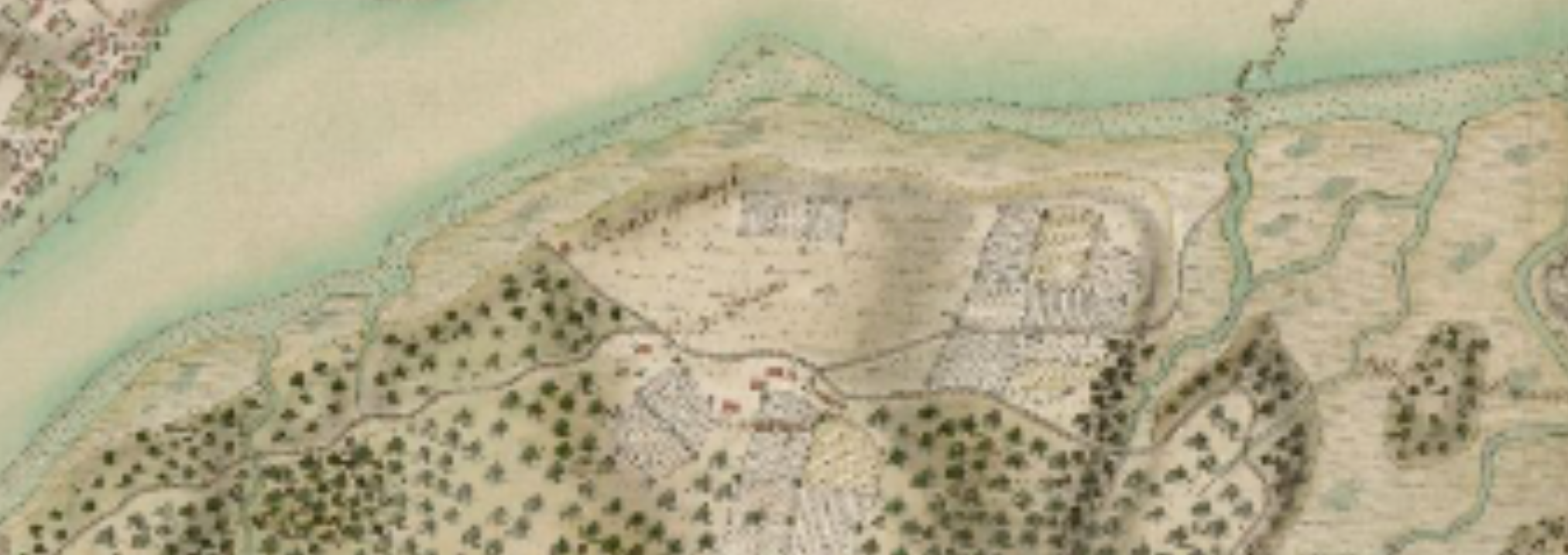
No way could Pierre's family and their neighbours have been unaffected by hostile military tramping across their farms, dragging cannons and setting up ramparts - and doing whatever damage or abuse. Then the defeated English soldiers in 1707 likely took revenge on the inhabitants as they retreated to the ships.
Labat was doing more than making a map; he was recording events and adding information over several years, making an important historical record. This military engineer, sent to construct a fort, seems to have developed an affection and respect for the people he was living amongst. He added more and more information to his map, pasting new sections such as a list he made of all the family homes around the fort, partially obscuring some of the map he'd made previously. His sympathies are clear in what he wrote about the 1707 and 1710 invasions: "the English got their feet wet and had to divert through the higher wooded land where possible" [tr] and "tous les marais et terres basses lelong de la Rivière sont inondés" (the marshes and lower land were flooded - one great sea).
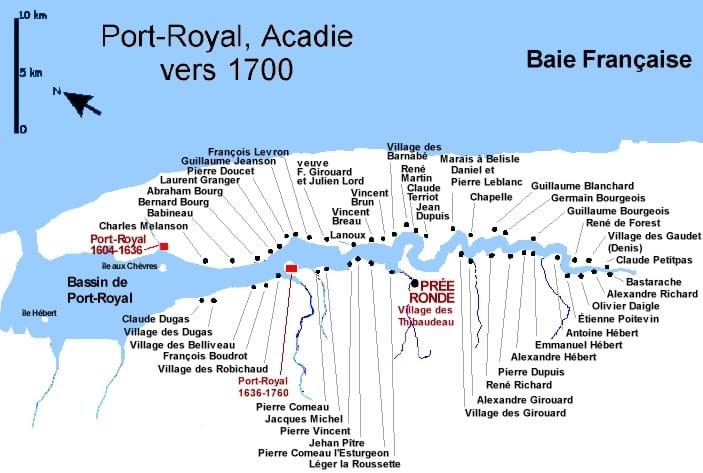
Labat's map shows that many Acadian families and their farms were in the Port-Royal area by this time, as does another map naming and locating all the families.
A French official appealed to France for supplies and assistance after beating off the 1707 attack: "there could not be greater need here, the country is denuded of everything" [tr]; 1708-10 were also years of bad harvests. He said 43 families were destitute as a result of the English attacks; they were without necessities such as iron pots, scythes, sickles, knives, salt, blankets; they had no hatchets or kettles to trade with the Indians, so were getting no furs with which they could trade for necessities.
The response from Paris was that France itself was in a parlous state and would abandon Acadie if any more requests were made.
In 1710 Louise Doucet and Jean Loppinot's house burnt down again, perhaps from one of the many pirate attacks or simply from a domestic accident; whatever the cause, an indication of how tenuous was life in Port-Royal.
And a few months later, disaster struck on a much bigger scale. A stronger force, 2,000 men, trod the same route as in 1707, doing god knows what new destruction along the way. In the census of 1707 (probably conducted in the spring, as most censuses were), René had 4 arpents of cultivated land, 19 cattle, 17 sheep, 8 hogs and 1 gun; oddly, Pierre is not listed in that census, suggesting René had taken over the farm and was regarded as the head of household. What land and farm animals they had after the lengthy attack later in 1707 and after the 1710 attack is unrecorded; a simple census conducted for the new English governor does not record that information. However, that Pierre, René and Matthieu's lives and livelihoods were badly affected by so many belligerent soldiers on their land is beyond doubt.
It sounds like farming in the Port-Royal area was becoming close to unsustainable, and the conditions had been getting worse year by year.
How many French or Acadian soldiers or civilians died in all these hostilities? There seems to be no other record than what is included, amongst much else, in the sole surviving registers for Port-Royal, which was in St Jean-Baptiste parish. These parish registers, starting from May 1702, include among the many other burials day by day some detailed as "mort le même jour d'une blessure reçue en se battant contre les Anglois" (died the same day from a wound received fighting against the English), and similar wording; French soldiers are described in the burial register as "natif de" Paris, or Provence, Anjou, Nantes, Poitou. Extracting all the Acadian and French military and civilian deaths from the burial registers (online, but hard to read) would be possible with time.
In all the attacks since 1690 the Port-Royal fort had held out, just avoiding capture. But in 1710 the new fort was put under siege by a much stronger and better led New England and English force, with the declared intention of not only capturing it but also removing the Acadian inhabitants - an ominous sign of what was to happen half a century later.
And the New England soldiers were better motivated: they were promised the pick of best Acadian homes and farms - another bad omen.
The siege ended on 10 October 1710 with the capitulation of the fort, its reserves exhausted by the poor harvests and previous assaults, and by lack of military supplies from France. This foretold the soon-coming end of any French (state) control of peninsular Acadie.
Although the siege lasted only a week, much damage was done not only to the fort but to the houses nearby. Under the terms of capitulation, the remaining 156 French soldiers plus their dependents and other officials were shipped to France (after being fed and given supplies - they were destitute). A bigger mercy was that the order to remove all inhabitants of the Port-Royal area was rescinded and they were offered "the continuance of all such lands, estates and privileges, as they do at present possess..." Generous? Well, better than being forcibly deported, but of course the new occupants of the fort needed supplies from surrounding farms. Almost all Acadians did choose to remain, albeit in families and countryside much damaged by years of on-off warfare, and under the shadow of English/French rivalry elsewhere.
Port-Royal was renamed Annapolis Royal (in honour of the English Queen Anne) and Labat's wonderful new fort became known as Fort Anne; some bitter irony there. Acadie was renamed Nova Scotia, but commonly known still as Acadie because Acadians continued to live there for years to come (as future chapters of In Acadian Footsteps will describe).
The victorious New Englanders agitated for the fruits of victory they had been promised, what Acadians had developed from scratch over many decades: "a vast country with fertile fields, a productive fishery, forests abundant in naval stores, and a country much better suited to 'the British constitution'" - as the English governor (had the nerve) to describe it. That well functioning network of very productive and accessible farms is shown on Labat's map when looked at closely online, with the lighter areas of cultivated fields reclaimed from the tides, large areas of grazing, and the many Acadian houses shown in red.
A few weeks after the fort was captured, a simple census was conducted described as being "famille par famille" - it just listed every Acadian family in the Port-Royal area, parents, children, widows, widowers, grouping family members together, and it was called a "rolle". It may have been commissioned by the new English governor, as his note at the end states this "list of the inhabitants within three mile circuit of Annapolis Royall... as delivered to me by Mr Allyn one of the chief inhabitants of this place." That explains the "rolle" being written in French, and with some knowledge of the population, such as the Germain Doucet family correctly not being lumped in with the Pierre Doucet family just because they shared the surname. Pierre and René are shown separately, as heads of two households or families, Pierre as a widower with one boy at home, René with a wife, one boy and two girls. Pierre was old, and had far less help to farm and repair damage done to the dykes, deliberately by les Anglois as well as by storms.
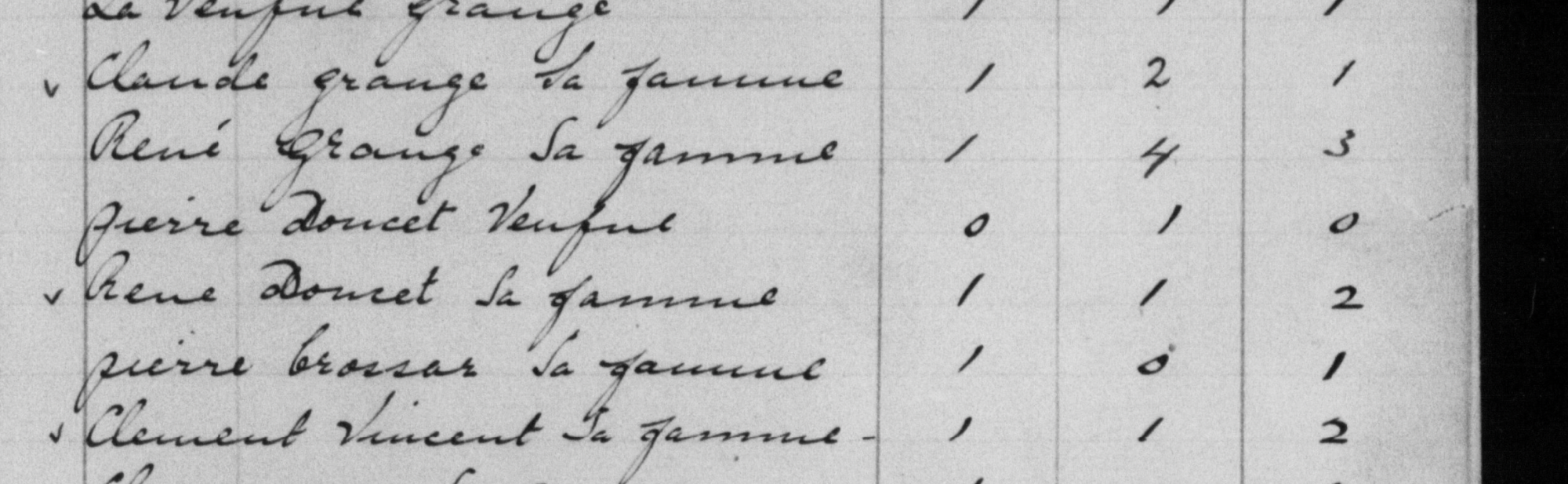
There were 481 people in 84 families with 84 heads of household, 159 boys and 151 girls in the Port-Royal area in this "rolle" on 20 October 1710.
The strife and turmoil did not stop immediately with the English capture of Port-Royal. Life there continued to be disrupted by the guerilla tactics of Mi'kmaq and remaining French soldiers or Acadian volunteers; the governor complained that "his men couldn't even go out to cut wood because they were so often shot at or attacked by French or Indians hiding in the bush." His men in the fort were short of food and other supplies, which local Acadians refused to provide, and he got very little help from England, few instructions and no regular provisions or pay for the men.
There was a state of undeclared and inconclusive warfare in the first years after the 1910 capitulation of Port-Royal fort.
As in 1654 and 1690, it was as if England and New England, having captured Acadie, didn't know what to do with it; they didn't actually want to do anything with it, they just felt threatened by its existence, its cultural difference (francophone, Catholic, free obstinate and awkward), alien to them. Of course, what they had captured was not Acadie, boundless, abundant Acadie, just the small fort in the small capital Port-Royal. The bulk of the Acadian population was prospering elsewhere.
Three years later France recognised 'the facts on the ground' and ceded Acadie to Great Britain (as England had just become) one final time.
And in that year, on 1 June 1713, Pierre Doucet died.
His long life can be seen to embody the resilience and endurance which became a characteristic of Acadians and of Acadie. He had left his mark on Acadie.

After a hell of a life, in many senses, Pierre was buried the next day where his sister had been buried three years earlier, at the Saint-Laurent chapel. The parish register that survives is faint but clear. On this remarkable old register, someone has written alongside Pierre's entry "100 ans!!"
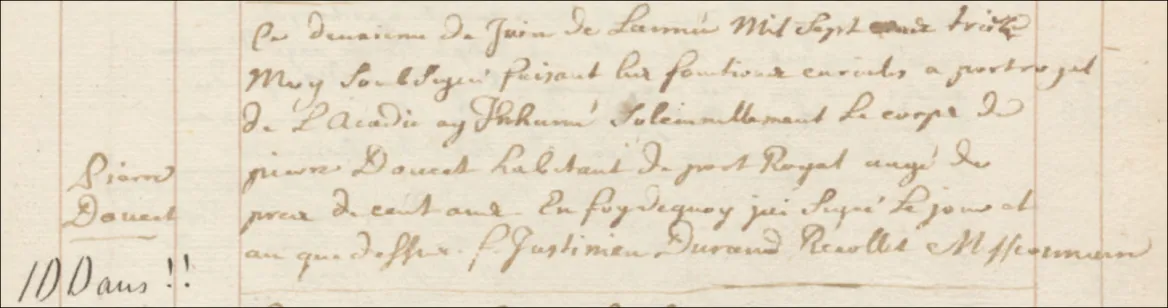
The Register entry translates as:
"This second day of June of the year one thousand seven hundred thirteen, I the undersigned, doing the curical functions at Port-Royal of Acadia, have solemnly buried the body of Pierre Doucet, resident of Port-Royal, aged nearly one hundred years. In witness of which I have signed on the day and year as above. Fr. Justinien Durand, Missionary Friar."
On a separate burial record there is:
"J'ai inhumée Pierre Doucet agé de Près de 100 ans, habitant de Port-Royal" followed by the priest's signature.
By the time Pierre died, five of his six sons, all born in Port-Royal, had created families of their own, marrying women from other Acadian families (Caissie, Blanchard, Girouard, Broussard, Lord/Laure) and producing many children. His four daughters had married (sometimes twice, after the death of a first husband) into the Hébert, Bernard, Doiron, Chênet, Comeau and Loppinot families. This - one of many family examples - shows the interweaving and mutually reinforcing nature of Acadian society as the small original population grew rapidly in the isolated environment of Acadie.
Astonishingly, by his last year on earth Pierre already had 52 grandchildren in nine families, and there were a further 20 Doucet grandchildren in the next few years. He had buried his wife Henriette 25 years earlier and his oldest daughter Marie Anne in 1710; she had had 14 children. Pierre had seen Mathieu marry in 1712 and in his last year have their first child, Joseph (through whom I am descended).
Did he have a sense of achievement? Or was he just exhausted, well into his 90s, and lonely, the fate of many who live to a great age, siblings, friends, colleagues and even some of our children having passed away.
Did he realise he was the last member of the founding families of Acadie?
Just as important: did he realise what he and Henriette had started - 72 grandchildren, and their children, and their children, and their children and so on - Acadian life and their family life going on, and that it would go on after him and Henriette, in the abundance, in all senses, that was Acadie.

A long life, a long story. Pierre Doucet's footsteps started in France. As a young man he took the perilous and uncertain voyage to the Acadian part of North America where others had failed to settle and survive. His was one of the few founding families that despite hardship and hostility created a distinctive society and national identity previously unknown to the world.
Pierre is important because he was the oldest surviving member of the original founding families of Acadie, and he lived through the tumultuous first century of this new country, witnessing its growth and the many attacks on it from his farm directly across the rivière Dauphin from the Acadian capital Port-Royal. As Acadie prospered, against all the odds, its small population doubling every 20 to 25 years and grain growing in such abundance it could be exported, this new country drew grudging admiration from visitors both English and French. As well as their hard work and prosperity, the stubborn independence of the families creating Acadie drew comment; they were said to be:
“most independent in character and accustomed to decide matters themselves”[tr]
“a very ungovernable people and growing very numerous”
Modern writers express the same, with admiration, affection and respect; the academic geographer Andrew Clark was moved to write:
"those dedicated, stubborn, resilient, pettifogging, inventive, exasperating, peace-loving, and, in many ways, altogether magnificent people created a geographical entity which was absorbed in or replaced with, but never quite obliterated by, the Nova Scotia which succeeded it. "
Footnotes
At a time when almost all shipping was coastal and navigation was imprecise, there was an important exception. Since at least the 1500s ships from the Atlantic coast of France had sailed each spring to the abundant cod fisheries off the coasts of Acadie. Cod was a valuable, much-sought food in Europe at the time, and furs which the sailors obtained from local indian tribes were also prized. Profits from fish and furs were great, an incentive to risk ships and lives crossing the Atlantic.
French and other attempts to settle or explore this eastern coast of the American continent had started in the early 1600s but were unsuccessful in the harsh climate; 30 out of 70 Scottish settlers died over-wintering there in the 1620s. A 'habitation' - like a fortified manor house in feudal France - was established at Port-Royal by earlier French settlers in 1605 but this was not permanently settled. Scottish settlers occupied a fort at Port-Royal (on the northern side of the river) at the time that Acadie was ceded to France in 1632, and departed peacefully when the French arrived; the French fort was on the southern side of the rivière Dauphin.
Many ships from France sailed to the Acadian coast from the 1630s to 1650s, for commercial as well as settlement reasons. The passenger list has survived from only one voyage; that was the ship Saint Jehan, in 1636. None of the Doucets are named as being on that sailing.
The 78 passengers and 18 sailors on the Saint Jehan included some who became the first long-term settlers in Acadie, with the trades and skills needed for settlement: farmers, carpenters, tailors, a miller, a cooper, a cobbler, a gunsmith and lockmaker, a toolsmith, a vintner. The toolsmith, Guillaume Trahan, came with his wife and two children; likewise Pierre Martin with his wife and son, the widow Madame Perigault and her two sons, and Nicolas Le Creux with his wife Anne Motin, her sister and two brothers, Pierre LeJeune with his wife and three children, Jean Theriot and Perrine Rau who was pregnant with their first child, others by the names Blanchard, Aucoin, Gaudet, Brun, Breau, Boudrot, Cormier, Bourg, Landry, Péraud. These became some of the first families to make permanent settlement on Acadie, along with the Doucets and others on sailings of those early years.
In all, the Saint Jehan in 1636 brought 23 men, six women and 11 children - a very small number to settle a large countryside. Also on the ship were others probably with short-term, contractual trading or work purposes, such as saltmakers, salt then being a valuable item in Europe.
There were many other sailings which may have brought people intending to set up home in Acadie, as well as traders, employees of commercial concerns and so on. But the only other sailing of these early years for which there is information was in 1632, and this is minimal: that the passengers were 300 "hommes d'élite" (elite men) and several Catholic missionaries; another brief report states there were three ships "loaded with all kinds of necessaries and three hundred gentlemen."[tr] They crossed the Atlantic with Isaac de Razilly, newly appointed governor of Acadie. Germain Doucet was likely one of these elite or hand-picked men, as he became commander of the fort at Port-Royal and after Razilly died in 1636 was close to Razilly's successor Charles de Menou d'Aulnay. The first documented date of Germain being in Acadie was 1640, at Pentagouët.
For a long time it was assumed that Germain was the father of Pierre and Marguerite. But then d'Aulnay's will of 1649 was discovered, in which he heaps praise on Germain for his loyalty, asks him to look after his (d'Aulnay's) children, and leaves money for Germain to look after his (Germain's) "nepveux et niepces"; there is no mention of Germain having any children of his own and there is no other record of any, nor of Germain marrying. So it seems that Germain was Pierre and Marguerite's uncle.
Did they and their mother and father - Germain's brother - arrive with Germain on the 1632 elite men sailing? Pierre, Marguerite and even their parents may have been on that 1632 sailing with Germain, as his dependents.
No record has been discovered of who (or where) Pierre and Marguerite's parents were, except that their mother's surname was Bourg. They may also have come on the many other unrecorded sailings in the 1630s and 40s, or have stayed (or had previously died) in France, Pierre and Marguerite travelling as orphans with their uncle Germain.
D'Aulnay's 1649 will refers to Germain's "nepveux et niepces". So who were they, the several nephews and nieces, apart from Pierre and Marguerite? Pierre must have had a second sister, because a female Doucet married Jean Lejeune and had two children around 1656 and 1661, but her forename was not recorded (this was before the first census). The plural nephews may refer to both Pierre and a child named Germain, born around 1641 in Port-Royal, from an Acadian woman and an Abenaki father. This son seems to have been adopted into the Doucet family and treated as Pierre's brother, named after the first Germain (an important man in Port-Royal and the family's protector), suggesting the 15-year-old Marguerite may have been his French Acadian mother. This second Germain appears in the censuses later with his wife and children, making a second Doucet family beside Pierre's in the 1600s and onwards. More about him, and Pierre's mysterious second, and nameless, sister in a later chapter of In Acadian Footsteps.
It seems likely that there were many Acadian/ Mi'kmaq or Abenaki couples and couplings such as produced the second Germain, and marriages in some form but records lost/destroyed if civil records were made at the time. Those children were termed métis and sometimes adopted into Acadian families taking on Acadian names while others formed distinct métis communities. The Godet, LeJeune, Guidery, Petitpas, Charret and Sellier families, as well as the Doucets, are known to have included métis children. This was another aspect of the benign relationship between the new French settlers and the indigenous tribes of Acadie. Both the indigenous peoples and Catholic Acadians valued formal marriages for the care and protection of children.
The two peoples were living in close proximity, each benefiting from the other's presence. The early Acadians may not have survived without learning from the indigenous inhabitants how to live in Acadie: how to hunt, fish and fowl, the making and use of canoes, of clothing and footgear from fur and skin, the use of native plants for food, herbal remedies and dyes. New to these French migrants was how the plentiful birch bark could be put to dozens of uses such as insulating homes and making containers, as well as canoes which were the main and essential way of getting about.
"The general picture for a century and a half was that of a harmonious and almost symbiotic mutual interdependence of the two groups."
D'Aulnay's will is a really useful 'find', because it gives some details from a time when most written records were lost, or destroyed at a later date. It identifies Pierre's uncle Germain's birth-place as "Couperoue en Brye" (Coupru en Brie), in the Picardie region of France. In a French official document of March 1644 Germain is noted as "le sieur de La Verdure et Capitaine d'Armes en Acadie"; he was commonly referred to as Germain Doucet de laVerdure or "dit" (meaning 'known as') Laverdure. There is no historical record attaching these honorifics to Pierre or Marguerite. After the English capture of Port-Royal in 1654, Germain and his fellow military returned to France, where Germain later died, with no further known connection to Acadie.
De laVerdure is also attached to another Acadian, Pierre Melanson, which suggests la Verdure refers to birth-places in France, but this has not been proven; there are other theories about the origin of the Melanson name. Some of the first Acadians were identified by their French places of origin, such as François Levron dit Nantois, neighbours of the Doucets; the two families were later joined by marriage.
From the censuses we know that Henriette's younger sister Jeanne had married Barnabé Martin who like Pierre was born in France, and they had eight children between 1667 and 1686 (Marie, René, Madeleine, Jeanne, Etienne, Cecile and two unnamed). In 1671 they had two small areas of land, possibly on the south bank and up-river from Port-Royal where their son Etienne's farm was in 1707, so her family and Pierre's were not close neighbours. When Barnabé died Jeanne, aged 47, married Jacques Le Vanier, 37, and they had one daughter, Elizabeth, and by 1693 a farm of 16 arpents.
Acadians were resistant to the censuses and some avoided being counted, even though they were introduced under French rule and the first in 1671 was conducted by a Catholic missionary; perhaps it was a (justified) distrust of all officialdom - after all, how would census data benefit the ordinary Acadian? Some examples of Acadian stroppiness recorded in the first census are:
Pierre Melanson, tailor "refused to answer. (He had a wife and 7 children)"
Estienne Robichaut "told his wife that he did no want to give an account of his cattle and his land"
Pierre Lanque, cooper, "sent word that he was feeling fine and he did not want to give his age".
In 1686 the chief clerk sent to Port-Royal to carry out that year's census found the inhabitants "rebellious and independent".
The early censuses list not only family members (names, ages) but also how much land each family cultivated and how many farm animals. This usefully indicates the size of family farms and their growth from 1671 to around 1700. These early censuses show an interest in how Acadian society was developing, whereas post-1700 censuses seem less benign and to function more as instruments of control, lacking the former societal detail, simply listing the number of people, primarily 'arms-bearers' (adult males), and numbers of guns. The early censuses show wide variations in farm sizes, which typically grow from one census to the next, as do the number of children, and indicate some environmental setback when farm sizes decrease. Pierre Doucet's was one of the smaller farms.
Even with their faults, the censuses are almost all we have and provide a window of about 40 years into the nitty-gritty detail of early Acadian life, acres cultivated, how many animals, children born, children gone (left home? died?). Pierre is first documented (indirectly) as being in Acadie in 1661, calculated back from his first child Marie Anne being 10 years old in the 1671 census.
There is another window into 1600s Acadie. A few shafts of light are thrown onto the early, unrecorded marriages by consanguinuity dispensations given by priests in the 1700s; see later chapters. This is how it became known that Pierre's mother was from the Bourg family. Or, from a Bourg family - perhaps more accurate to be vague here, because Pierre Doucet whose mother's family name was Bourg married Henriette Pelletret whose mother was Perrine Bourg; this apparent consanguinuity of some degree is not something I have seen remarked upon.
Migration to Acadie was initiated by a few seigneurs - minor French noblemen and landowners - with grand but underfunded schemes for idyllic agriculture-based colonies and/or for profitable 'resource-colonies' trading in furs and fish; these seigneurs - Isaac de Razilly who oganized the 1632 sailing, Charles de La Tour, Charles Menou d'Aulnay de Charnizay, others before them - competed with each other to the point of armed conflict. Many of the first migrants were peasants, employees and servants of these landowners. Prior to the 1636 Saint Jehan sailing, there had been several efforts to establish settlements in Acadie, none of which had become permanent. Those migrants arriving in the 1630s and later, who did establish a permanent, successful settlement, are regarded here as the founding families of Acadie.
Some of the seigneurs remained in Acadie, but the feudal, fixed and hierarchical society of France was not replicated in Acadie; daily life there was too basic, too backward, the migrant population was tiny in a large, undeveloped and unfamiliar environment. The migrants had a freedom of action they'd never had in France. There was an unavoidable equality between them all - they were all in it together, to survive or not survive. Some of the seigneurs, and a few merchants such as Emmanuel Le Borgne, laid claim to large parts of Acadie but had no means of enforcing their claims and were largely ignored.
"Lacking governmental control in almost all of the operations and activities of their daily lives... the Acadians achieved a modus operandi of occupying new land, settling disputes, trading individual skills and surpluses, and developing the ...teamwork necessary to build dykes, aboiteaux, and drainage channels and, no doubt, houses and other structures and the small sailing vessels. "
The phenomenon we call 'the Acadians' developed out of small numbers of migrants, of diverse origins, mostly strangers to each other, arriving unplanned in scattershot phases, finding common cause in the struggle to survive in a harsh new environment. Strangers - to each other - in a strange land, independent-minded people discovering the necesssity of cooperation for survival. The Acadians were a product of circumstance and character.
That Acadie developed from just a handful of founding families might suggest inbreeding, genetic limitation and weakness in future generations. But here as in other respects (some), fortune favoured Acadians. The migrants of the 1630s-50s were from disparate origins; peasants displaced, discontented or persecuted in feudal France; soldiers and engagés opting to settle in Acadie when out of contract were also from many different parts of France so they too were likely genetically diverse; there was a regular influx of new migrants through the decades; Mi'kmaq men and women contributed to the gene pool (as with the métis Germain Doucet; by 1671 at least five of the seventy Port-Royal households had a Mi'kmaq wife); individuals and groups of different national origins and religions arrived and became part of the growing population (there was a Doucet l"Irlandois!). Over the years there was a continual mixing and adding-to, all part of "the tiny colony's capacity to recruit and absorb newcomers... During the early decades of settlement, these factors were of major importance for the health of the colony but, even later, the arrival of people from different places enriched Acadian demography..."
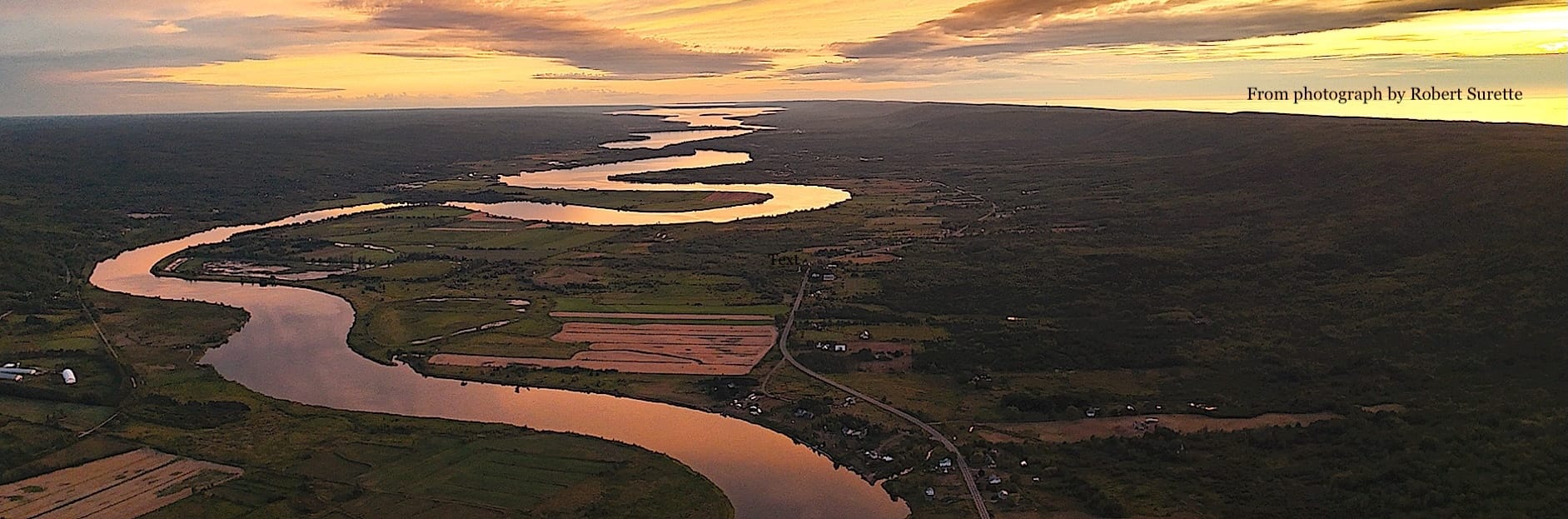
The old maps are useful in locating the lives of Pierre and Henriette's family in the 1600s in Port-Royal, but for Acadian descendents living elsewhere today a modern aerial photograph gives a much stronger sense of the glorious and challenging place where Acadie began. This photograph, The Winding Ribbon of Light, looks downriver to where the fort was on the left, with the Doucets and their neighbours across the river on the right.
A few stylistic notes are in order here. England and English is used in this article in place of Britain and British. England became a component part of the new entity Great Britain, under one monarch, with the joining of Scotland in 1707, and the Kingdom of Great Britain and Ireland dates from 1801. But people of the time spoke of England not Britain much of the time; England was (and still is) such a predominant part of this unequal Great Britain that even after 1707 it is really English policy and practice that is being referred to. The language is called English too, not British.
Acadie, or l'Acadie, was the name given to the eastern seaboard of North America by Giovanni Verrazano, an Italian explorer, on his voyage in 1524. He wrote that when he reached the coast everything was in full bloom and so beautiful that it reminded him of Arcadia in Greece, praised in the popular poem L'Arcadia. As a strange coincidence, in the Mi'kmaq language the suffix -akadie means 'place of abundance'; the Mi'kmaq had names for many places in Acadie, and Acadians often adopted many of these place-names such as, in the Cobequid area, Shubenakadie, or francophone versions of them.
The spelling used here, Acadie, needs explanation. That change of one letter from the English form Acadia requires a quite different pronunciation which seems appropriate for what was a distinctly francophone society, particularly because this article is one of many efforts to maintain the fact of the existence of Acadie. Je me souviens.
I have kept to the original francophone place-names where possible, except where by treaty and usage at the time a place-name changed definitively, e.g. Port-Royal became Annapolis Royal in 1713. But after this date I have not changed Baie Française to Bay of Fundy as, in practice, it remained Acadian territory long after 1713 unpopulated by les Anglois. That's wrong in one way, right in another.
Another spelling/pronunciation point: the final t in Doucet was sounded then and still is today in Canada: "Pour les noms terminé en -et aux XVII et XVIII siècles, la prononciation actuelle fait toujours sonner le t final: ainsi Doucet, Gaudet se prononcent 'Doucette', 'Gaudette'..."
For a fuller description of Acadian life, see the earlier article on this website entitled simply Acadia. That is a Part 1 to the present In Acadian Footsteps.
In this article I have tried to add flesh to the factual bones (and will correct any historical dates etc) in order imaginatively accompany Pierre Doucet through his long, remarkable life. As a descendent of Pierre, I am just one of very many; there are thousands of descendents of Pierre and his half-brother Germain. And we all descend from the many other marriages and parentings through nine generations or more (I am the tenth, and there are three more generations after me currently on this small twig of the far-spreading Doucet tree). So while this is my version of the Doucet story there will be many others.
Next:
2. Towards A Golden Age
Mathieu Doucet, 1685-1744/1760
Anne Lord, 1687-1770
Sources and Credits
In order to focus on the lives of the Pierre Doucet family some aspects of the Acadian story have been omitted or touched on only lightly, such as seigneurial land-grants, international treaties and colonial politics, names of governors, officials, military men. These and other topics are covered fully in the publications listed below, from which this article (including quotations) is drawn. Opinions and views expressed here are mine, of course, as are any errors. Credits and attributions have been added where known; any missing can be be added.
Clarke, A.H., Acadia. The Geography of Early Nova Scotia to 1760. University of Wisconsin Press, 1968. 450pp.
https://archive.org/details/acadiageographyo0000clar/page/92/mode/2up
Griffiths, N.E.S., From Migrant to Acadian, A North American Border People 1604-1755. University of Moncton, 2005. 633pp.
Faragher, John Mack, A Great and Noble Scheme, The Tragic Story of the Expulsion of the French Acadians from Their American Homeland, Norton, 2005, 562pp.
Massignon, Geneviève, Les noms de famille en Acadie, La Société Historique Acadienne, Septième Cahier, March 1965, Moncton.
White, Stephen A., Acadian Family Names of the 18th Century, Les Editions d'Acadie, 1992.
Coleman, Margaret, The Acadians at Port-Royal, National and Historic Parks Branch, Dept of Indian and Northern Affairs, September 1969, 110pp.
https://publications.gc.ca/site/eng/9.872762/publication.html
Wikitree Acadian Project
Acadian Genealogy, Facebook
https://acadiamagic.com For members of the Acadian diaspora unfamiliar with the diverse landscapes and waterscapes of Acadie today, or only from maps, I recommend Greg Hartford's excellent website.
Ian Louis Ross Doucet
2025