In Acadian Footsteps: 2
From the oldest Doucet to his youngest son, Mathieu, my x-times great grandfather, eight generations before me, and the woman he married, Anne Lord. From awful childhoods to a golden age for Acadie and Acadians in new, wild and rich lands. And the ancestral line of a second Doucet founding family.
2. Towards A Golden Age
Mathieu Doucet, 1685-1744/1760
Anne Lord, 1687-1770
for preceding events and context, see In Acadian Footsteps:1
France ceded Acadie to Great Britain in 1713 and, ironically, this led the way to an Acadian golden age.
A francophone Catholic colony of (ex)Europeans ruled by English protestants is an odd thing. But after a determined and overwhelming victory at Port-Royal, the British ruled lightly most of the time, had no interest in bringing settlers like themselves to the country, and Acadie (Nova Scotia but populated by Acadians) started to flourish again. They were left to get on with their lives for the most part, though that did not happen right away.
Mathieu's father Pierre had a hell of a long life, and Mathieu must have had a hell of a childhood. His mother died during his infancy, possibly very soon after giving birth to him, and his grandmother Perrine Bourg died a few years later, then his aunt Jeanne died. One brother, named after their father, either died young or disappeared. As a child he saw Anglois ships and privateers raiding Port-Royal across the river in 1690 (he was about 5), and in 1692, 1696, 1703, 1707 and 1710.
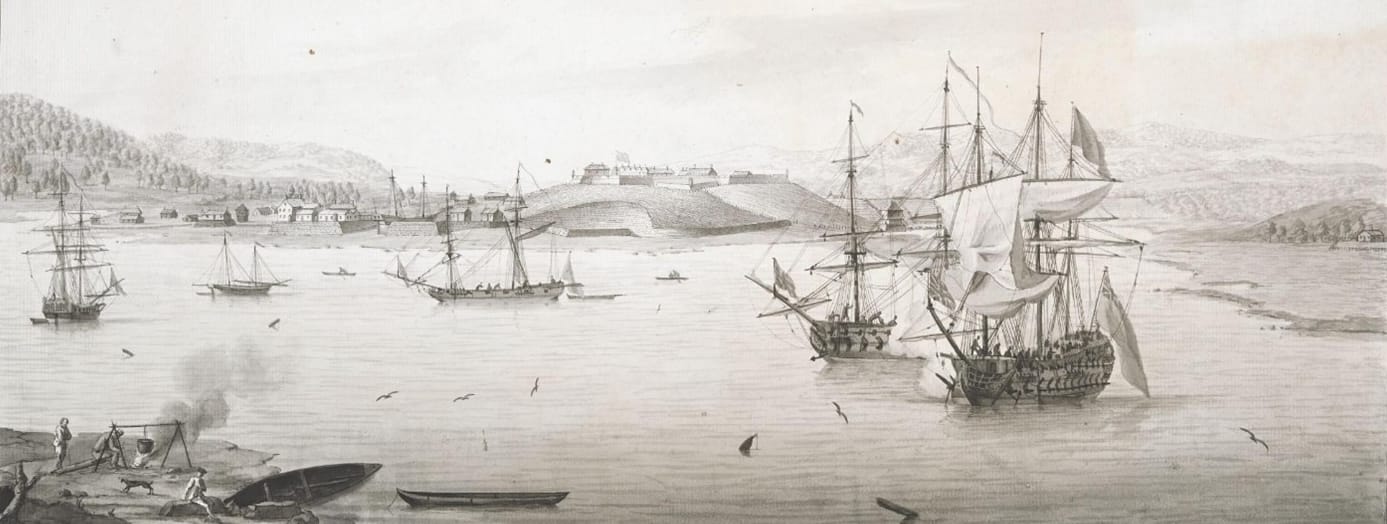
Since he was born they had lived in fear of attack, looting and worse - his home may have been burnt down in any of those raids, rebuilt and burned again; most of this older siblings had got out, to safer places; he surely went hungry during the harvest failures and flooding of fields; English soldiers tramped across his father's farm, probably took it over in order to 'live off the land' for the summer of 1707; two thousand of them came back in 1710 when he was a young man supporting his 90-year-old father, 'conquered' them and did not leave.
The first years after 1710 when French rule ended and les Anglois captured Port-Royal were full of uncertainty and confusion. The two imperial powers took opposite positions on whether the Acadian population should be forcibly removed or not. Bizarrely, it was France that wanted them to leave Acadie (defined narrowly as the Port-Royal centred peninsula) and move to l'Île Royale (now Cape Breton) in order to strengthen the French position there, while les Anglois newly occupying Port-Royal/ Annapolis Royal with few men or resources wanted the Acadians to stay and remain being usefully productive (without which the new occupants of Annapolis Royal "...would not be able to make it through the winter without dying of misery" as one of them said). When the 1713 treaty came, ceding Acadie to Britain, it did little to settle matters; the geographical boundaries of Acadie were never fully defined by that complex treaty in which, again, Acadie was a pawn of minor interest.
Acadians generally were reluctant to move to l'Île Royale; the few families who tried it out mostly returned, preferring "les prés (meadows) d'Acadie", the abundant homeland their parents and grandparents had bequeathed them.
Arguing his case for not forcing the Acadians to move to French territory, and against the notion of replacing them with more amenable subjects, the British governor extolled Acadians' "skill in the fishery, as well as cultivating of the soil" and said one hundred Acadians:
"...who were born on that continent, are perfectly known in the woods, can march on snow shoes, and understand the use of Birch Canoes, are of more value and service than five times their number of raw men, newly come from Europe..."
Some irony there, for Acadian descendents to read those words coming from an English governor.
With uncertainty and confusion going on around them all, Mathieu saw his father die - suddenly, we can assume, because other deaths were recorded indicating the sacrament had been given by a priest as the person was approaching death. This has to be imagined: did Pierre die in the family home, no longer a hive of activity, or did Mathieu find him dead in the fields? Did he go missing, and Mathieu and René had to search for him, his body? We don't know, because the record of his death says nothing of how he died; when his nephew Bernard died five years earlier the death register stated that he died of a "maladie", but he was about 42; no explanation was needed of a very old man like Pierre dying, of too much life lived. I have known several people living to what we call a grand old age; they don't find it grand at all, physical and mental faculties failing. Just waiting.
Waiting, and watching his wife die, his sister, even a daughter, and his son Pierre? Maybe the reality of Pierre's "Près de 100 ans" long life was not something to be so celebratory about.
Born when Pierre was in his late 60s, Mathieu had never known his father as the vigorous, young or even middle-aged man he was once. Mathieu (probably with brother René) must have taken Pierre's body for burial the next day - on a canoe, waiting for the tides? - further up-river to the St Laurent chapel. Was there a funeral as we know it? Did the other children have time to travel back from the places they'd moved to, a week or more's journey?

René had married Marie Broussard in 1701 or early 1702 and the first of their eleven children was born the following year; Marie's family lived further up-river where large areas of reclaimed land were farmed. It seems they set up home in the Doucet house, as no other building can be seen there on Labat's 1710 map (see previous Footsteps story) and René is named there on another map of this time. The census entries for 1710 list Pierre and René separately, as two heads of household.
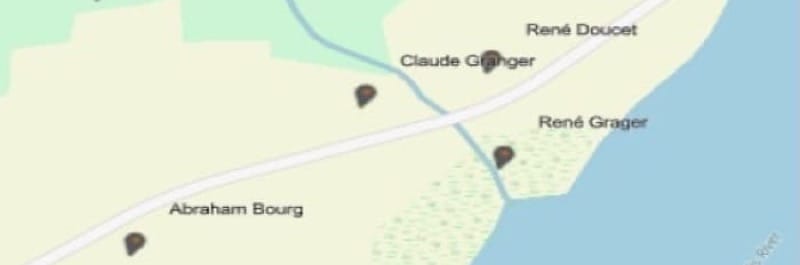
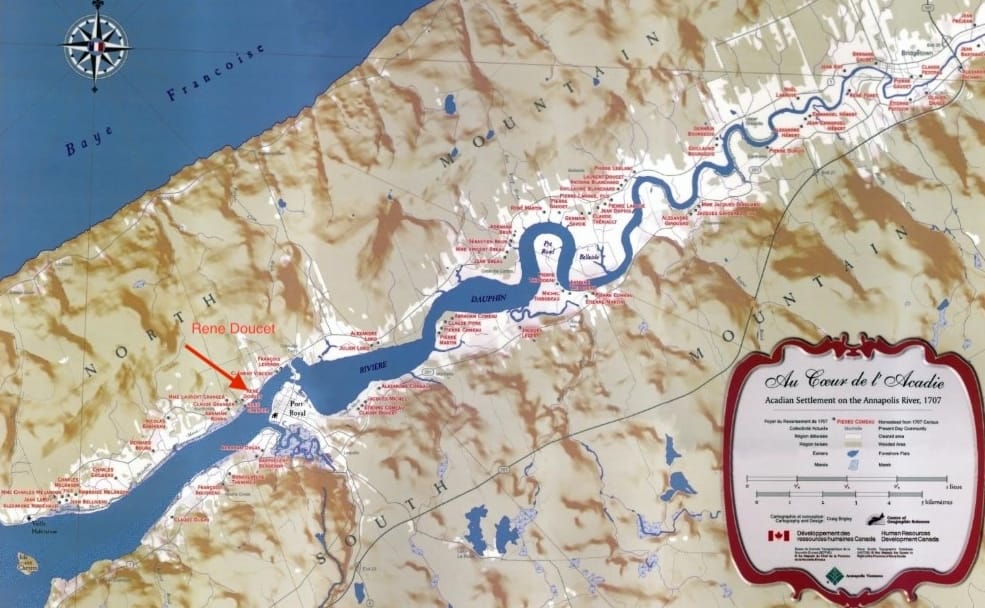
That a later map, below, shows Mathieu rather than René occupying the Doucet farm in 1733, and René is not shown anywhere else, suggests that he had died by then.
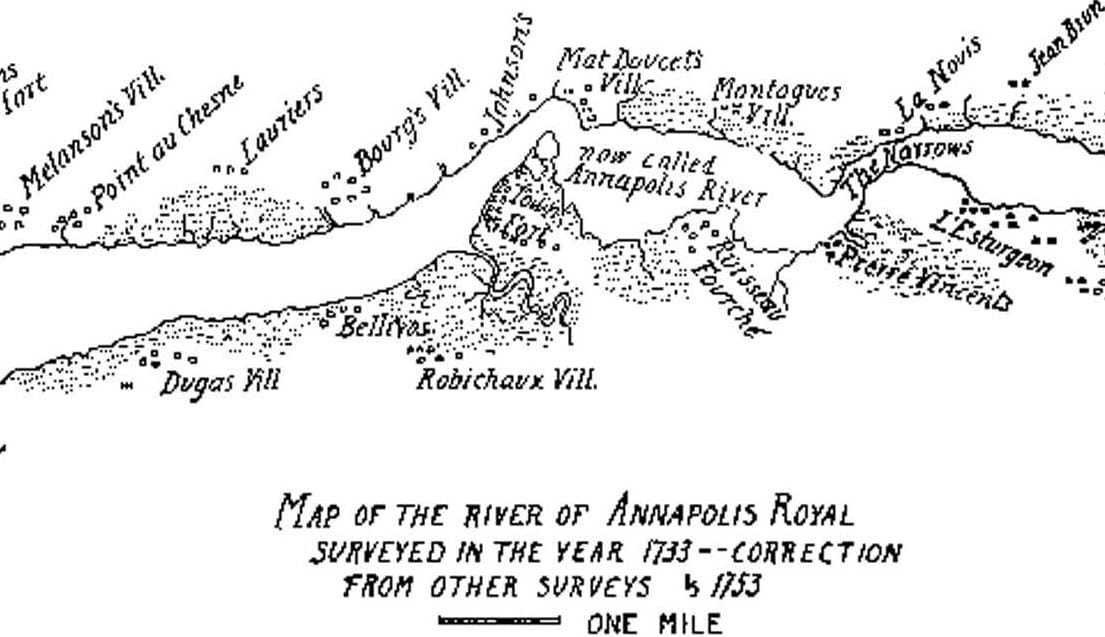
Mathieu was 26 when he got married, on 15 June 1712, to Anne Lord who was 24 and whose family lived nearby, on the same side of the river. They must have known each other all their lives, had pretty much the same troubling childhood experiences across the water from Port-Royal. I wonder how it was that they had not married earlier, as many young people did; perhaps with all the hostilities, bad harvests and Mathieu's ageing father (Anne's parents were much younger) they were too busy on the family farms to think of setting up home together and having children.
The Lord surname is given variously on surviving documents of those times, when spellings were not standardised and words often written as they sounded, as Lore, L'or, Lort, Laure, Leure. Anne's father Julien Lord dit Lamontagne was a relatively late comer to Acadie, arriving around 1670 as a soldier and marrying Anne Charlotte Girouard in about 1675; their daughter Anne born 1687 was the fifth of nine children. In their first years of marriage they lived on the parental Girouard farm.
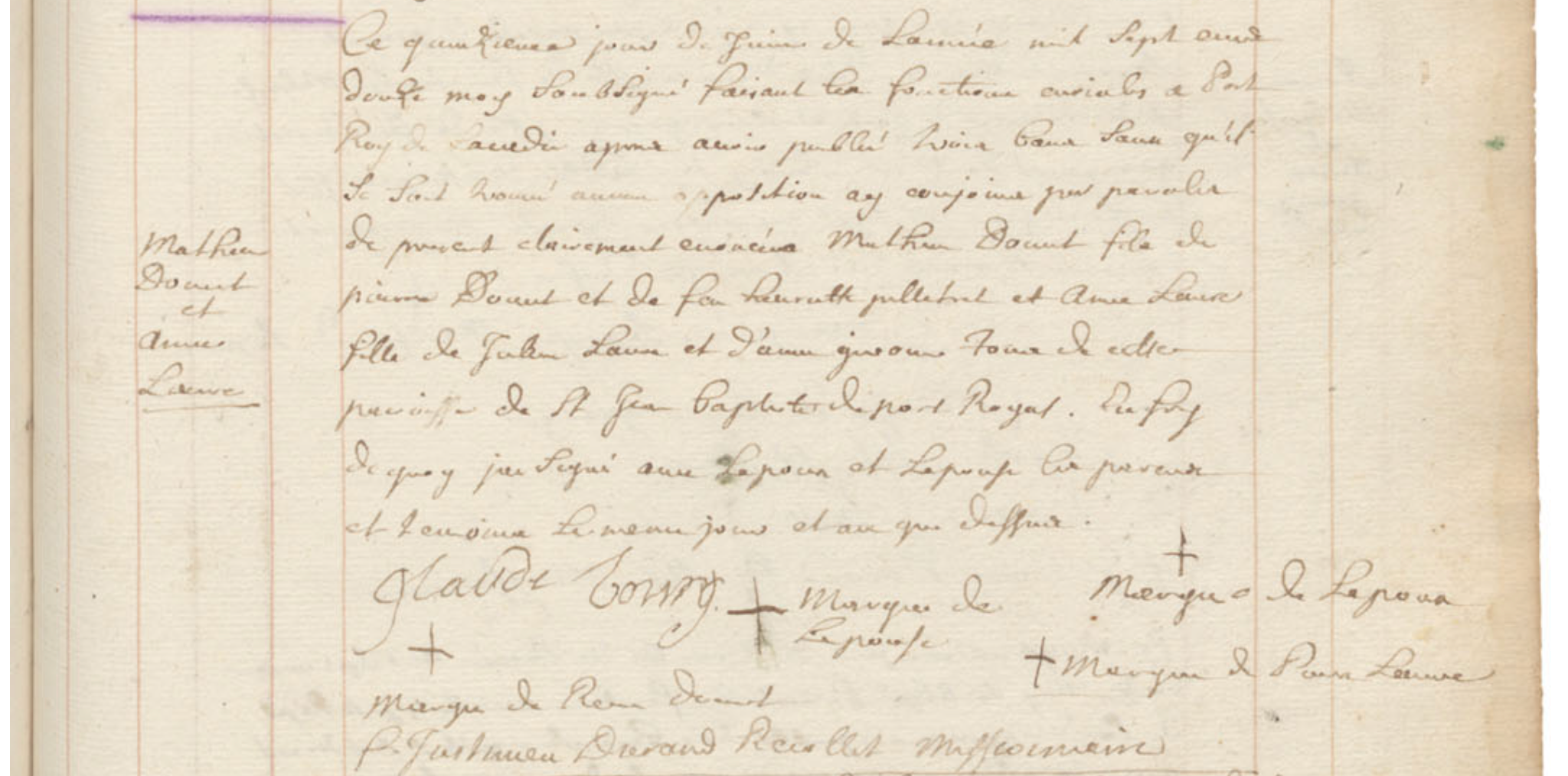
When Mathieu and Anne married, the mother and father of each was named in marriage record, and there were five witnesses who signed by name, Claude Bourg, or by making their mark, René Doucet, Pierre Lanoue, and two others that are hard to read in the original online. Anne's surname was written as Leure.
Mathieu and Anne's first child, Joseph, was born on 24 June 1713, within weeks of Pierre dying. They went on to have six more children between 1713 and 1732, all in the Port-Royal area. As was common practice, which can be seen as the binding of Acadian families together, the other children were given names from both sides of their parents' families: Pierre born in 1715, Anne in 1717, Marguerite in about 1719, Marie Josephe in 1722, Elizabeth in 1725 and Charles in about 1732. The one forename not carried on from either family is Joseph, perhaps chosen by way of Catholic piety, and Marie is similarly given as a forename to girls, often to the first-born.
Joseph was my x-times grandfather. I and the three generations after me are descended through Joseph and his wife Anne Bourg, the subjects of In Acadian Footsteps: 3 to come.
In the years of British rule, no censuses were conducted in Port-Royal/ Annapolis Royal after 1714, and that census was a bare-bones, minimal recording of population data. The 1714 census simply records "Mathieu DOUCET and wife, 1 son" and "Rene DOUCET and wife, 1 son, 3 daughters".
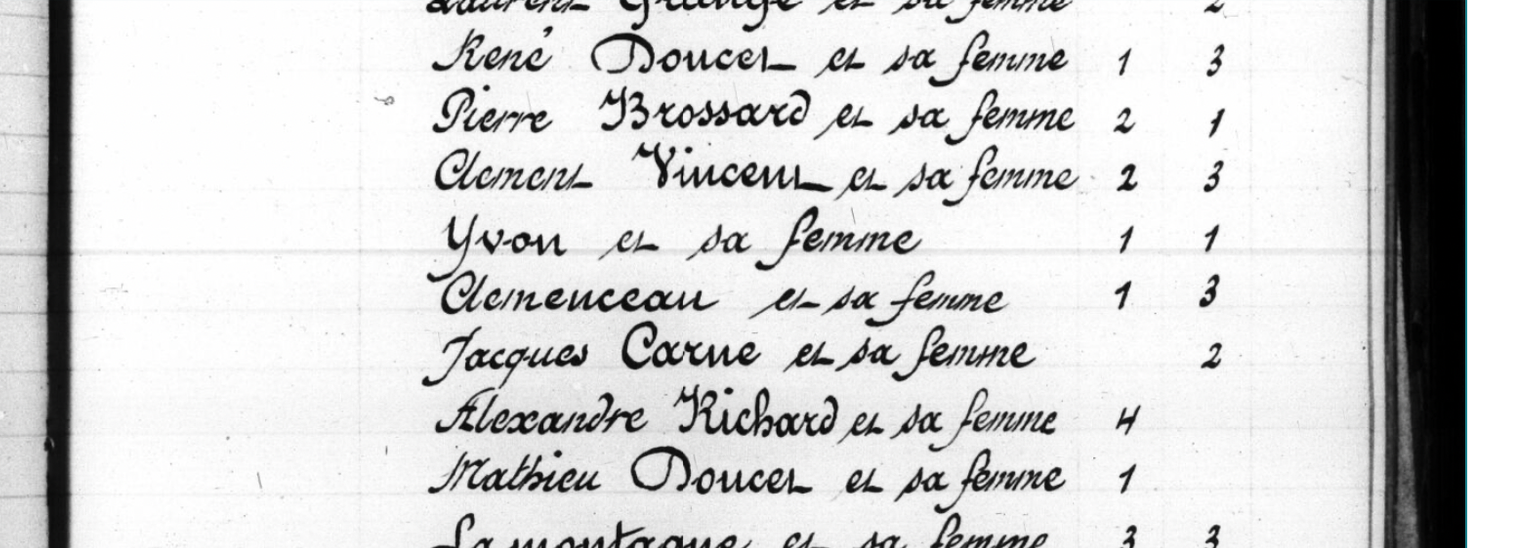
There's nothing that gives their locations, or amounts of land and livestock, as in previous censuses. It seems likely that these families lived close together on or near what had been Pierre's farm, although René and Mathieu's names are not listed together on the census. The children probably grew up together, played together, in years no longer interrupted by hostilities, looting and killing nor, hopefully, by the hunger that had come with harvest failures and dyke destruction in previous years.
In the absence of censuses, the St Jean-Baptiste parish registers are a godsend (and show how much information is missing for the 1600s, with those records destroyed or lost). The parish registers in the 1700s tell us birth-dates precisely, and marriages and burials, though some are missing and the registers are hard to read in places. Also a blessing for descendents connecting with their ancestors is the Acadian practice of appointing godparents (maraine and parain) when baptising their children. This was not a token or trivial matter, godparents became close relations of both their godchildren and their godchildren's parents, a spiritual and a practical kinship. Hence the great strength of Acadian kinship bonds, which proved to be a saving grace in years to come.
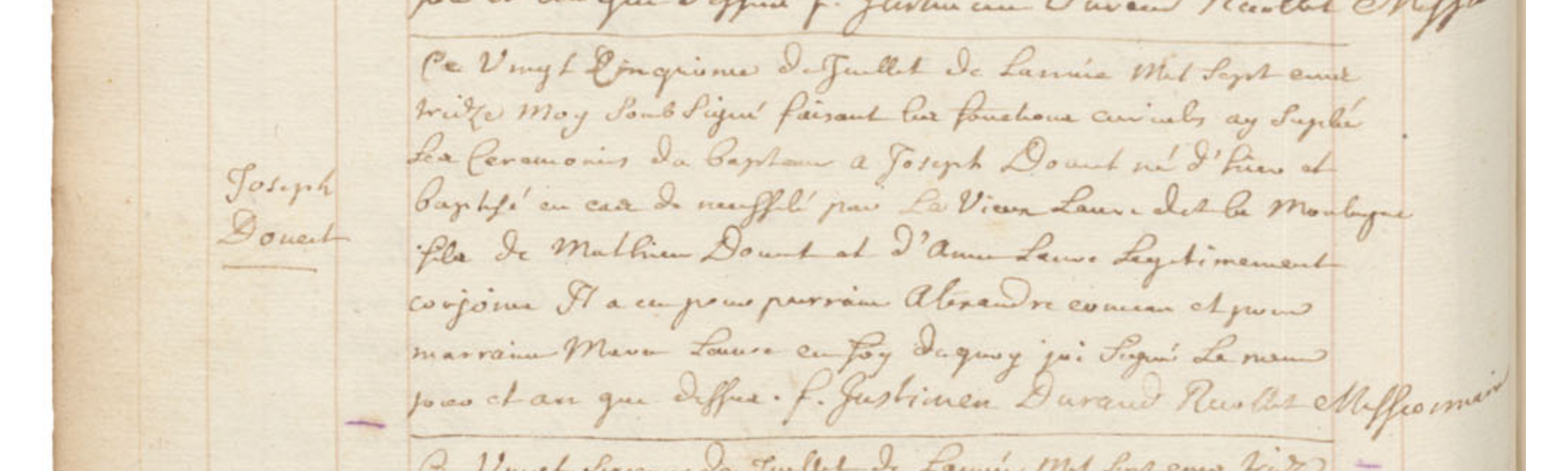
The parish registers also give glimpses of real life then, such as this. Joseph Doucet was baptized immediately at birth, in case he didn't survive, by "le vieux Leure de la Montagne"; this was probably Anne's father Julien Lord dit Montagne; he was about 60 years old (vieux) when Joseph was born. As Joseph (and Anne) did survive, he was baptized by Father Durand the following day.
How Acadians bound their families together and made alliances between many more families (shown in bold below) can be seen with the children of Mathieu Doucet and Anne Lord:
-
Joseph was baptised on 25 July 1713 with his parain and maraine promising to protect and counsel him in life; these were Alexandre Comeau and Marie Laure (variation of Lord). Alexandre was the husband of Mathieu's older sister Marguerite and Marie was Anne's older sister.
-
Pierre, Mathieu and Anne's second son, was baptized on 28 April 1715; his godparents were René Doucet and Marguerite Lord.
-
Anne, their daughter born 14 September 1717, was baptized the next day, her parain and maraine being Jean Savoye (son of Marie Breau and Germain Savoie; the Breau farm was close to Mathieu and Anne's) and Magdeleine Laure/Lord (sister of Anne).
-
Marguerite was the next child born, in about 1719 - the date being uncertain because the birth and baptism record are missing, hence we do not know who her godparents were.
-
Marie Josephe was born on 2 October 1722 and baptized the same day with Joseph LeBlanc and Marie L'Or as godparents. This Joseph was the son of Madeleine Bourg (the Bourg and Doucet families weave in and out of each through the generations) and Pierre LeBlanc. L'Or is another variation of the Lord family name.
-
Elizabeth was born on 31 December 1725 and baptized with her godparents being Pierre Garceau (son of Marie Levron and Jean Garceau) and Elizabeth Levron (daughter of Marie Levron); as before, the Levron dit Nantois farm was nearby.
-
Charles, Mathieu and Anne's last child, was born about 1732; as with his sister Marguerite, the date is uncertain because the birth and baptism records are missing.
These inter-family connections wove more patterns when Mathieu and Anne's children came to marry in later years; for example:
- Joseph married Marie Anne Bourg, daughter of Pierre Bourg and Elisabeth Broussard;
- Pierre married Françoise Comeau;
- Marie Josephe married Jean Baptiste Thibodeaux, son of Claude Thibodeaux and Isabelle Comeau;
- Elizabeth (also known as Isabelle) Doucet married Maurice Comeau, widower of Brigitte Savoie. When she died she was named as Elizabeth dite Doucet; there's a fond memory in that name, I think, chosen after tragedy (what happened to these children is described in In Acadian Footsteps: 3).
The witnesses at each of these marriages add further family threads to this small piece of Acadian weave, as seen with the marriage of Mathieu and Anne (above). Even with just two generations the names become a tangle, drawing the interconnections on paper becomes too complicated; maybe the priests investigating consanguinuity, if and how two young people wanting to marry might be related generations ago, felt the same. Pierre Doucet and Françoise Comeau, noted above, needed a dispensation for a fourth to fourth cousin degree of consanguinity in order to get married on 22 January 1742 in St-Jean-Baptiste, because they shared a great-great-grandparent (Bourg).
From family inter-connections and mutual obligations such as these the distinctive new tribe and ethnicity, Acadian, came into being. And in the years that Mathieu and Anne's children were born and grew up, Acadie entered a golden age. After the repeated devastations of the 1690s-1713 period, the population of Annapolis Royal showed remarkable powers of recovery. In 1720 Mascarene (see Footnotes) observed that:
“from Goat Island to five leagues above the ffort, on both sides of the Brittish [Annapolis] River are a great many fine farms Inhabited by about two hundred familyes.”
But that golden age, of population growth and prosperity, was centred mainly on lands far from Annapolis Royal with much more potential for development. Some of Mathieu's older siblings had moved to these new areas soon after he was born, and they were following in the footsteps of others.
As early as 1671, as the first census was being conducted among the few hundred people in Port-Royal by newly installed French officials, the next steps in growth of Acadie were already starting in the upper reaches of the Baie Française.
The headwaters of the Baie divide into two broad areas, the Chignecto Basin and the more westerly Les Mines/Cobequid basins, each with many branchings and river estuaries. The much celebrated Beaubassin and Grand Pré are two of many Acadian settlement areas in the Chignecto Basin and Les Mines respectively. It is easier to understand the basic geography on a simplified map without the confusion of place names - modern, mid-1700s and earlier - found on most maps. What is also clear is the profusion of rivers entering the Baie; this was a defining and determining feature of Acadian settlement there.
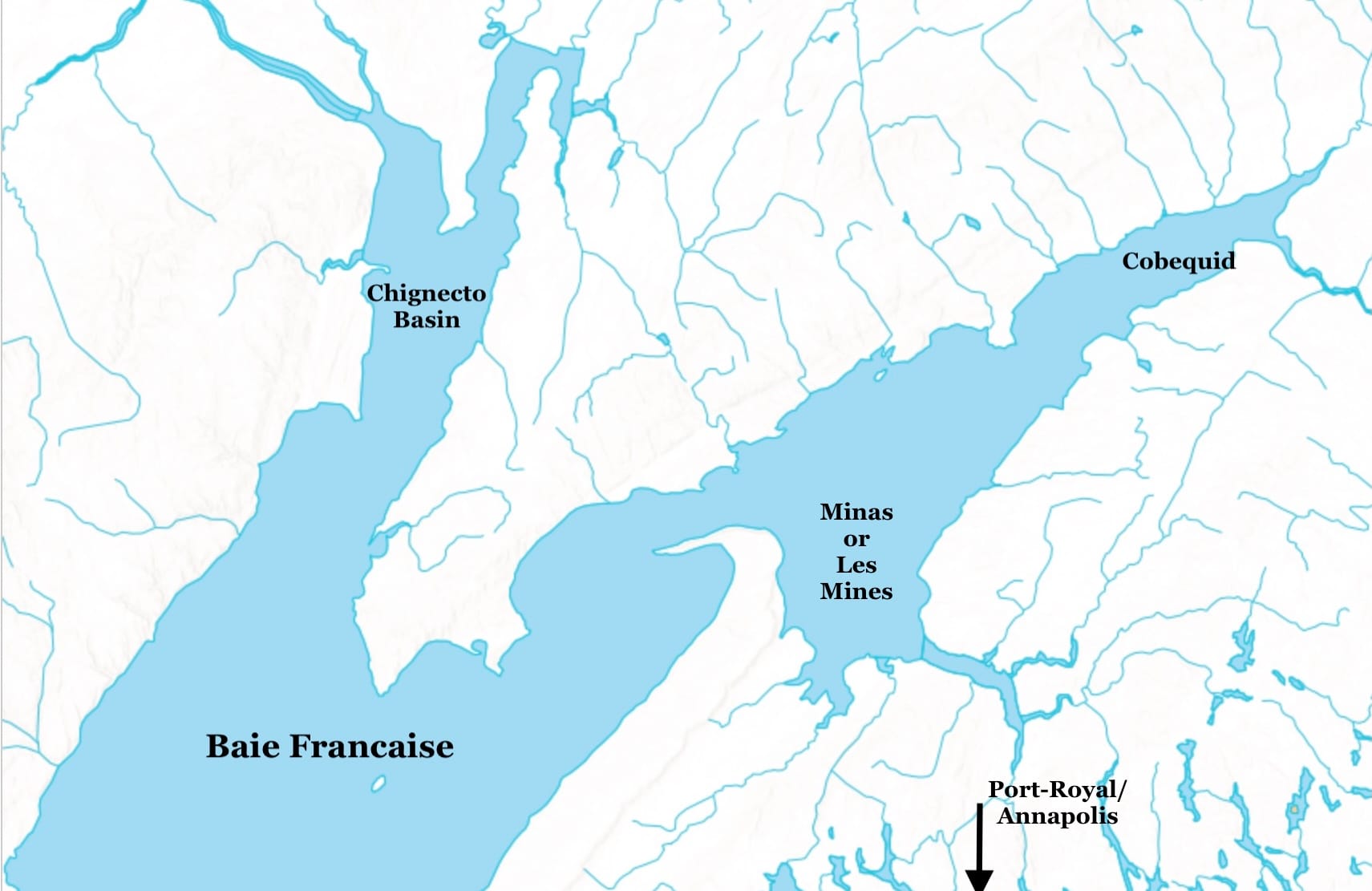
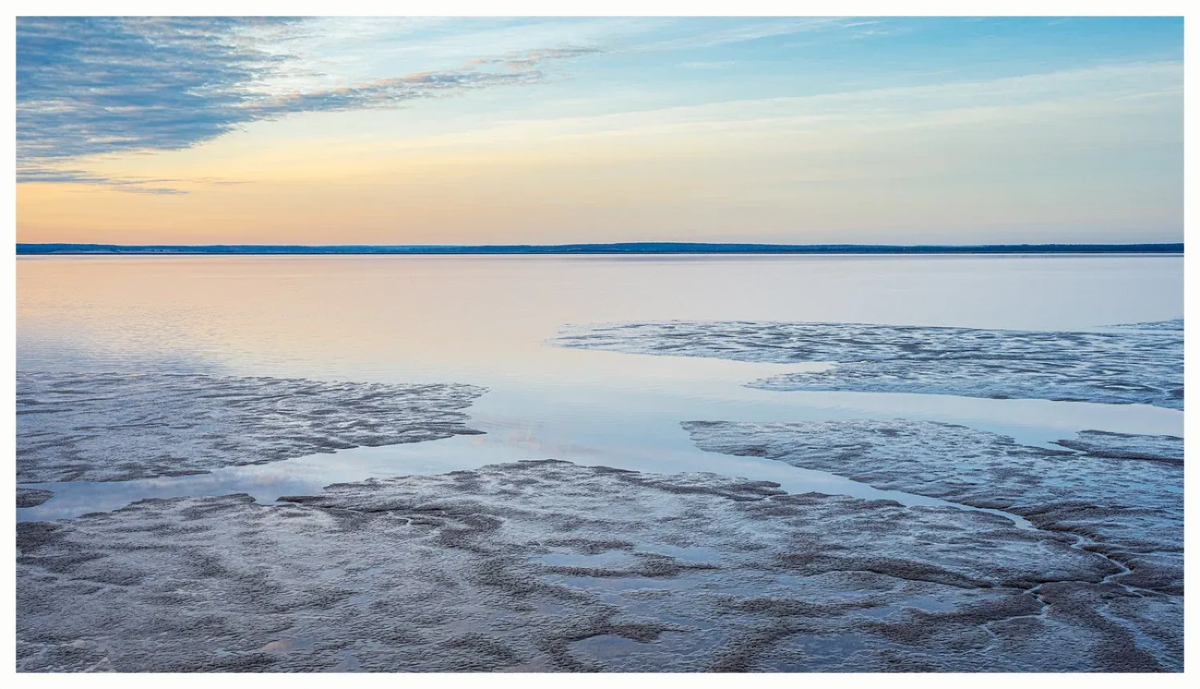
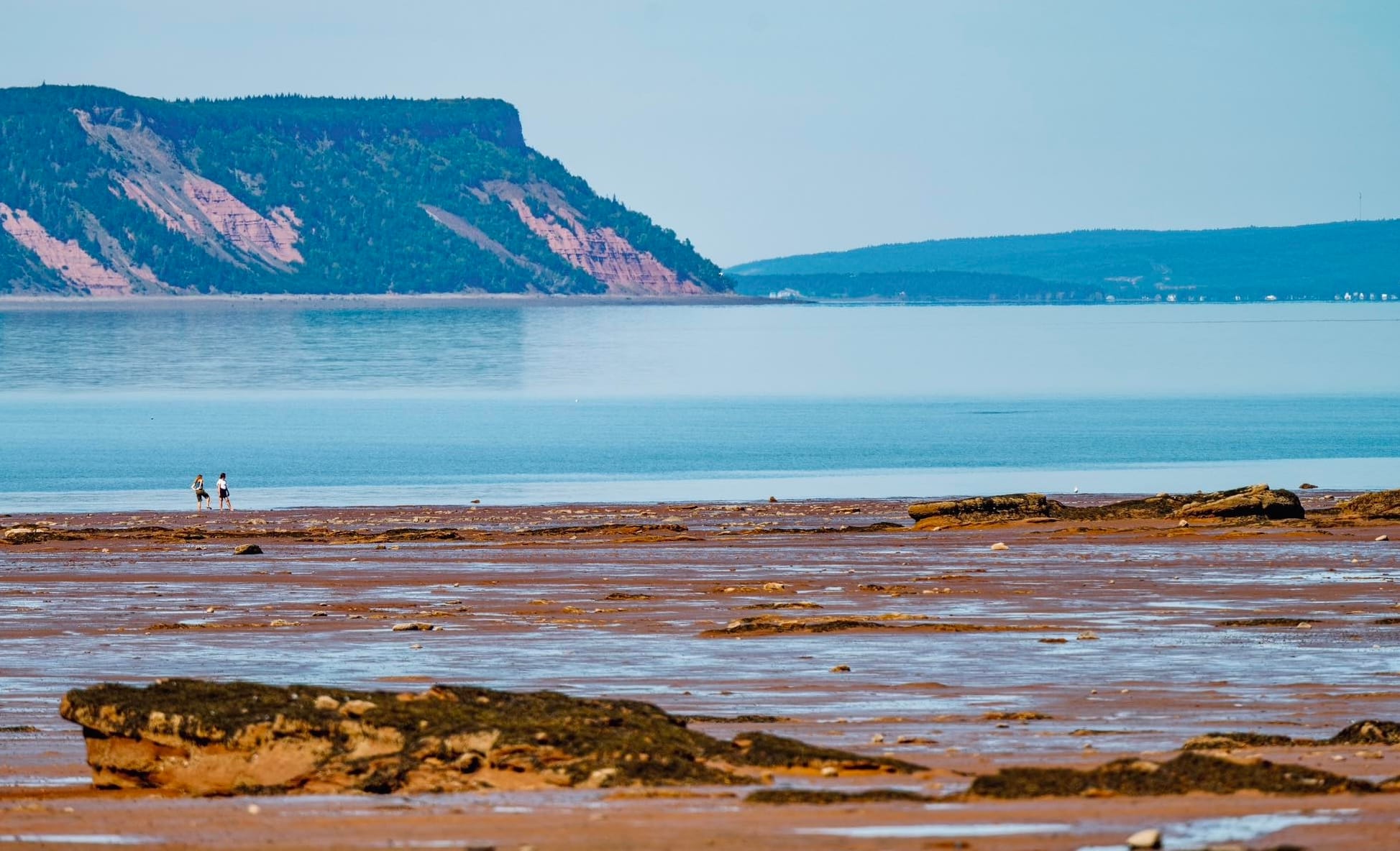
The physical environment is extraordinary and it was undeveloped, without any settled habitation or built features; it must have seemed both daunting and awe-inspiring to the first Acadians looking for the best places to settle and farm. It is a very large area - maps old or new do not convey that, but photographs do. This below is just one part of the Chignecto section of the Baie.
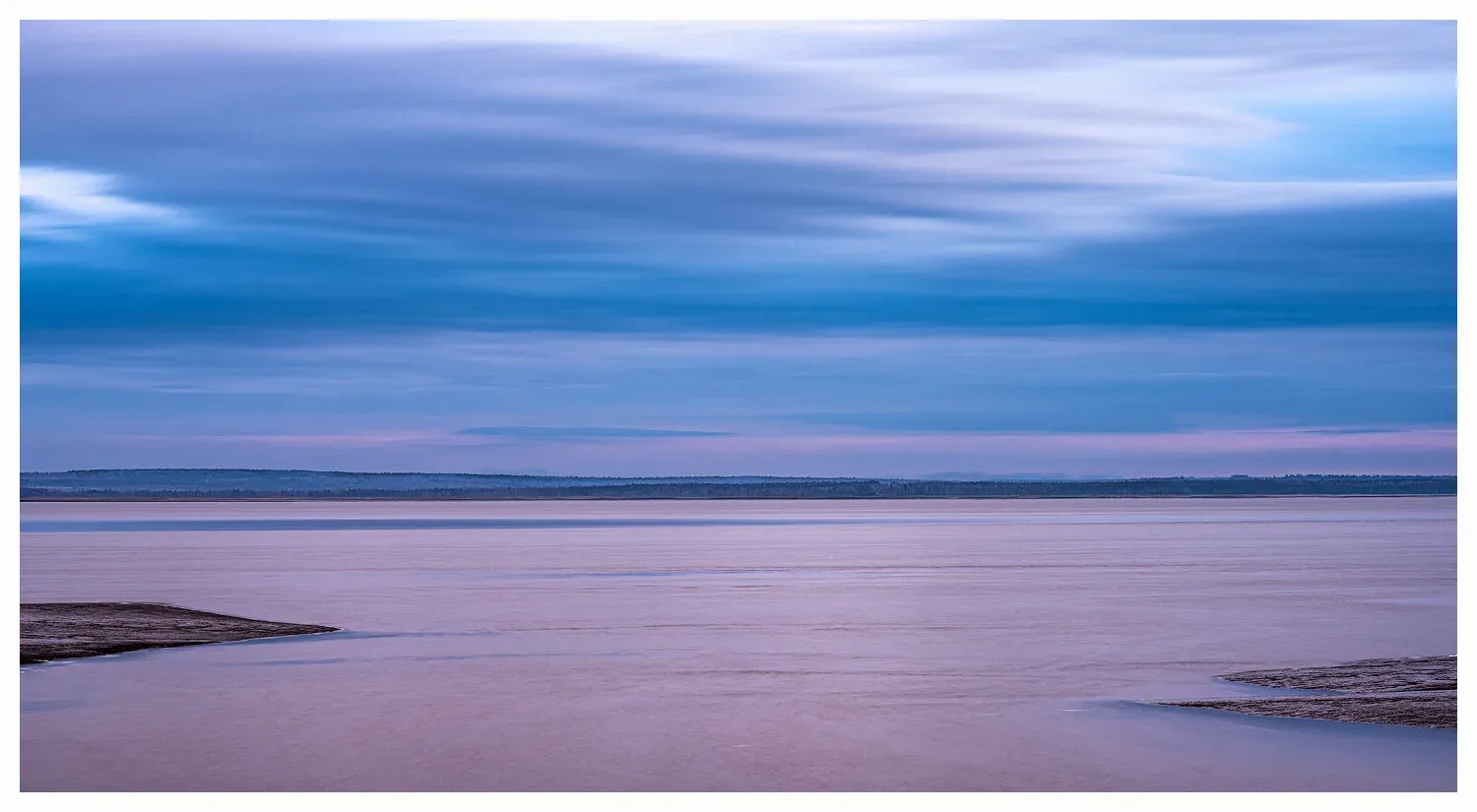
So they arrived there, this bleak, beautiful and unknown place, with only what could be carried in small craft. And found the tides much stronger and deeper than they'd known at Port-Royal. The funnel shape of the Baie Française causes tides to race in and race out with fierce currents around the headlands; these protrude into the waters creating narrow channels and several separate basins or bays. Not an easy place to navigate in small craft, or to land, or decide where to settle.
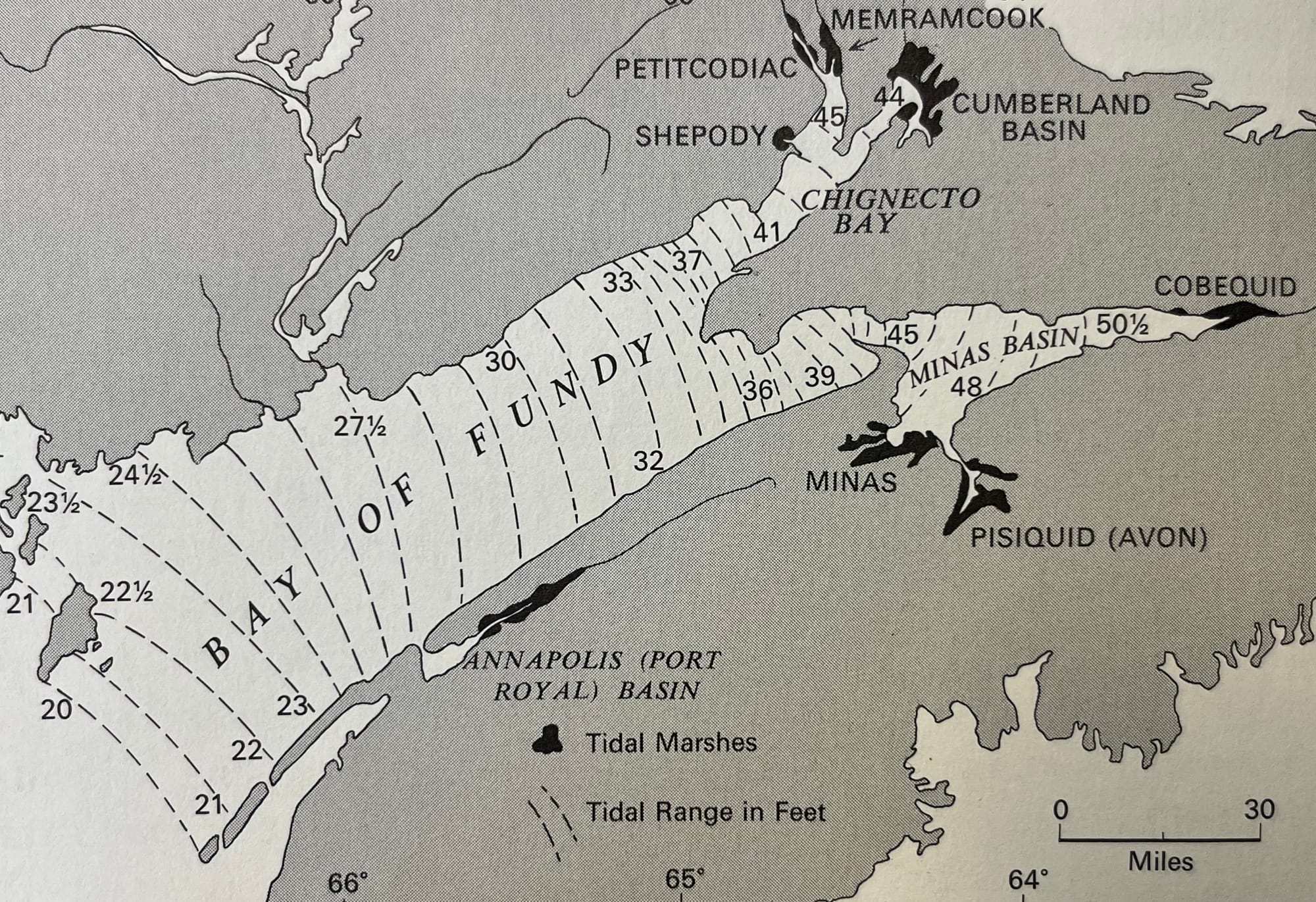
As can be seen, the tidal range - and power therefore - increases dramatically further up the Baie, great outpourings and inpourings of water.
These forces of nature carry great quantities of sediment, eroded from the landforms and brought down by the many rivers. According to the geographer Anthony Clark, sediments may be up to eighty feet deep, and extend to 75,000 acres. Though referred to as marshes and marshland, they are often firm enough to walk on. One area is described in a modern account as:
"renowned for its vast expanses of intertidal mudflats, salt marshes, and brackish wetlands, which are exposed and inundated by some of the world's highest tides, averaging 11 meters and reaching up to 16 meters during peak events. This dynamic coastal environment supports exceptional biodiversity..."
This can be taken as true of all parts of the Baie headlands where Acadians settled and eventually prospered. The first Acadians settling there may have expected that dyking tidal marshland would produce fertile pasture, based on their experience along the rivière Dauphin, but did they know how harsh the climate and physical environment would be?
The long winters, iced-up, snow-bound, extend into spring and start early in autumn with gale-force winds and flooding. The Baie was much more exposed to weather conditions than the Port-Royal area; the tidal range is highest in spring and autumn, with flooding likely between August and November when prevailing winds push up the Baie from the southwest, sometimes intensified by the tail-end of hurricanes. The effect, after long winters, is to extend harsh weather conditions well into the spring, reducing the time for dyking, agriculture, building and most other activities, before autumn sets in.
The headlands and tidal rivers entering the Baie create a very irregular coastline, with many 'islands' of higher ground between riverine marshland, and freshwater bogs trapped behind higher areas. It is an ever-shifting land/waterscape as tides and winds remodel what they have created. Clark quotes observers fascinated by the greenery of windblown marshland grasses seemingly continuous with the green waves of the sea, and the changes wrought by the tides: wide vistas of marshland level with distant sea, transformed within a few hours into waters covering everything almost as far as the eye can see.
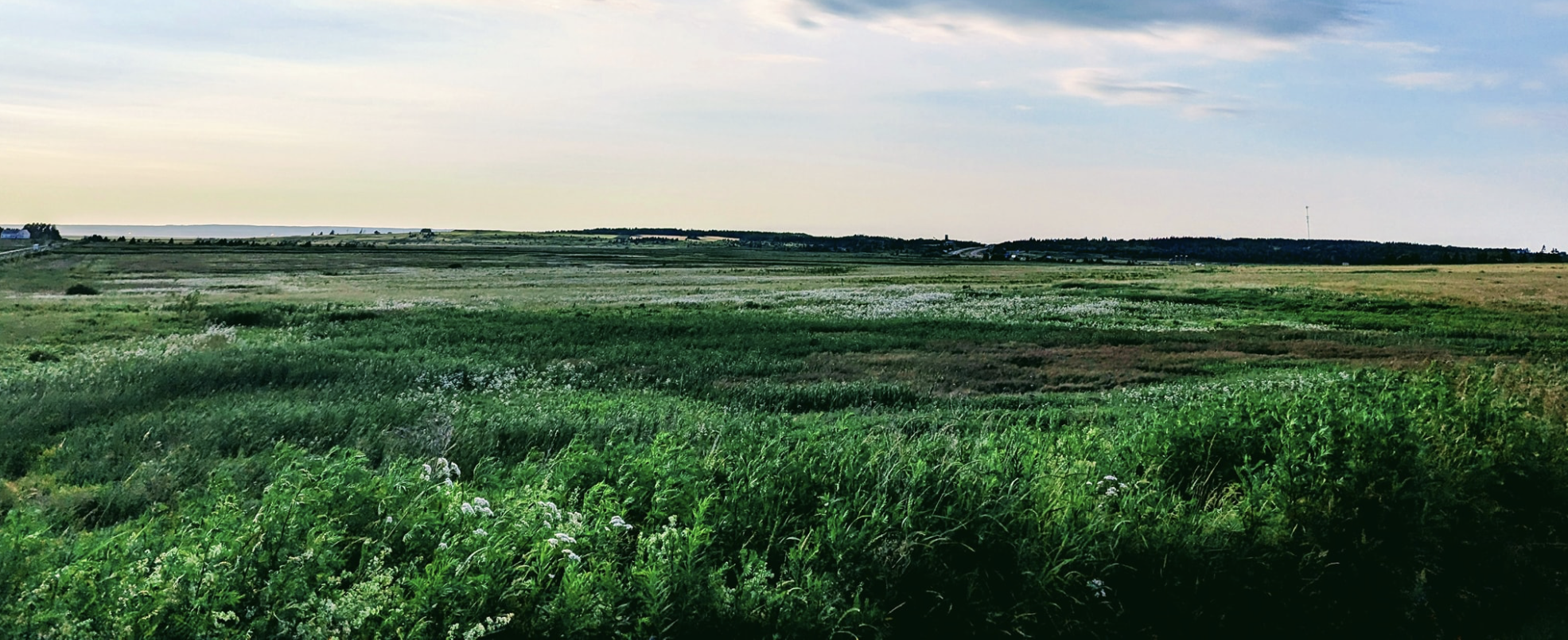
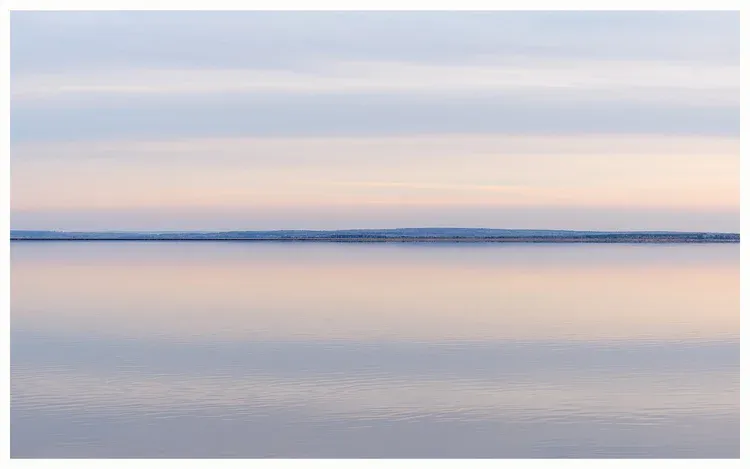
The Mi'kmaq had long inhabited this area in nomadic fashion, with summer camps for fishing and gatherings; it was and is a sacred ancestral place for them. In the long winters they moved inland for hunting and shelter.
They called the area of the westerly branch of the headwaters Sikinikt (meaning 'draining place') which the francophone settlers heard and voiced as Chignecto (after 1755 one section of it was renamed Cumberland Basin). Mi'kmaq place-naming was descriptive of each location's physical features, which were determinants of how the Mi'kmaq lived there; that was true for the arriving Acadian settlers too. The Acadian settlement of Pisiquid was Pesikitk in the Mi'kmaq language, meaning 'to flow splitwise' - that being what was important about that place, as the meeting point of several portage routes. Many years later the British renamed it Windsor, which was irrelevant; they might as well have called it Timbuctoo. And nearby Amaqapskiket, meaning 'big river flowing over rocks', became the (meaningless) Avon River, referencing a very different English landscape (and towns) they had left behind; disconnected geographically and culturally in a way that Acadian occupation of this Mi'kmaq land had not been.
Cobequid meant 'end of the tidal waters' in Mikmawisimk. When Acadians arrived and discovered the rich potential of these areas, they gave their settlements their own gloriously physically descriptive names - Beaubassin, Grand Pré (great meadow) etc. So there is an overlap between the Mi'kmaq names and the Acadian place-names, both expressing the same appreciation of the environment and the physical particularity of each location.
Minas, or Les Mines, has a different origin, so named from French explorers in the first years of the 1600s expecting to find minerals there which could be mined.
Why did some Acadians move away from Port-Royal? And why so early as the 1670s when France had just regained control of Acadie?
The seeds of Acadian demographic expansion were first planted at the far end of the Chignecto Basin by Jacques Bourgeois and two of his sons. His interest was primarily in fur trading with the Mi'kmaq but he persuaded several families to join him voyaging there in 1671 and they set up the settlement that became known, for its beauty, as Beaubassin.
Jacques was well established in Port-Royal, he did not have to make the long and hazardous journey with its uncertain outcome. He already occupied a farm along the rivière Dauphin and there was still much undyked/ reclaimable marshland. It was not coming under devastating attack from les Anglois at that time. The small community there provided support and society, it was the 'known' and what the parental generations had created. Family/familiar. It seems likely that Bourgouis and those who followed his example wanted freedom to trade with visiting New Englanders, anticipating the newly installed French governor and (few) officials would hamper this. Perhaps the taking of a census in 1671 was the final trigger. And more generally the independent, no-man-is-my-master, Acadian character came into play.
"Above all, the Acadians sought to live their own lives in their own way and outward expansion had in it much the same search for freedom and escape from restraint that sparked so much of the westward movement by other European settlers..."
They had a wonderful arrogance, our ancestors.
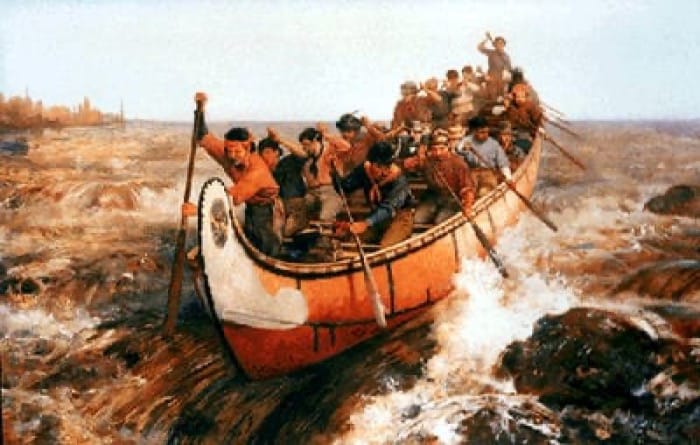
This needs a great effort of imagination, ours. It is so easy to read the words and not really comprehend what these people encountered and then achieved. Very few of us today will have paddled for weeks through rough waters, with all we own on our backs and children beside us, to a vast unknown and uninhabited territory, intending to stay and make our lives there. A one-way, sink or swim, no-going-back journey. And they did so willingly, not driven to it out of desperation, with courage and confidence.
"travel within Acadia was both commonplace and time-consuming, an everyday matter and yet an exhausting undertaking. De Meulle [see Footnotes] recorded that the journey from Beaubassin to Port-Royal by sea could easily take twelve days in the best of circumstances and the overland route during the winter could well take a month..."
"...the enormous space that the Acadians confronted ... distances that had to be measured in the time it took to travel them and the dangers that had to be faced"
In a land of water and trees, it was these two abundant natural elements that provided the means of transport. For the construction and use of birch bark canoes, the Acadians were blessed by the advice and example provided by the Mi'kmaq. Canoes were the every-day form of transport and carrying loads within the Port-Royal area. A missionary priest wrote in the mid 1600s that "they handle them as skilfully as our most courageous and active Sailors of France... crossing vast seas without compass". For longer distances larger canoes and boats of the fishing-skiff type were also used, especially for moving heavier goods. Chaloupes (shallops) of various design and size were much used in later years; the smaller ones could be rowed as well as sailed.
Maps belie the great expanse of these areas. For Europeans then and now, used to smaller and more populated landscapes, it can be hard to grasp the sheer scale of distances and the emptiness which confronted Acadians venturing there. Their fortitude and confidence astonishes me.
The Beaubassin settlement grew and flourished, attracting more Acadians, although Jacques Bourgeois, a restless, entrepreneurial man, travelled back and forth to Port-Royal. Bourgeois built a flourmill and sawmill, and the settlement traded with New Englanders for materials they could not produce. De Meulle, visiting as early in the settlement's life as 1685/6, was impressed by the vast extent of meadows which could support a great many cattle, the resources of the forested uplands, and the twenty or so farmsteads with barns and outbuildings for over-wintering animals, each with ten to twenty cattle, a dozen pigs, a dozen sheep.
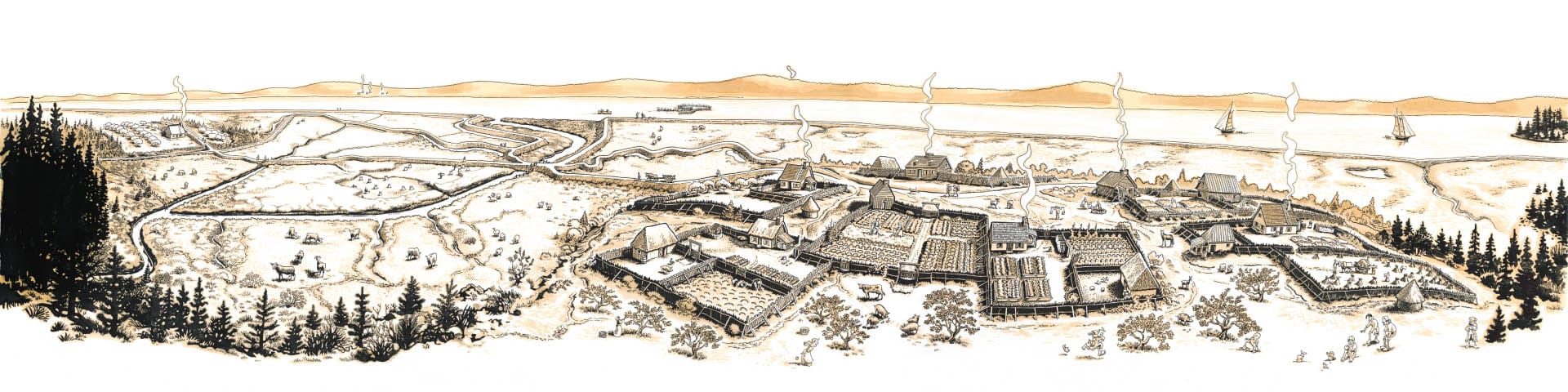
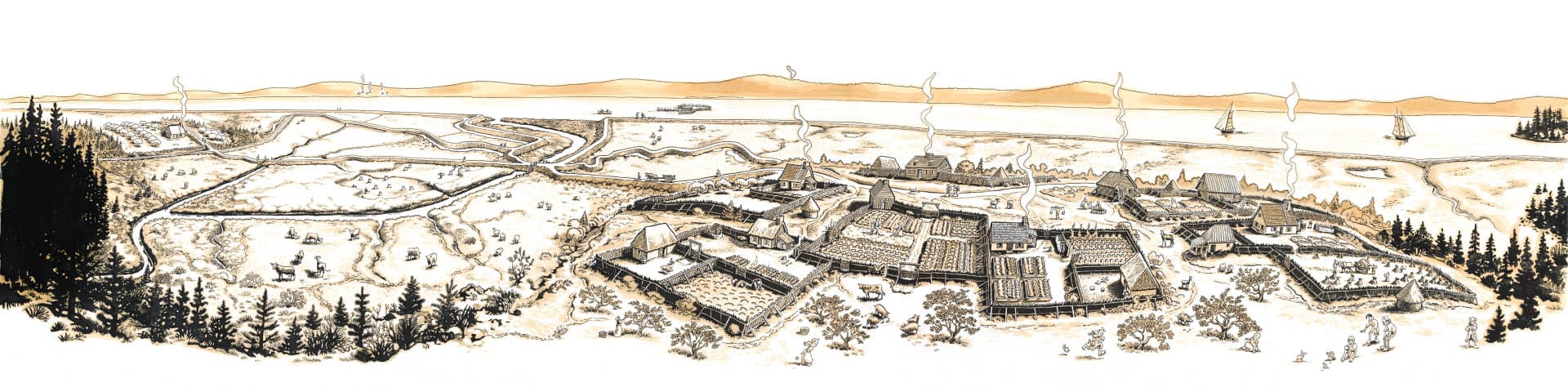
Wherever Acadians arrived at the head of the Baie, likely the first places settled were on terrain that was easiest for dyking by the few people there initially, streams and small rivers, with houses and gardens nearby on slightly higher land. The first settlers were sustained by rivers full of fish and hunting in the wooded uplands. Then, as numbers increased, larger areas of sea-bordering marsh could be dyked and houses and barns built on higher ground inland as this was gradually cleared of forest in the (efficient, multi-benefit) process of obtaining timber for buildings and boats. The natural divisions of marshland by streams and rivers meant that each family group could choose an area which became over time an extended family hameau or hamlet, separate but with near neighbours for larger dyking projects.
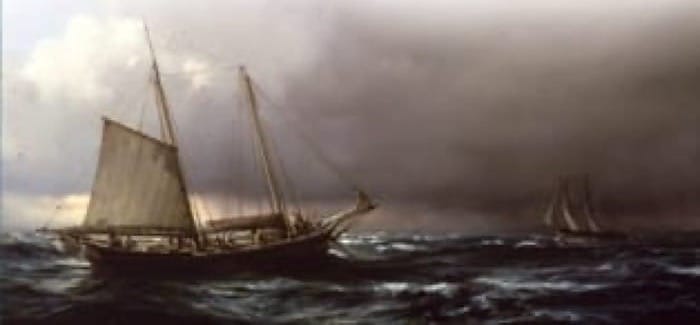
In the Minas area settlement was started later than at Beaubassin, in 1682 by Pierre Melanson and Marie-Marguerite Mius d’Entremont, and other couples and families, around a very large area of tidal marsh that became known as Grand Pré. The Minas bay is approached by sea through the narrow, tidal-race waters formed by Cape Split and Cape Blomidon (called 'Blowmedown' by later English sailors), both magnificent to see (modern photograph here) and surely dangerous to navigate past then (second, old picture).
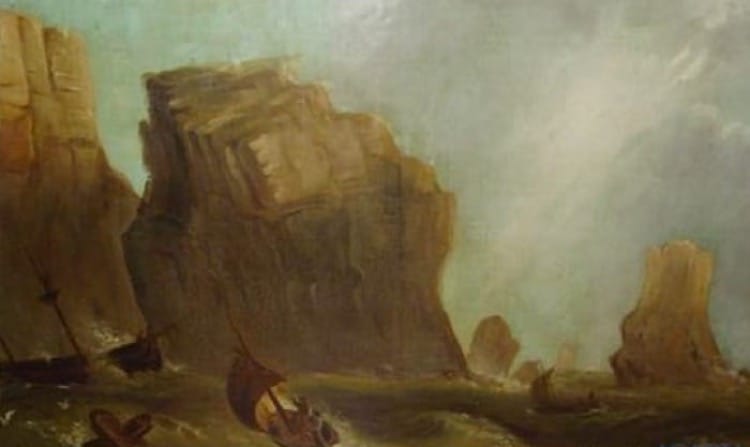
French officials forbidding trade with New Englanders and instituting censuses in Port-Royal very likely prompted Melanson to leave and set up home in a new place, freer from 'authority'. During the first census in 1671 in Port-Royal, the census-taker recorded that he "refused to give his age and the number of his livestock or lands" and "his wife told me that I was crazy to run through the streets asking for these things."[tr]
Le Blanc and Landry family members joined the Melansons at Grand Pré. Four years later there was another family there and seven families nearby on the St-Antoine river, 57 people in all. Four of the five farms had a total of 83 arpents “under cultivation” - presumably dyked.
"Altogether it was a remarkable start in four years. Rapidly the word spread and settlers came in from Beaubassin as well as Port Royal. In the winter of 1687/88 Gargas [census-taker] guessed 'about thirty families' there 'where all the young people from Port Royal [are] settled.' "
There is a delightful and very informative map of the Minas/Grand Pré area.
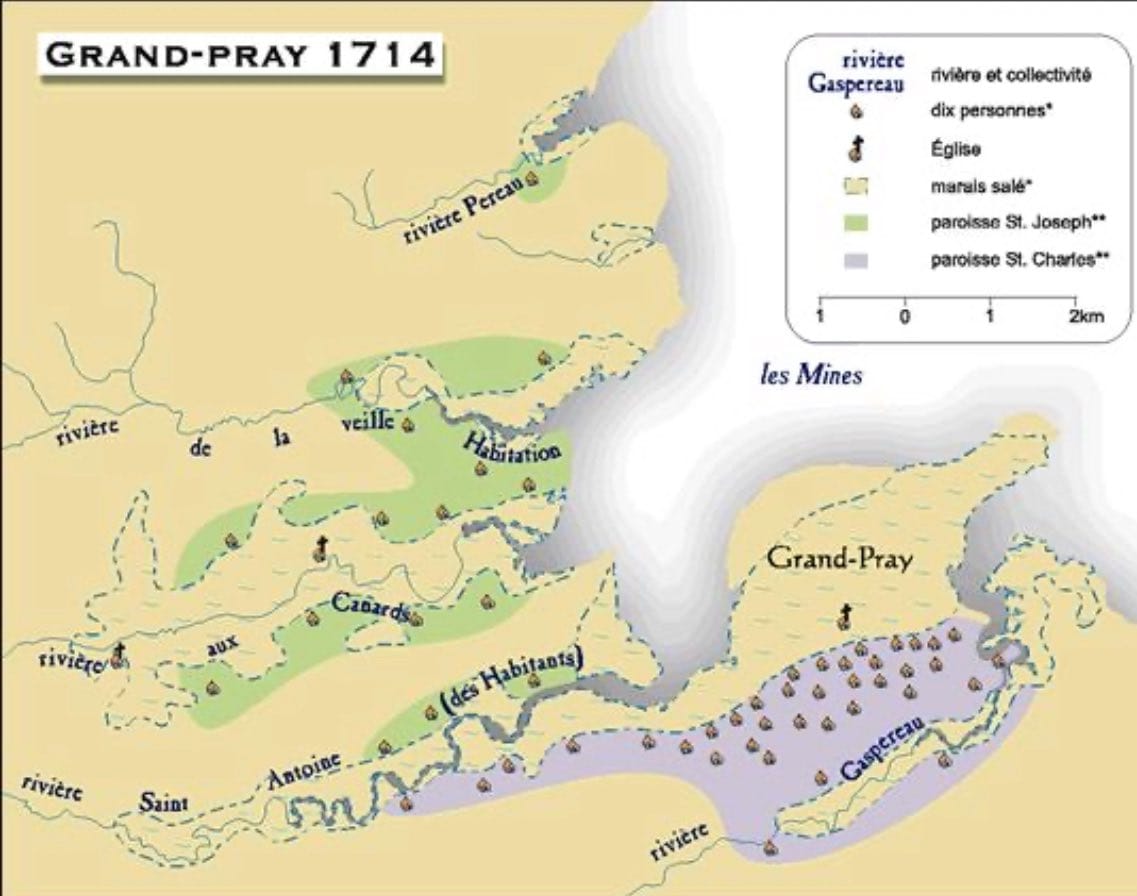
By 1714 Acadians there had established two churches and parishes. I have drawn attention to all the hardships they encountered, but these new places at the head of the Baie were not bare-bones, subsistence-level settlements. They were not people who had moved to a wilderness and lived an unregulated life, couples shacking up together. Many of them were young. But they took their Acadian culture and practices with them; marriages were recorded, parents of the new partners were noted and relatives and friends signed as witnesses; children were baptised into the Catholic church with parents recorded and godparents signing onto their duties. In each new settlement, the few first Acadians created functioning, rounded communities of inter-related families.
As more Acadians arrived, the Minas settlements extended upriver to land forming a small bay called Wecobequik or, as it was later known, Cobequid. The low terrain offered the same potential for reclamation of land.
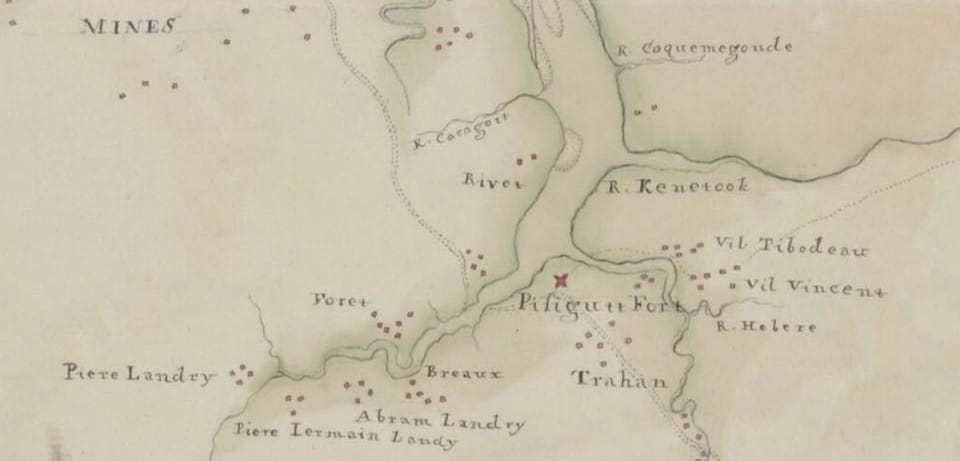
It was similar with the settling and development of Pisiguit, further inland where the rivers were smaller. The community grew quickly, there was much marshland for dyking and cultivation, within a few years wheat was produced in abundance and there were plenty of cattle. This hand-drawn map (undated) shows the pattern of family hameaux on river banks, a small community of 'independents' that were interdependent. Among the family hamlets, at a later date there was a Ville Doucet.
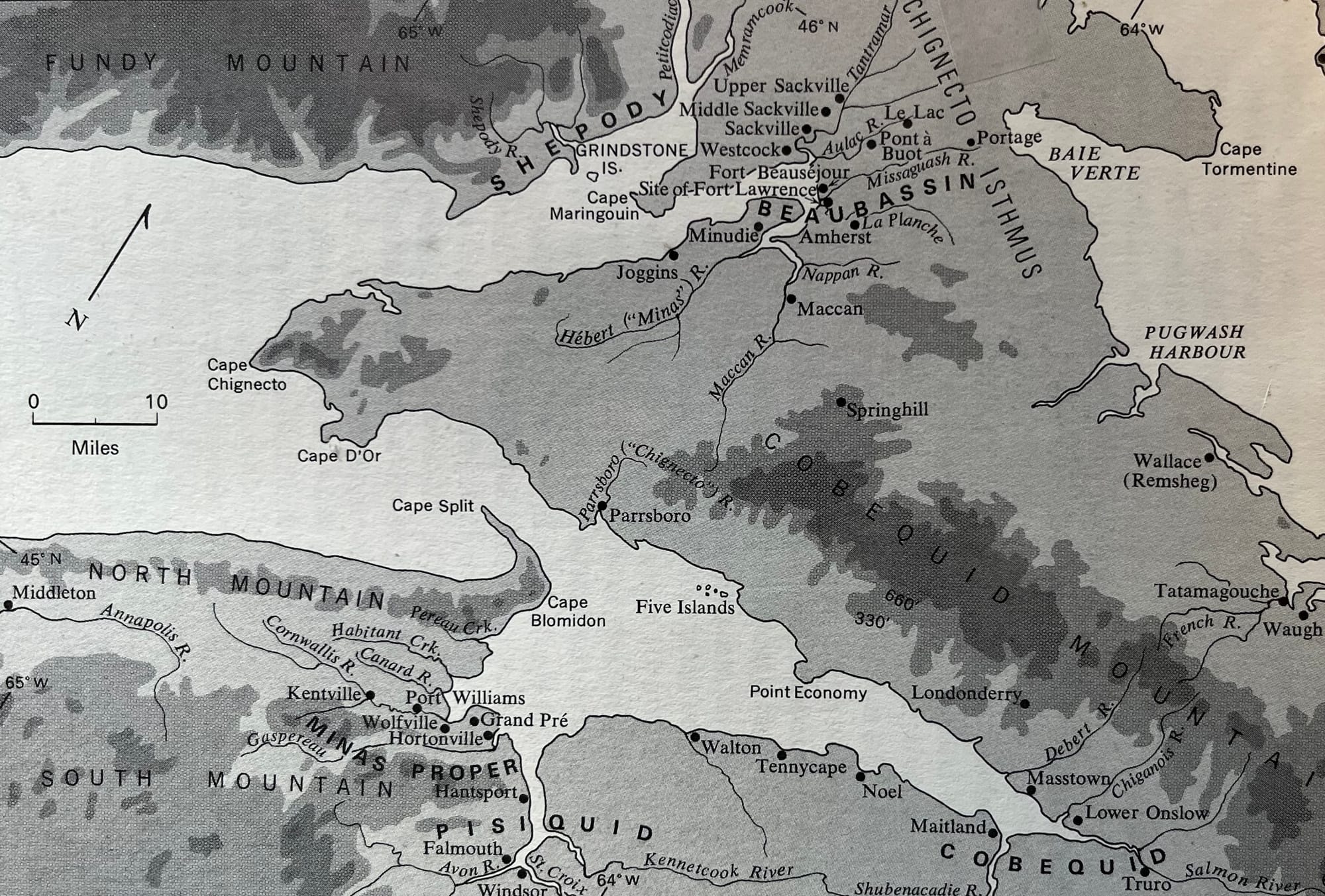
This map below locates the Acadian settlements described, and includes later, 18th century names.
Visiting in 1701, de Brouillan, who later became governor of l'Île Royale, was impressed by the prosperity of the Minas settlements. They had "... a great number of cattle and were able to export seven or eight hundred hogsheads of wheat a year." He was less impressed by the inhabitants, who seemed to be "a demi des republicains" and "most independent in character and accustomed to decide matters for themselves."[tr]
The small population in these new settlements in the early years was increased somewhat by migrants from further afield. The 1686 census includes some who came to Chignecto from Québec and whose names do not appear in the earlier Port-Royal census. After this the Baie settlements probably grew largely by natural increase; the family names in the 1693 census were still mainly those recorded in Port-Royal in 1671.
These settlements grew quickly, and spread to new locations. In the western part of Chignecto Basin a settlement was started in 1698 by Pierre Thibaudeau at Chepodie, a summer camp-place for Mi'kmaq and Malecite - another case of Acadian/indian accord; there were seven Acadian households there by 1702. The Blanchards and other families made settlements nearby along the Petitcodiac river and Memramcook valley, the so-called trois-rivières settlements of Chepoudy, Petitcodiac and Memramcook. By 1734 there were 65 Acadian families along these tidal marshlands.
Censuses continued to be carried out. These started to distinguish different parts of Les Mines as early as 1701 as families developed land-holdings on the banks of the many rivers flowing into the bay. There were Acadian families named in the Rivière Ste Croix, Rivière de l'Ascension, Rivière Kiniscour, St Antoine, des Gaspereaux areas of Minas, and settlement had spread further to Cobequid.
These places at the head of the Baie Française, with their fabled, evocative names - Beaubassin, Grand Pré - thrill the heart (or is it only me?), and they went on to become the proud, prosperous and independent centres of Acadian life. In the early 1700s:
"The perhaps two hundred houses of Grand Pré were spread out over two or three miles along the northern slope of the ridge that descended gently from the height of land near the Gaspereau valley to the edge of the great thousand-acre marsh... the settlement took its name from the marsh but the houses and other buildings were well above it on permanently dry land."
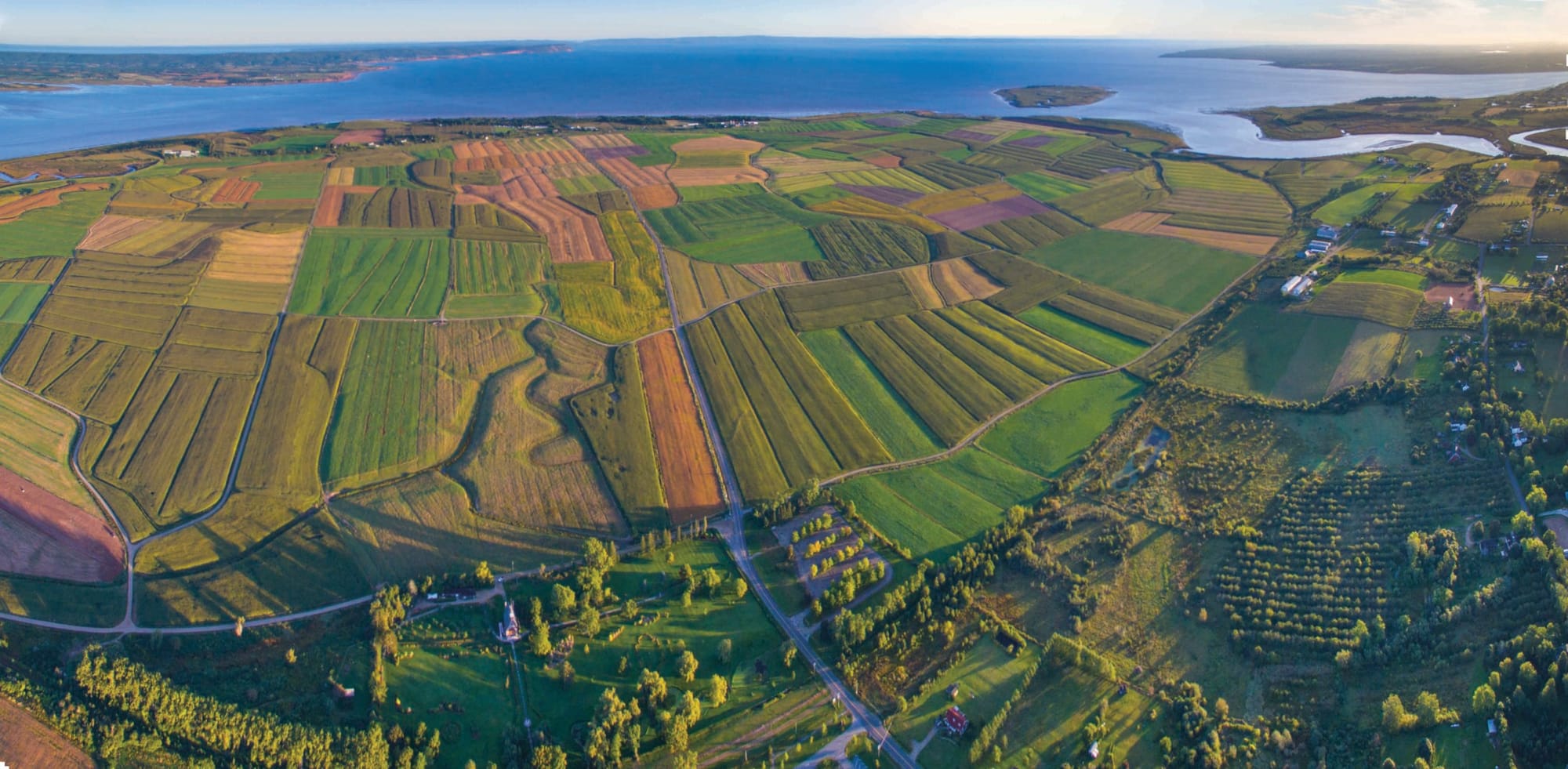
Grand Pré with its thousand acres of tidal marshland reclaimed became the largest single settlement. It impressed a British officer with its great agricultural productivity when he visited. He noted: "This place has a great Store of Cattle and other conveniences of life... they catch... a kind of fish, the blubber of which turnd into oil, yeilds a good profit."
A contemporary New Englander described Beaubassin as a panorama of ridges rising like islands in a sea of grassy marshland:
".. one of the most Beautiful prospects the Bason of Chignecto affords in Summer for which cause it is called by the French Beau Basin here may be seen a Number of Villages divided from each other with long intervals of marshes and... Hills covered with Trees... Rivers turning and winding among the Marshes then Cloath'd with all the Variety of Grain".
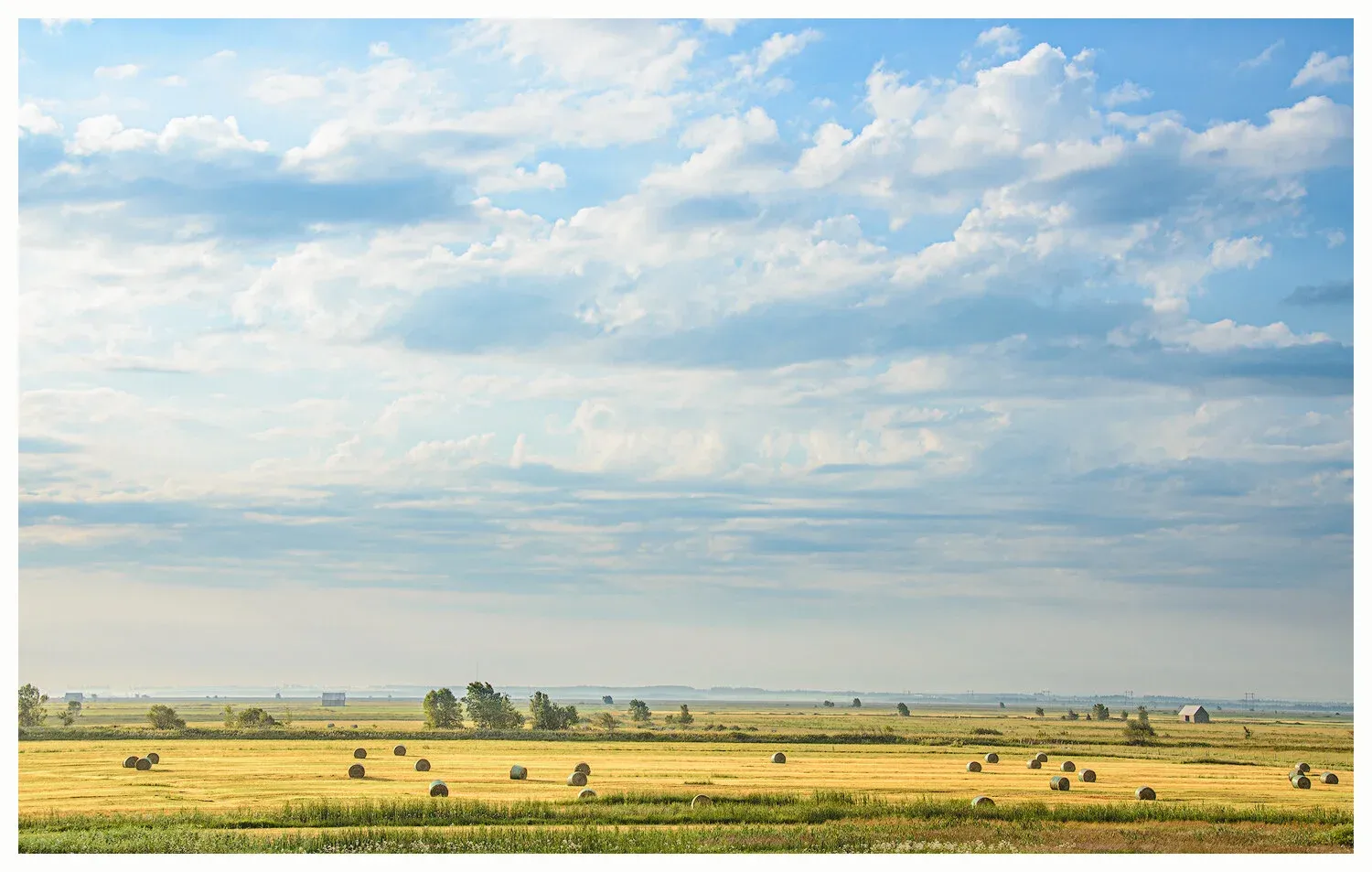
A present-day photograph, of course.
The English and New Englanders were in awe of these Acadian settlements. They visited frequently in the early 1700s, sometimes aggressively to seek oaths of loyalty, and destructively, sometimes covetting how much Acadians could produce, but always marvelling at where they had chosen to live and thrive.
Variations in aspect and exposure, weather and soil conditions between the various locations favoured cultivation of different crops or animal husbandry on a large scale, but for local consumption almost all foodstuffs were grown in all settlements. By the 1720s Minas had become the grain-growing centre of the area, while Beaubassin specialised in livestock.
These large and fertile settlements at the head of the Baie were where the Acadian population expanded most. The census of 1714 had recorded 530 people in total in the Minas Basin settlements, Grand Pré with 287 and four other riverside settlements adding several scores of people each. Twenty years later there were over 2,000 people in Minas alone, and each settlement area of the upper Baie exceeded the population of Annapolis Royal.
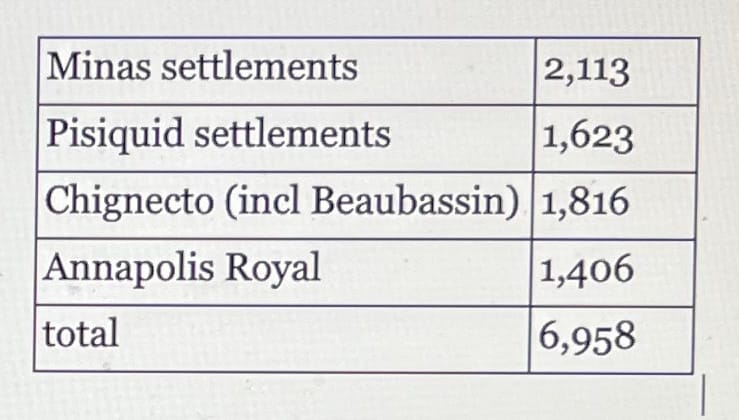
1737 population of Baie settlements and Annapolis Royal
adapted from Clark
The Acadian population in 1737 was likely greater than the total of 6,958 recorded by census, with some people away from home engaged in fishing, hunting or fur-trading with the Mi'kmaq, or simply evading the census, suspicious of authority - and how could the census benefit them?
"During the years between 1720 and 1744, the Acadian population more than doubled, giving it a critical mass sufficient to develop and preserve its own unique community identity. The kin relationships between various Acadian villages [were] the most important connective element of the society".
Richard Philipps, Governor of Nova Scotia, writing in 1730 marvelled at "the great increase of these people, who are at this day a formidable body and ... spreading themselves over the face of the Province".
The demographic growth came from the high procreation and low infant mortality of a people living in healthy surroundings with healthy diets and routines of hard physical work. Where they lived was relatively isolated and free from the epidemics which afflicted sea-board mercantile communities and the New England colonies further south. Among the reactions of New Englanders there was envy and admiration; Robert Hale from Massachusetts, trading with the Acadians at Beaubassin, observed in 1731 their "substantial and diverse diet" from the farming of reclaimed dyked land.
"They grew wheat and peas, cabages and turnips, and other vegetables on their reclaimed fields. They grazed cattle and sheep on their pastures, and raised hogs and poultry around their homesteads. They pulled cod, bass, salmon and shad from the waters surrounding them. They ate well... their diet was rich in protein and fat as well as stone-ground whole grains, and included plenty of cabbage and turnips, and fresh fruit and vegetables in season."
By the 1730s, visitors noted that "most of the Acacadian communities were well established settlements of well-built and well-furnished houses" and "the French entertain'd us with much Civility and Courtesy".
Dykes, the agricultural productivity and prosperity they allowed, also gave Acadians the economic power and freedom to ignore, argue with, contest British claims of dominance, to assert their independence and difference. What did Acadians in the 1700s need from Britain and New England? Nothing except trade, which they could often do from strong bargaining positions. What did they get from France (New or Old)? Nothing.
In these places, more remote from the Atlantic, Acadians were less under the eye of whichever officials, French or English, occupied the capital Port-Royal/Annapolis Royal. They were freer to trade with New England merchants, with the Mi'kmaq and with the French in l'Île Royale and Québec.
The story of this second, larger area of Acadian development can also be told through the lives of Mathieu's siblings and, in the next Footsteps story, through his children. Like many of the second/third generation of Acadians, most of Pierre and Henriette's children had moved away from congested, contentious Port-Royal and established families in the Minas, Beaubassin and wider Chignecto areas before Mathieu, the youngest sibling, had grown up.
Marie Anne, Pierre and Henriette's first child, married, age 14, to Jean Hébert, 22, in 1676. She was the first and earliest of the Doucet children to move away from Port-Royal. They moved to Les Mines/ Minas at the head of the Baie Française in 1688/1689. Like Marie Anne's mother Henriette, Jean was one of the first generation of children born in Acadie; he was born in 1653, his parents being Antoine Hébert and Geneviéve Lefrance, both thought to have been born in France; their birth dates, parents and when they arrived in Acadie are uncertain.
Marie Anne and Jean had fourteen children that we know about. Their first six children were born in Port-Royal (Catherine was the sixth in 1688) and their seventh, René, in 1689 in Grand Pré. Birth places of later children state Les Mines or Grand Pré or unknown.
The 1693 census for Minas records Jean Hébert, aged 40, living with his wife, Anne (Marie Anne) Doucet, aged 32, and their seven children: Jean (this was Jacques) 15, Matieu (Pierre) 13, Jacques (Jean!) 11, Pierre (Joseph) 9, Genevieve (Jeanne) 7, Anne (Catherine) 5, and Christophe (René). The family owned 1 gun and lived on 11 arpents of cultivatable land with 12 cattle, 12 sheep and 6 pigs. The 1701 census has fewer errors, and gives their location as Rivière-St-Antoine at Les Mines; they had more livestock (20 cattle, 30 sheep, 12 hogs) and less cultivated land (8 arpents), and 3 guns.
Marie Anne was widowed some time between the 1703 and 1707 censuses, age about 46 with seven children still to look after; the last child born to Marie Anne and Jean was in 1706 suggesting his death in 1705/6. Marie Anne died on 3 November 1710 aged about 49 and was buried the next day at Saint Charles des Mines, Grand Pré. There were some older children still in the household, but what happened to this parentless family subsequently is unknown. Three of the last five children were recorded as "anonyme", indicating that they died before being baptised. When Marie Anne died, the two surviving youngest children (Anne and François) were about eight and six years old.
Despite having that hard start in life - their mother ailing, still getting pregnant and birthing three siblings who died, then their mother dying - both these two youngest children went on to marry and have long lives. Anne had four children with Jacques Saulnier, the youngest in about 1746 after which no more is known. Her brother François had six children with Anne Bourg (daughter of Michel Bourg and Elizabeth Melanson - more interweaving) and is known to have lived until at least 1755. Anne Bourg (sometimes Marie Anne as baptised - more confusing) died in 1756, aged about 50.
Toussaint, Pierre and Henriette's first son, moved in his early 20s to Beaubassin where in 1690 he married Marie Caissie, the first child of Roger dit Jean Caissy and Marie Françoise Poirier. Roger is thought to have been Irish, 'Caissie' being a francophone version of Casey or Kesey - an example of the inclusive, mixed nature of the early Acadian population.
The Caissie family is a particular example of the development of Acadie geographically and, in its mindset or culture, the determination to be free of the feudal obligations of 'old' France. Marie, her three younger siblings and her parents had moved to Beaubassin together in March 1682 when she was about 12 years old. The land which the Caissie family took on was claimed by a man who had established himself as the seigneur of Beaubassin and demanded they (and other families there) occupy the land on a feudal basis, owing him unpaid labour (the corvée of feudal France). However, a few Acadian families had already started to dyke, reclaim and farm land there as early as 1671, before the seigneur arrived. The eleven families involved in contesting his claim to seigneurial dues, including the Caissies, won a court case in Québec entitling them to contract-free, non-feudal occupation of their farms.
That these Acadians, the first to undertake the heavy manual work of turning marshland into productive fields in a vast previously unoccupied area, were able to combine to defy a seigneur and put together a successful court case (travelling many miles to Québec to present it?) adds a remarkable dimension to what we know of Acadian character.
As one of the first settlers of Beaubassin Roger Caissie became well known, his branch of the family distinguished in years to come as 'dit Roger'. The Caissie/Poirier homestead was situated on a hill that bore his name, la Butte à Roger, overlooking the Missaguash river. Here it is, in a contemporaneous picturing and a more modern, quite different version.
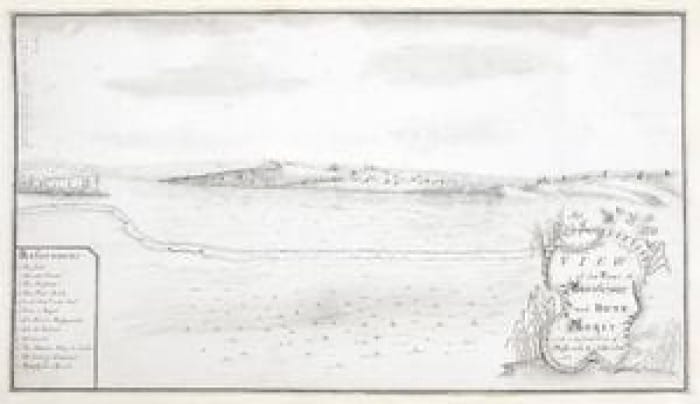

Toussaint was commonly known as François, but also appears in censuses under his baptismal name. On moving to Beaubassin, he had married into a well established family. The Caissies already had six children and went on to have one more.
By 1690 Marie was age 31; Toussaint/ François was 37 when they married. Between 1692 and about 1715 they had eleven children, the first two named François and Marie, others named Pierre, Anne, Marguerite (two children given this name) and Madeleine. Three of the other children died young: Marie had three sons between 1704 and 1707 who died, possibly as newborns as no baptismal names are known; they are absent from the 1714 census. The grief of losing three little children like that.
Two of the children were named Marguerite, which seems odd; this sometimes happened when the first had died in childhood but both these Marguerites lived well into adulthood. The second Marguerite is thought to have been born around 1715-1717, after the 1714 census. When she married François Bourel on 4 February 1748 in Beaubassin her father was noted as Jean Doucet, and Marie Caissie her mother.
Toussaint/François and Marie, already in their 30s, may well have had help from the Caissie family in the hard labour of establishing their own farm, creating dykes and waiting for reclaimed land to become fertile; it seems they did not have the easier option of living on the parental Caissie farm. The Acadian collective ethos may have lent them a hand, as it did in many cases. Brook Watson, an Englishman, made the general observation in the 1730s:
"The whole village worked to help settle the newly weds...They built them a house, they cleared a plot of land sufficient for its immediate use, and provided them with cattle, pigs, fowl; and nature, aided by their own industry, soon placed them in a position to begin helping others."
However they did it, by 1693 the new Doucet/Caissie farm had 10 arpents of cultivated land (the parental Caissie farm had 16 in that year's census); in 1698 the new couple had 13 arpents (and four children), by 1700 14 arpents (and six children). By 1707, the last census in which farm sizes were recorded, the Doucet farm had decreased to 8 arpents, as had the parental Caissie farm. What had happened is probably that their farms and many others in settlements in the Baie Française were still recovering from particularly devastating raids several years earlier by New England soldiers.
In 1704 the governor of Massachusetts instructed a force of over 500 men to use "...all possible methods for the burning and destroying of the enemies' houses and breaking the dams of their corn grounds... and make what spoil you can upon them, and take away the prisoners".
The New Englanders burned buildings, killed inhabitants, looted their household goods and slaughtered their livestock; over 200 cattle and other animals were killed. They broke down dykes to flood the fields. Acadian settlements at Grand Pré, Pisiguit and Castine were also attacked. The French governor of Acadie at the time reported that the English stayed at Beaubassin nine days without drawing any supplies from their vessels, which means they lived off what they looted; those Acadians not killed were left with empty houses and barns, nothing except the clothes on their backs.
Benjamin Church, leading the military forces, reported afterwards that much of the Acadians' grain stores had been destroyed and the inhabitants suffered famine the following winter; could these events have been related to the early deaths of three of Marie and Toussaint's sons?
There had been English attacks on Beaubassin previously. In 1696, several hundred New Englanders in small ships arrived and landed unopposed; after some questioning of the inhabitants' loyalty, despite their protests of neutrality, the New Englanders caused great destruction to the undefended villages. Benjamin Church (him again) wrote that the Acadians' "cattle sheep, hogs, and dogs" were left "lying dead about their houses, chopped and hacked with hatchets" by his men. The church and some of the houses were burnt.
To read of this is shocking, the delight in causing such hurt and harm, the hatred of - of what, innocence? difference? independence?
There had been another attack in 1702:
"The Acadians were in arms and an indecisive skirmish ensued. After the Acadians retreated into the woods, Church and his men found that the inhabitants had removed as much of their household and farm goods as possible. Church set the buildings on fire... and killed about 100 cattle before leaving to return to Boston."
When Acadie became British by treaty in 1713, most of the Acadians remained in Beaubassin and the other settlements, taking an oath to the King of Great Britain and promising to be neutral in hostilities between France and Great Britain. Despite this, New Englanders attacked Acadian settlements sometimes prompted by events elsewhere, such as French ships and privateers harrassing New England fishing and trading vessels, and French and Indian attacks on New England colonies. Acadians were not involved in these events but they were francophone and friendly with the indigenous tribes - and available for revenge. The reprisal raids were pointless, for all the killing and burning they did.
After the repeated raids and devastation of these early years, Beaubassin went on to experience decades of relative peace and prosperity, raising cattle, growing grain, trading the often sizeable surpluses with both the English and the French, and trading fur with the Mi’kmaq and Maliseet.
A section of a contemporary map of Beaubassin shows the great extent of reclaimable tidal marshland on the many rivers winding their way into the waters of the Baie. It identifies the early Acadian settlements on many different locations of higher ground nearby, and gives a clear sense of how the Acadians formed settlements in the headlands of the Baie.
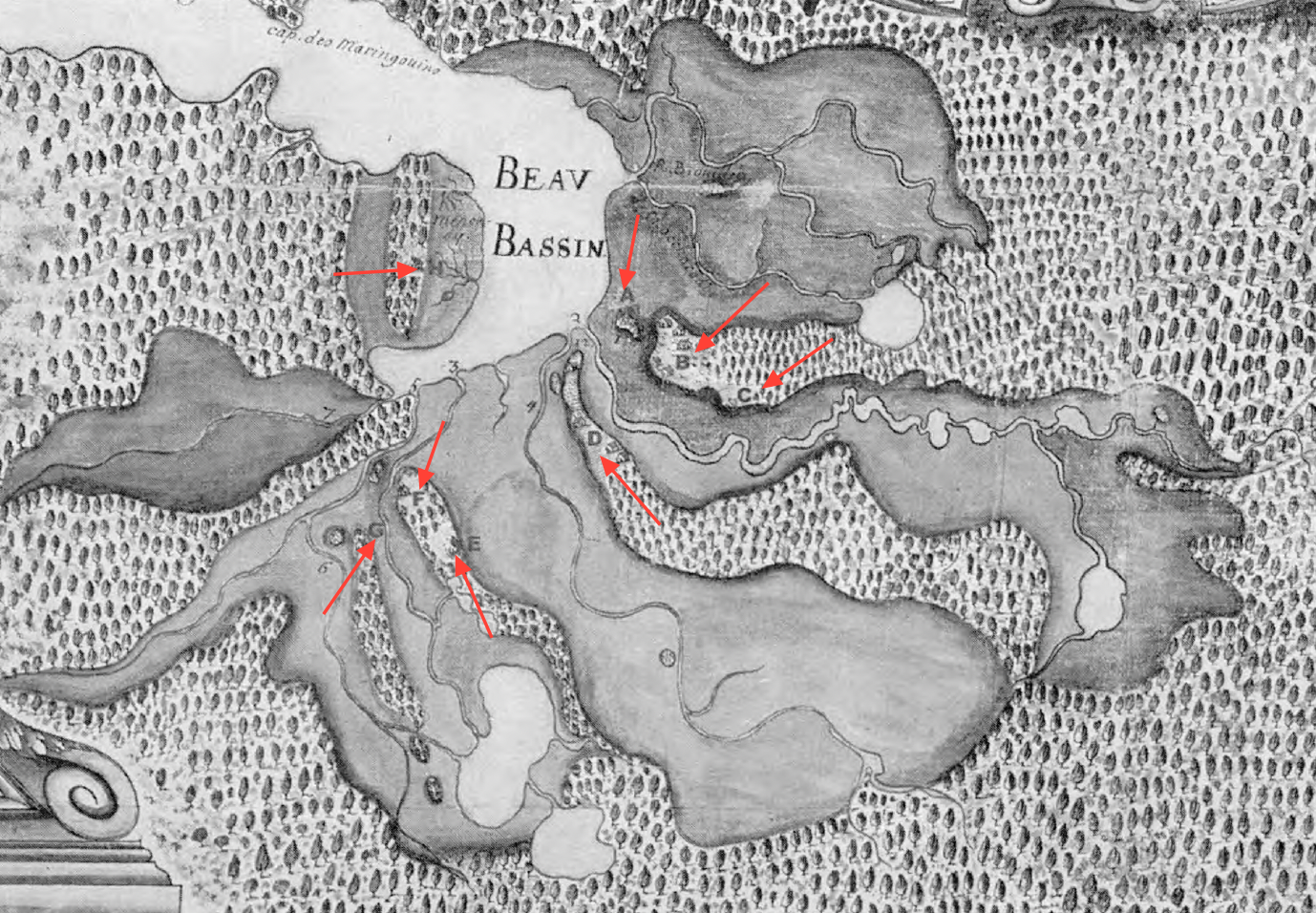
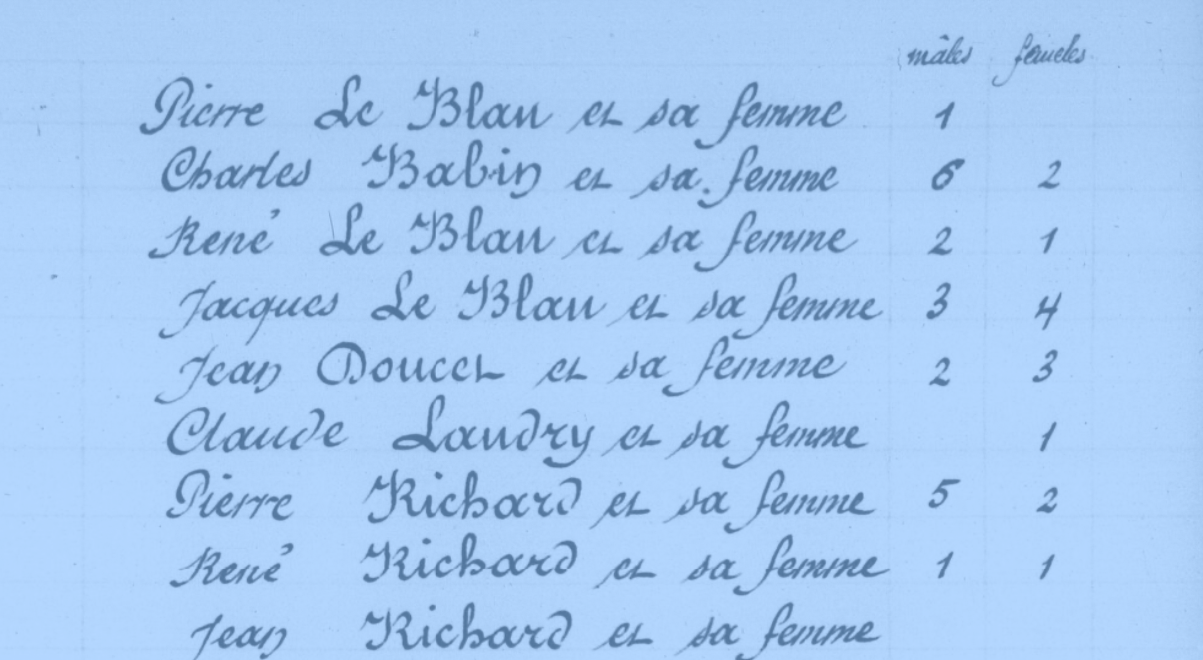
In the 1714 census Toussaint was recorded under his every-day name François, similarly in a simpler 1715 rolle-census.

The Acadian generations were already proliferating in Beaubassin by 1714. Also in the census was Toussaint/François and Marie's first daughter Marie (confusing!) who had married Germain Girouard in 1710 and had two children; they went on to have eight more children.
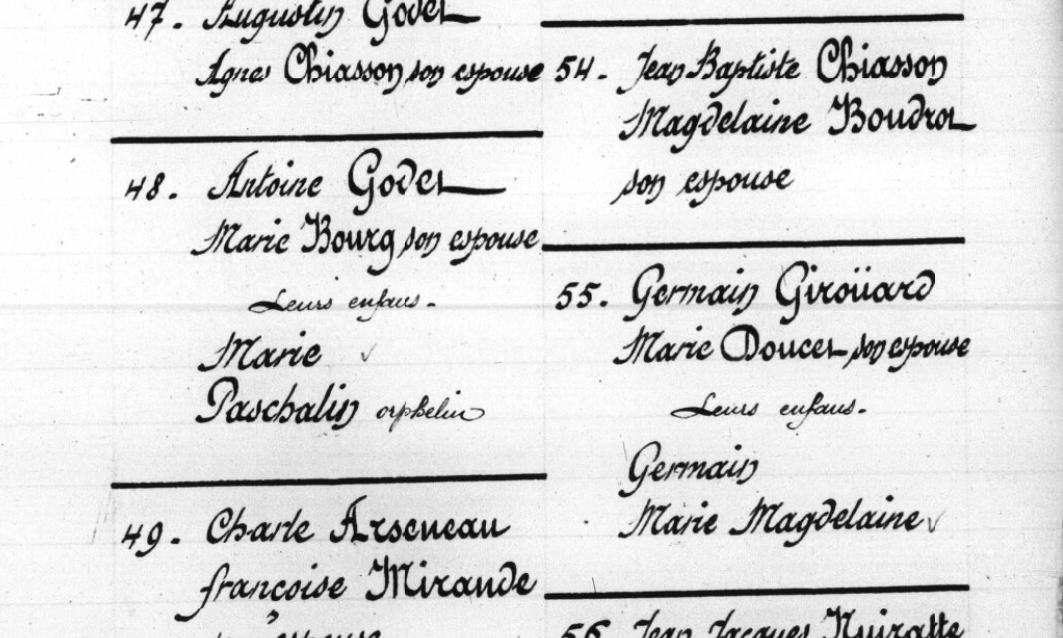
The uncle of Marie (the daughter who married Germain) - Louis Doucet - had already married into the Beaubassin Girouard family (see Louis section below).
Toussaint/François Doucet died some time before August 1733 when his daughter Madeleine married Pierre Richard in Beaubassin; in the marriage register he was described as "défunt" and Marie apparently was not.
Jean, Mathieu and Toussaint's brother, also moved away from Port-Royal towards the head of the Baie Française. Aged 26, he married Françoise Blanchard who was 20; she was the daughter of Martin Blanchard and Françoise LeBlanc. The Blanchard family connect in other ways with the Doucets, as will be seen with Laurent Doucet (see Footnotes).
It is unknown whether Jean and Françoise married in Port-Royal, but their first child Madeleine was born in Minas in 1693; the census of that year states "Magde" to be 4 months old, and the family was already well established with 8 arpents of land, 5 cattle, 9 sheep, 5 pigs, 1 gun and (unusually) a servant; this suggests they had moved from Port-Royal several years earlier, and may have married in Minas (a child was often born soon after marriage).
They had six more children between then and 1712 in Minas. The 1714 census records them having two sons and three daughters living in the household; the two oldest daughters had married by then; one son is 'unknown' but evidently counted in that census.
Grand-Pré as well as Beaubassin was raided by the Anglois forces of Benjamin Church in 1704. The tides and terrain, river banks and narrow channels prevented them landing initially and gave the inhabitants time to prepare; some escaped to the woods with their valuables. Church’s men start pillaging homes and barns, in which two of his men were killed. They set houses on fire, damaged the dykes and killed animals. Such intrusions into the seasonal pattern of Acadian life could have a knock-on effect, beyond the actual destruction and looting.
Summers were short, and raids like that diverted time and energy into repairs and re-building, away from the weather-critical business of harvesting and preparations for winter. Church's raid, coming after a drought the previous year, created a shortage of grain and flour.
Then, in November 1705, high tides flooded "tous ceux du pays sans exception" (all of the country without exception), the likely result of the New Englanders' deliberate destruction of dykes and aboiteaux the previous year.
When France was responding to the British take-over of the Port Royal area of Acadie in 1710 by encouraging Acadians to relocate to l'Île Royale, it was not only to strengthen France's position there, but also to develop the colony productively, following the example of Acadie. De Brouillan, who became governor of the French territory in 1718, had written earlier that the Acadians were the best possible settlers.
"These people are naturally handy and industrious, above the level one finds in Europe... They succeed in all they undertake... understanding by native wit what they know of various arts. They are born smiths, joiners, barrel-makers and Carpenters" [tr].
Many Acadians decided that they preferred the fertile reclaimed soils of peninsular Acadie to the rocky and poor soil of l'Île Royale. But not Jean.
In the story usually told about the Chignecto and Minas settlements, Jean doesn't seem to fit. He and Françoise had established a decent-sized farm there, had children some of whom had started their own families and lived nearby. Why did he want to leave? Had continuing that life become too hard years later, or was it just a restlessness of character, or a hankering after living his last years on French territory? Though we extol Acadian 'kinship bonds', sometimes there must also have been tensions, disputes and just not-gettings-on in families and with neighbours.
Jean was one of the first to visit l'Île Royale, in 1714, on a trial basis. In fact, French records show several men from Minas and Beaubassin went there too; most were from Annapolis Royal. He returned to Minas where he is recorded on the 1715 list of inhabitants but later did move his family to l'Île Royale. Françoise and youngest daughter Claire were still there in the 1752 census; it is assumed that he had died at an unknown date earlier.
Madeleine Doucet married René Bernard when she was 17 and he was 25, in Port-Royal in 1689. Who his parents were, whether he was born in Acadie or when he arrived, are all unknown. They had moved to Beaubassin by the time their first son, also named René, was born in 1690. Perhaps Toussaint moved there with them. They established a farm whose size and livestock is recorded in the early censuses; as with Toussaint's and the parental Caissie's farm, the amount of land decreased in 1707, according to that year's census, the last one recording such details.
Madeleine and René went on to have seven more children, before René died between the 1707 and 1709 censuses. By their marriage, Madeleine Doucet became the ancestral matriarch of the Acadian Bernard family.
Widowed and with seven of her children still at home (either one had left, or the third child had died), Madeleine married Pierre Dorion, a widower, in 1709; she was 37, he was 28. She had two more children, as recorded in the 1714 census for Beaubassin.
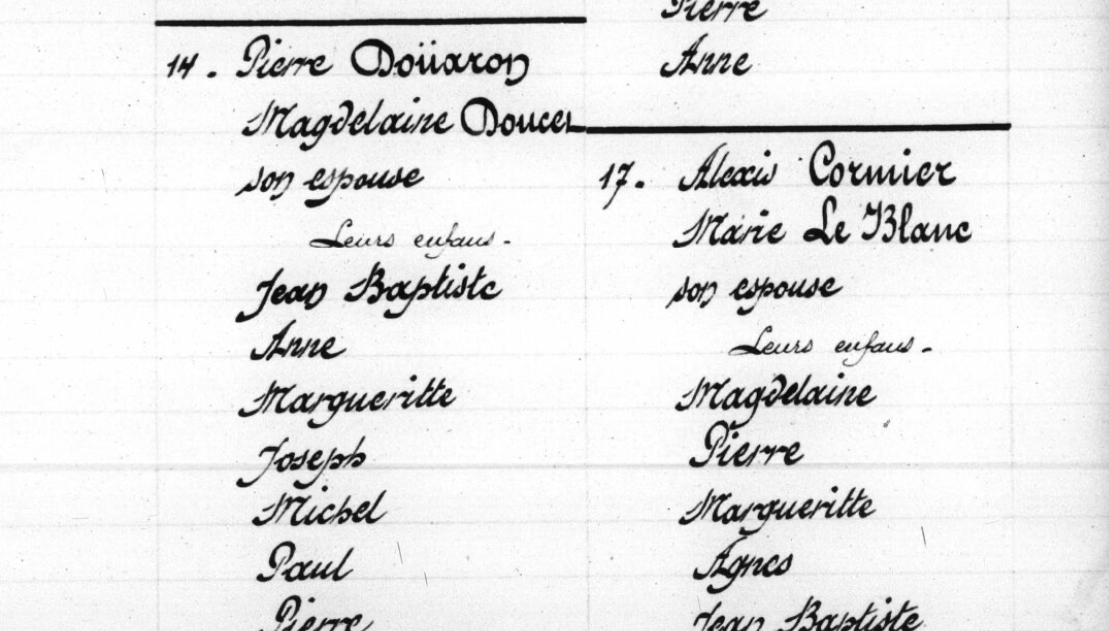
After Madeleine died (date unknown) Pierre remarried on 25 February 1740 to Veronique Brasseur.
Louis moved to Beaubassin some time between the 1698 Port-Royal census and 1702 when he, aged 27, married Marguerite Girouard, 19. She was the daughter of Jacques Girouard and Marguerite Gautrot, who had 14 children; all were born in Port-Royal, so it may be that Louis and Marguerite (the daughter) met there and moved together (and with Toussaint and Madeleine in 1700?) to Beaubassin where they married. Marguerite's older brother Pierre also moved there at about this time and her sister Marie Anne had moved to Grand Pré; several of her younger siblings (Guillaume, Denis, Germain) lived in Beaubassin at later dates. Much of the expansion of settlement within Acadie was a matter of 'kinship migration'.
Striking out for 'pastures-new' (literally) was clearly popular with this second/third generation of Acadians, and there is no sign that parents disapproved; some of them moved too, away from Port-Royal, the so-called cradle of Acadie but also the focus of foreign hostility.
Louis and Marguerite had seven children, all given family forenames (Pierre, Louis, Marguerite, Joseph, Marie, Madeleine - two children were named Madeleine; oddly it is the older one born about 1709 who is thought to have lived to at least 1763, while about the younger born 1722 nothing more is known (odd because often a forename is repeated when the older child dies young). And the birth of their last child Madeleine on 19 August 1722 is the last date on record that Louis and Marguerite are known to be alive; marriage records of their children which would provide later information have not survived.
Louis's name is repeated down the Doucet generations, to my unmet grandfather and to me as a middle name.
Louise - also known as Jeanne - Doucet pursued a different course of betterment. She was 14 when she married the 44-year-old Pierre Chênet in Port-Royal in about 1691. This might look like an uneven match, even oppressive of poor, very young Louise marrying a much older man. But there may be another story here. Pierre Chênet had been born in Paris and he was an important man in Port-Royal; he was the king's procureur (prosecutor) for Acadie and had obtained two titles to areas of land (seigneuries, one purchased, one granted) before marrying Louise; earlier he had added 'Dubreuil' to his name and so became Pierre Chênet seigneur (or sr.) Dubreuil. That he and Louise had even met says something about the small, even congested, nature of Port-Royal society at that time. And that they married - young girl off a small farm to a seigneur/procureur - says something about the social fluidity (or shortage of marriage partners) of Acadian life then. They had three children, Pierre in 1692, François in 1693 (who may have died age about seven, because the last date known for him is 1700) and Marie born in 1698 (last known date alive is 1700).
In the 1693 census Louise and Pierre were living on a large farm, 30 arpents. In 1698 she was named as Jeanne in that year's census, and in 1700 she is described as a widow: "Louise DOUCET, widow of Pierre Chienet DUBREUIL, royal prosecutor, Pierre 8; Francois 7; Marie 2, 11 cattle, 7 sheep, 3 arpents."[tr] How come the 30 arpents had gone down to three arpents in five years? Or did the census-taker mishear a mumbled trois for trente or vice versa? There is no known date for Pierre's death; one source states that he returned to France in 1710. Presumably Louise and children continued to live on their land for a time after her husband Pierre died or disappeared; she is not shown on the 1701 census or later either as Louise or Jeanne. Odder still, her three children do not figure in any records after the 1700 census (except Pierre pops up in 1724 and 1750); were they taken in by another family before Louise remarried in 1702?
It is known that Louise's son Pierre married in 1724 and, when his daughter married in 1750, he was named and not stated to be deceased (as was usual if that was the case). The other two children, François and Marie, do not figure in any records after the 1700 census
Remarkably, it was to another Parisian lawyer that Louise/Jeanne married, Jean Chrysostome Loppinot who had recently (1699) become court clerk at Port-Royal. He was socially mobile too; in 1704 he became king's attorney and in 1706 he too acquired a seigneury; there is no indication that Louise and the Loppinot family (nor the Chênet family) ever lived on the seigneurial lands or collected rents; these titles seem to have been honorifics, indicators of social status; both Chênet and Loppinot brought with them from France feudal expectations which Acadians had dispensed with. Louise/Jeanne and Jean lived in the township around the fort; there is no indication that they farmed any land, and the Loppinot family of Jean and Louise does not appear in any later census; nor do any French officials.
In 1707 their house was burnt down when Port-Royal was attacked by les Anglois; this was described: "L'incendie de la maison de Loppinot, située au bord de l'eau, eut lieu lors de l'attaque, finalement infructueuse, de March [Sir Benjamin March] contre Port Royal en 1707. Dans une correspondance, du 25 décembre 1708, il insiste sur cette situation défaborable et estime sa perte à cette occasion à plus de dix mille livres" (The fire at Loppinot’s house, located by the water, occurred during March’s ultimately unsuccessful attack on Port-Royal in 1707. In a letter dated December 25, 1708, he emphasizes this unfortunate situation and estimates his loss on that occasion at more than ten thousand livres).
The house occupied by the Loppinot family in 1710 is shown on Labat's map; it looks directly across the river, where it is narrow, to the farm and house where Louise grew up with her parents and siblings. That's the physical distance, the social distance was greater, and we do not know about the personal distance between Louise and her birth-family; there is no evidence of association, such as acting as witnesses to marriages or godparent-ing, in either direction, as there is in other cases.
Louise and Jean's house burnt down again in early 1710 possibly as a result of a pirate raid or a domestic accident; this location is described and shown on the map, numbered 34, of The Annapolis Heritage Society (see Sources). They had had a child in December 1708, baptised as Jeanne, about whom there is no later record so may have died young; in January 2010 they had Joseph who died two days later. It is impossible to know if being on the front line of cannon-fire and pillaging year after year had anything to do with these family tragedies, but the suffering cannot be doubted. They had five children, of whom two (Jean Chrysostome Nicolas Sebastian born 1703, and Louis 1707 - another Louis born 1705 had perhaps died) are known to have survived. Because this new Loppinot/Doucet family does not figure in any censuses, we cannot know if they were also caring for Louise's first three children.
In 1712 Jean Loppinot became clerk to the court in Plaisance, Terre-Neuve (Newfoundland); Louise and the children may well have moved there with him. Both Louise/Jeanne and Jean had apparently died by the time their grandly-named oldest child Jean Chrisostome Nicolas Sebastian Loppinot married on 7 January 1733 in Louisbourg on l'Île Royale.
René married Marie Broussard in 1701 or early 1702 (before the only surviving parish records started in May). He was 23 and she was 16, the third of eleven children.
Marie's parents were François Broussard and Catherine Richard. No Broussard was noted in the 1671 census and François was the only Broussard noted in the 1678 census; it is likely he was born in France and arived in Acadia after the resumption of migration in 1670 when Acadie was ceded to France; he may have come as a soldier. Catherine Richard was born in Port-Royal, and 14 when she married François aged 24 in 1678. In this way, Marie's parents are an example of the inclusive, multi-generational development of Acadie as a country. As a young couple, and François being a newcomer, they lived initially on the well established farm of Catherine's parents, the Richards (who who were another example of an Acadian-born woman marrying a man arriving from France, in the 1650s probably). The Richards figure in another branch of the Doucet family, relating to Laurent Doucet and his wife - see later; even this early, Acadian family intertwinings get so complicated.
René is marked on maps of the early 1700s as living on the farm Pierre founded, and there is no indication that he and Marie lived anywhere else; the amount of land is noted in only the 1707 census and this is small, 4 arpents, similar to what had been recorded for Pierre's farm; the 1714 census notes René (and Mathieu) as "proche de fort" - the Doucet family farm was just across the river.
They had eleven children between 1703 and 1730, all in Port-Royal; most were given familiar forenames. One, Catherine Josephe died before she was two. When some of the later-born children were baptised one of the older children was named as godparent, suggesting that by the 1720s connections with René's older siblings were more distant. Members of the Bourg family appear often in birth and marriage records of René and Marie's children, as well as Broussards and Grangers.
Anne Marie, their second child, born in 1706, is shown here at the time of her 1726 marriage to Pierre Landry in Annapolis Royal. The text accompanying this modern illustration describes the events of Pierre's life - his father Abraham is noted as starting the Pisiguit settlement - but says nothing about Anne Marie, except that she was 19 when marrying. In fact, there is more of interest: they had four children together, at least three of whom survived into the late 1700s and beyond, having reached Louisiana, indirectly.

From the few surviving records, we know that Mathieu was godparent (with Isabelle Broussard, Marie's sister) to their fourth child Anne, born on 23 March 1713. Anne was baptized at birth rather than the next day as was usual, by Abraham Bourg, and a full ceremony officiated by a priest was held a month later. On 5 February 1721 Abraham also baptised Marguerite at birth with a full ceremony later. This indicates it was feared that the newborns Anne and Marguerite might not survive; the baptismal records state "ondoyé par Abraham Bourg"; ondoiement is a provisional or emergency baptism, as carried out with the newborn Joseph Doucet in 1713.
In 1731 when Anne had given birth to her first child, Marguerite (Garceau), René was named as godparent (with Anne Granger) of his granddaughter, and this gives 10 September 1731 as the last recorded date that René is known to have been alive. He was about 53 then. He may have died soon after that date, because an English surveyor's map thought to be 1732 lists Mathieu on the Doucet farm, not René, as does the 1733 map shown earlier. Some of René and Marie's children had long moved away from Port-Royal, Agathe and Charles to Chipoudie, Marguerite to l'Île St Jean. Nothing is known of the last child born, Jeanne.
Marie was still alive aged about 66 in January 1752 when her daughter Cecile married Charles Bourg in Annapolis Royal.
Most of the children lived into the tumultuous events of the 1750s and '60s where they met various fates; what happened to Anne, after her will-she-survive start in life, tells a long story of loss, capture and escape (see In Acadian Footsteps:3). The maternal Broussard family also became particularly noteworthy later.
Marguerite Doucet, born two years after René and before Mathieu, married Alexandre Comeau in Port-Royal in 1700; she was 19, he was 25. Their six children (Françoise, Marie Anne, Joseph, Madeleine, François, Charles) were all born there, where she died on 18 July 1747. Their house in Port-Royal is described and shown, numbered 20, on the map of The Annapolis Heritage Society (see Sources).
Pierre appears in the 1686 census, aged 18, and then is recorded in no later censuses or records. Did he run away and disappear from sight, or die from an accident or in the attack of 1690?
And Mathieu? We know little of him. Did his growing up in traumatic times make him a cautious man, and/or as the youngest did he feel duty-bound to continue (with René) on the farm his father and mother had establshed, rather than adventure-forth to Beaubassin, Grand Pré or wherever? We know he married and had children with Anne, and not much more.
He is included in the 1714 census, the last one of Port-Royal/ Annapolis Royal, his and René's entries close together, suggesting they lived close at the time (see earlier). From a 1730 document, a refusal of Acadians to survey their lands for the British governor, it is clear that neither Mathieu nor René could write, signing their names with a marque instead.
We do not know exactly when Mathieu died. The last date he is known to have been alive is 11 August 1744 when, aged 59, he was witness to his daughter Marie Josephe Doucet marrying Jean Baptiste Tibodeau in Annapolis Royal. We do know that he had died by 20 July 1760 when Anne was listed as being a widow, aged 73. About which, more later.
Census excerpts above have been given from the original 1714 document. Interesting that this is in French, although Acadie had been ceded to Britain; the census was carried out by Felix Pain, who signs himself off as a Récollect missionary living in Beaubassin. Maybe he was making his own small rebellion: he titles the first section of the census as being of Port-Royal, not Annapolis Royal as it had been re-named; and, although the Port-Royal and Minas sections record only the names of heads of household, who are almost all male, when it comes to Father Felix's home ground he lists all family names in Beaubassin.
In the Minas section of the 1714 census, Felix Pain goes to the trouble of naming the different river-bank hamlets where each named Acadian family had settled: "De La Rivierre des Gaspards, De La Rivierre de Pigiguit, De La Rivierre des Habitants, De La Rivierre De La Vieille Habitation, De La Rivierre Des Canards" (ducks!). This gives us a picture of how the Minas communities had developed, and (I think) a feeling for their lives there which just the numbers would not. Likewise, enumerating the small area of Port-Royal, he places the Acadian families "proche de fort" or at the "cappe" (cape) or in the "banlieu" (township seems a better translation than the modern 'suburb'). Felix was a man doing a job for the new colonial masters (presumably), but he surely cared for these Acadian communities as they started to prosper again. Better he'd done this job than some Brit, and this fits with the way post-1710 'conquest' Acadians appointed their own intermediaries to deal with the British masters and reduce colonial intrusion into their communities.
However. Despite Felix's small show of independence with the 1714 census, Acadians did not entirely escape the hand of officialdom and imperial control by living in Beaubassin.
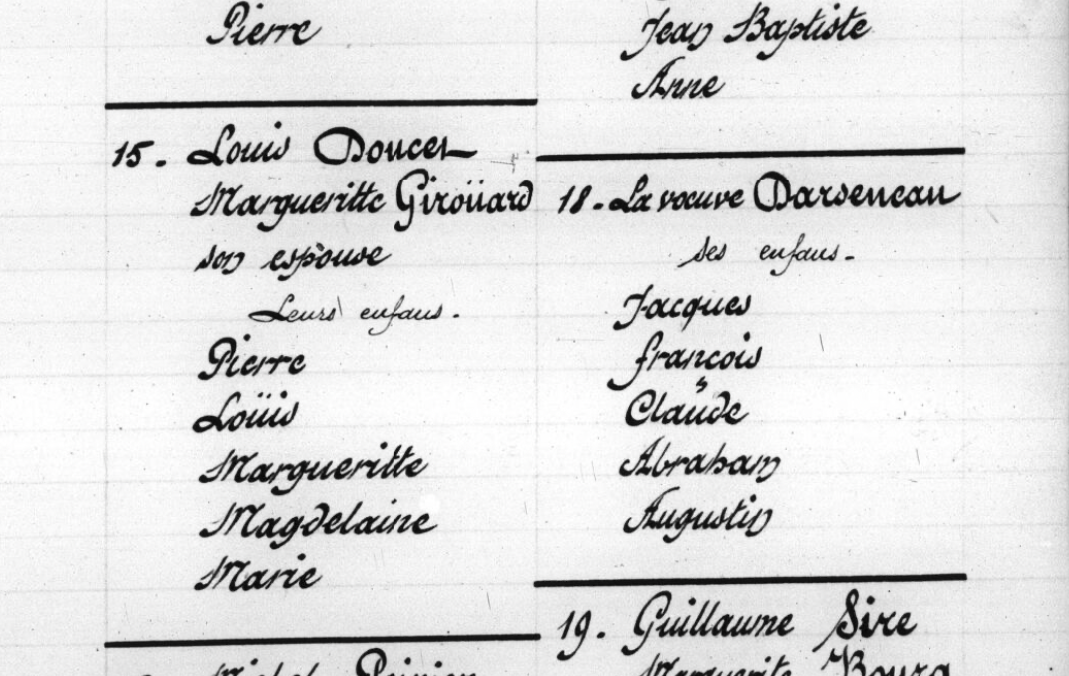
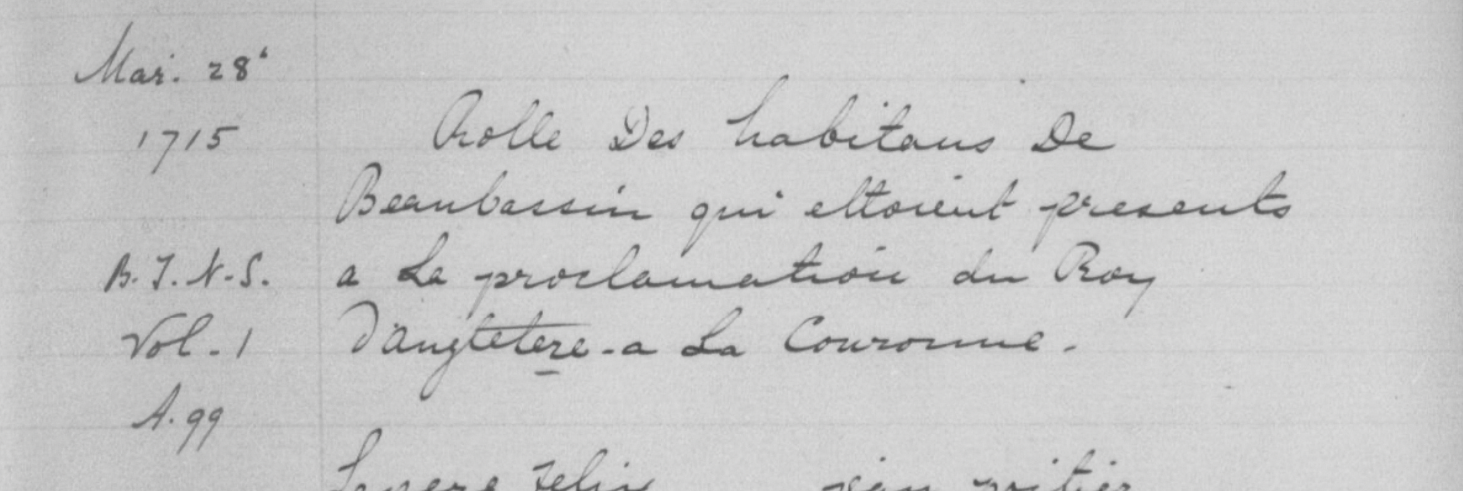
After the ceding of Acadia to Britain, a "proclamation du Roy d'Angleterre" was made to the inhabitants on 28 March 1715 and a "rolle" made of the male inhabitants present at the proclamation and those absent; this document is in French presumably because the five men present who signed it off (three of them by making their mark) made the list. There were 44 men present, including François Doucet, Germain Girouard (both of them) and Pierre Douaron; Louis Doucet was one of the 13 absentees. The proclamation may have been made by Major Caulfield, who signed for receipt of the list. Did he or a deputy travel to Beaubassin to give this proclamation, or send a text to be read out? The date is given as 28 May (I think), when travel conditions had likely improved.
A listing of the population of Les Mines including Grand Pré was also carried out in 1715; this was written in French and termed a "Liste des inhabitants" rather than a recensement (census). As with the Beaubassin proclamation, it was sent to Major Caulfield; everything suggests it was carried out on his precise instructions: it recorded 138 heads of households there, almost all male, those present (81), and also those absent (57), and it was conducted on 12 May. An Acadian, S. Bourg (or initial A. for Alexandre, the first listed) signed/ attested the document. Where were the 57 men absent; were they - hunting, trading furs with the Mi'kmaq or across the isthmus into French territory? Jean Doucet was one of those absent.
Not to be forgotten here is the mysterious sister of the founding family siblings Pierre (father of the children named above) and Marguerite Doucet. This second sister is thought to have existed because d'Aulnay's will refers to neices in the plural, because a female Doucet (forename unstated) married Pierre LeJeune in about 1654, and because a consanguinuity dispensation in 1747 deduced that there was a second sister to Pierre and Marguerite.
She had two children (Pierre and Martin) with Pierre LeJeune. One authority suggests she married in the presence of her uncle, Germain de LaVerdure, before he returned to France in the same year. These events were well before the earliest census (1671), and neither she nor Pierre LeJeune appear in that or other censuses but their children do. They are both thought to have been born in France, Pierre LeJeune arriving in the 1650s migrations encouraged by d'Aulnay or the new governor de la Tour.
The 1686 census lists both their children living in the Le Haive/ Mirligouche area, and the lack of mention of their parents indicates neither were there, possibly had died. Pierre is listed with his wife Marie Thibodeau, Martin with his wife Jean Marie Kagigconiac and children.
Footnotes
There was a second Doucet founding family growing up in Port-Royal, that of Germain, the son born in 1641 of an Abenaki father and, perhaps, Pierre Doucet's teenage sister Marguerite; at any rate, he was taken into the Doucet family, apparently named after Germain de LaVerdure, treated entirely as a Doucet and in later years accepted as a blood relation in marriage dispensations. Marguerite went on to marry Abraham Dugas in about 1647 and have eight children; this ancestral line is usually followed paternally - Dugas - (and she was buried as "Marguerite Dugast" rather than Doucet) but it did have a Doucet maternal origin; no woman no progeny.
Germain married Marie Landry in 1641, and they had nine children: Charles, Bernard, Laurent, Jacques, Claude, Marie, Jeanne, Alexis and Pierre (the latter two with surname spelled Doucette sometimes) between 1665 and 1685 in Port-Royal. Germain was described as a "laboureur" (farm-worker) in 1671, the only census to state the occupations of heads of household. By 1693 Germain and Marie had a large farm of 18 arpents. They and most of their children lived their lives among the tightly-packed houses of Port-Royal ville, a mini-urban setting, within sight of but different from the rural situation of Pierre and Henriette's family across the river.
Germain died sometime after the 1693 census; by the 1698 census his widow Marie had married the widower Etienne Comeau but despite this censuses continue to refer to her as "la veuve Doucet" (in the 1700 census she is not listed with Etienne Comeau or even close in the listings, and as living with one son and one daughter). Marie was still alive in 1714 in the last of the Port-Royal/Annapolis Royal censuses.
The second son Bernard died in 1709 and his wife Madeleine Corporon (another "la veuve Doucet", in the 1710 rolle) remarried.
From a 1730 document, a refusal of Acadians to survey their lands for the British governor, it is clear that Laurent and Jacques could not write, signing their names with a mark instead. Claude (known as dit Maitre Jean for some reason) did sign his name.
The 1710 Labat map shows Charles, Bernard and Jacques living in neighbouring houses in the township. About a kilometer upriver was Claude's house with his wife Marie Comeau in a three-family hamlet, again showing the kinship pattern of Acadian settlement (with them were Marguerite Landry widow of Germain with new husband Étienne Comeau, and Catherine Comeau with Jacques Michel dit St-Michel; Marguerite was Marie Landry's second forename). The homes of Charles, Bernard and Jacques in the ville, and of Claude nearby, are described and shown on the map, numbered 6, 10, 11, 19, of The Annapolis Heritage Society (see Sources).
Laurent had a farm upriver on the north side, shown on maps.
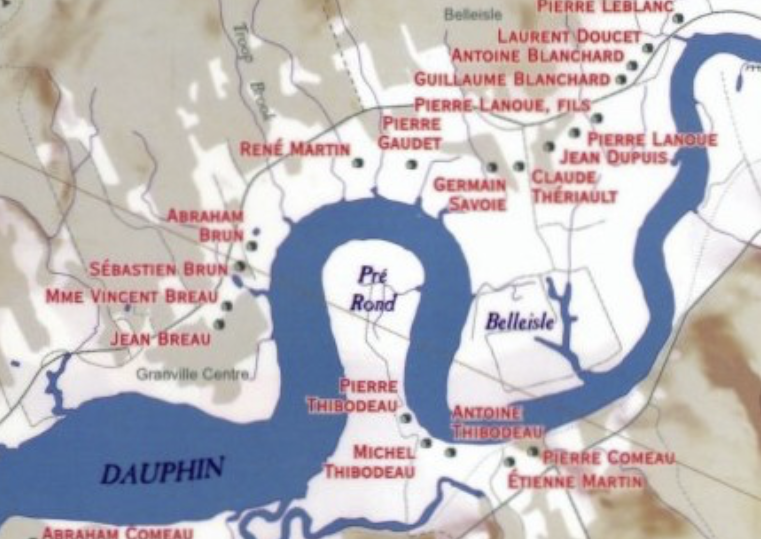
Laurent's marriage indicates how precarious and unpredictable life remained in the late 1600s for many in Acadia. In 1687, age 17, he married Jeanne Babin and took on her already large family. Jeanne, about 21, was a widow with her two children and five other children living with her. Four years earlier she had married Michel Richard who was 39 years older, and he himself was a widower. She and Michel had two sons together and she took on five of the ten children from his first marriage (the others had married and moved out; one of the five she became 'mother' to was about a year older than Jeanne). When, in 1687, she married Laurent they lived with her two sons from Michel Richard and (presumably) his 'earlier' five children. Six years later, the census shows a smaller family: four children, the two from Michel Richard and two she and Laurent had had; by this date, 1693, presumably all five of the 'earlier' children had left home (the youngest two would have been 14 and 17 years of age).
In 1698, eleven years after she and Laurent had married, they had four children, and this busy, composite family had prospered: they had a big farm, 18 arpents of cultivable land with 7 fruit trees, 13 cattle, 13 sheep and 6 hogs. The 1714 census provides more limited information, only husbands are named, and children numbered.
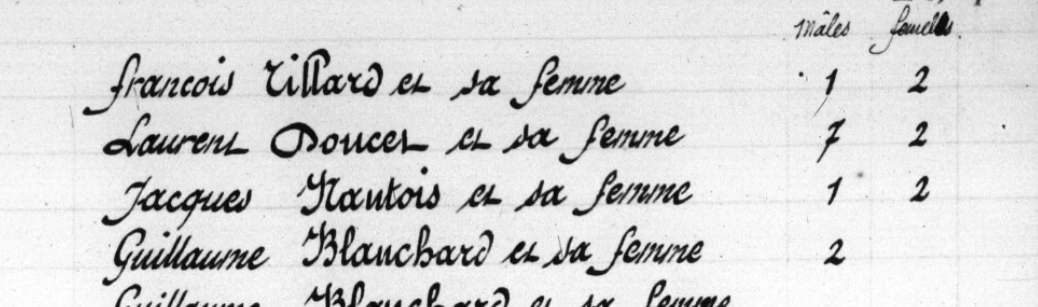
Jeanne (Babin/Richard) and Laurent Doucet had a total of twelve children together. Several of them lived into the 1760s and beyond; for six of them no more is known than their birth dates, suggesting short lives. Laurent had died by January 1728, circumstances unknown. It is not known if Jeanne married again; all her children (the youngest born in 1713) may well have left home by the time Laurent died. Jeanne was still alive on 15 October 1748 when her son Michel Doucet married Marie Josephe Babineau in Annappolis Royal; she was about 81 then, having lived 20 years after Laurent. The date and place of her death are unknown, as is the case sadly with many Acadians after the 1740s (see In Acadian Footsteps:3). But she should be better known, and celebrated; a lot of hardship and heartache in that life, hopefully love and some good times too.
Jeanne was the fourth of eleven children, born about 1667, of Antoine Babin and Marie Mercier who had both migrated from France. By her marriage to Michel Richard she is the - or an - ancestral matriarch of the Acadian Richard family; it is a pity that puts her own family names Babin and Mercier in the shade somewhat. Michel's first wife Madeleine Blanchard may also be considered the matriarch; it is uncertain whether she was born in France or Acadie.
In 1686 Jeanne's older brother Charles also married into the Richard family, Madeleine, 14-year-old daughter of Michel and Madeleine Blanchard. Interesting. What a small mixed-up world was Port-Royal in the 1600s.
The two Doucet families intertwine here, as noted earlier in the section on René Doucet and Marie Broussard. Marie's mother Catherine Richard was the daughter of Michel Richard and Madeleine Blanchard. Another twist is that Jeanne (Babin/Richard/Doucet)'s older brother Charles Babin appears in the 1714 census of Les Mines/Grand Pré, a few entries from Jean Doucet; Charles and his wife (not named, but Madeleine Richard) had six boys and two girls then; they were early movers to the Minas area, before the birth of their first child in 1688.
After the 1710 Anglois takeover of the Port-Royal area, many inhabitants of the township who had likely suffered most from the attack, burnings of houses and other depredations, moved to Louisbourg on l'Île Royale, still held as French territory. All of Germain and Marie's living children remained in Port-Royal, until in 1714 Charles and Laurent (with their cousin Jean, Mathieu's brother - see earlier) acceded to French encouragement to visit to l'Île Royale with a view to moving permanently.
What prompted Charles and Laurent to think about moving to French territory? The same year's census records "Laurent Doucet, 45, Jeanne Babin, 46, his wife, 7 boys, 2 girls"[tr]. No farmland details are given in the 1714 census but only seven years earlier this family was listed in the census with a reasonably sized farm: 6 arpents of land, 12 cattle, 12 sheep and 10 hogs; had the intervening events, the Anglois attacks of 1707 and 1710 affected them very badly? Charles had only one arpent of land in 1707 and lived in the Port-Royal township so probably was even more affected by the hostilities and had less of home-base than Laurent; he became a sailor and a carpenter at some point. Whatever the motives and circumstances, Laurent decided against the move and Charles decided he would move his family to l'Île Royale and they did so; they later returned to Port-Royal where Charles died in 1739, before his wife.
Claude died in 1754, and the last date Jacques was known to be alive was 1751. Jacques was known as Jacques dit Maillard; in the 1714 census he is even listed simply as "Maillard et sa femme" with three boys and three girls. His son Pierre born in 1707 and youngest daughter, Euphrosine, born in 1723, were also known as dit Maillard. The origin of this dit name is not clear, and why these two of his eleven children (Pierre was not the oldest son) were given that name is unknown; there seems to be no Maillard family connection, but there was an Abbé Pierre Maillard, based on l'Île Royale.
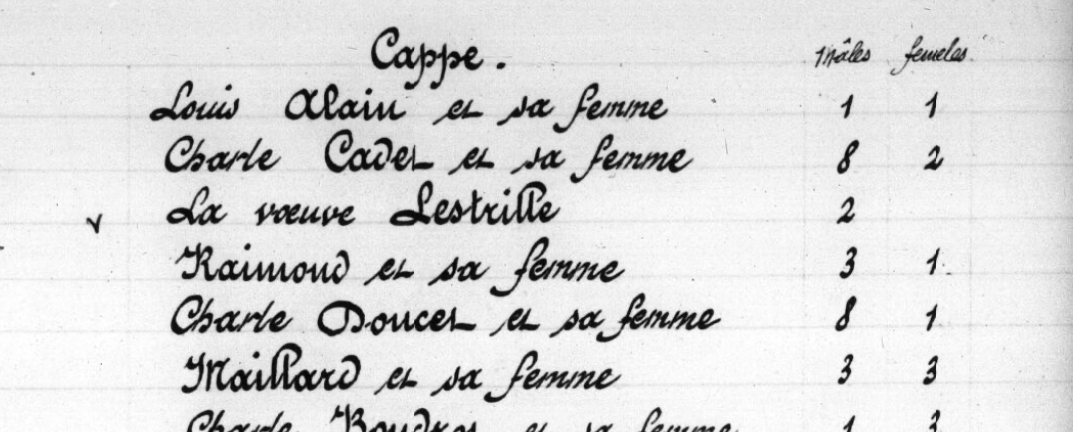
For Germain and Marie's daughters, Marie and Jeanne, no information on marriage, children or date and place of death has been found.
For the two youngest children, Pierre Doucet is recorded in censuses as living with his stepfather Étienne Comeau and his mother Marie in the 1700 and 1701 censuses, after which little is known except that he died, aged about 79, at Rochefort in France in 1764; what happened in between? About Alexis, even less is known.
There was a close Doucet connection to the Bourg and Landry families, both of which played important roles in the development of Acadie. After Henriette's father Simon Pelletret died around 1645, her mother Perrine Bourg remarried to René Landry and they had five children, Mary Marguerite, Marie, Madeleine, Pierre and Claude. By 1686 René Landry had died and Perrine lived with her youngest son Claude; she died between 1693 and 1698. Claude Landry's house in Port-Royal was close to Charles, Jacques and Bernard Doucet's.
Paul Mascarene was a French Huguenot who became a British subject and served with British military sent to Massachusetts. After the 1710 conquest of Port-Royal, in which Mascarene was involved, he was sent to Minas to gather tributes (money and goods) for the new British governor in Annapolis Royal; the Acadians there got his agreement that they could choose one or two men to represent each community at the head of the Baie Française and collect tributes "according to Each's Capacity". So developed a custom of representation, with delegates visiting the governor when needed, by which British officials and military were mostly kept out of these Acadian settlements. The delegates, chosen by the Acadians themselves, persuaded Mascarene that what the governor demanded should be reduced by a half; they proved to be canny negotiators over the years. In Annapolis Royal, a similar system of delegation and representation developed.
Jacques de Meulle was an official of New France who made a journey to Acadie, leaving Québec on 11 October 1685 and not arriving in Beaubassin until 23 November, such were the difficulties of travel. The bitter weather forced de Meulle to spend the winter there and continue to Port-Royal in the spring, arriving there on 2 May 1686.
Acadie can best be understood geographically, in landscape terms, which of course is how these people encountered this country and had to draw on all their abilities in adapting to survive. Not enough attention in most accounts of Acadie is paid to the physical environment; this was the determining factor for how Acadians' way of life developed. Anthony Clark, as a geographer, brings a focus on the physical nature of Acadie, in contrast to the colonial politics, genealogy, family names etc, which are the main concern of other books; see Sources.
Port-Royal has been described as the cradle of Acadie, but in a generation or two many Acadians grew out of the cradle, took adult footsteps elsewhere. The physical nature of Acadie varied greatly and much of it was unlike the rather confined Port-Royal/rivière Dauphin area with its harbour, fort and small village sheltered to the north and south by low mountain ridges. The Atlantic coast northwards towards Canseau (Canso) was quite different and settlements were different, a few large trading/fishing stations, many small scattered settlements of a few families each; they were exposed to the full force of Atlantic storms and passing ships, including unwelcome visitors.
Acadians seem always to have sought to live near water, and different again were the upper reaches of the Baie Française where high land abutting the waters created an indented coastline to make large sheltered bays. The simple difference is that this area was much bigger; even on a map showing only Acadie, the Port-Royal/rivière Dauphin is tiny in comparison.
What the initially few Acadians found in the late 1600s at the head of the Baie were many large sites to develop farming settlements, extensive marshes to be dyked and reclaimed as fertile land. Albeit on a scale requiring huge and sustained effort. We cannot pass over the enormous physical challenges facing people there. What the settlers encountered has been well described as:
"a cold, rough land. Winds swept in off the water and blew pitilessly across the marshes, which flooded regularly from the tides of Fundy. Travelers to this place described a landscape of endless grass, mud, and few trees. The small scrubby spruce that could survive the brackish soil were frequently spotted along the route pulled out by their roots by the wind. ...ever-shifting ground turned from swamp to mud, and from mud to water, and where trails vanished into fog."
The effort must have been enormous - and no time to waste, or they starved - and not a once-done-and-forget about it situation; these massive dykes had to be constantly maintained and repaired against tide and storm damage, and occasional Anglois efforts to destroy them. What was involved, for this small number of Acadians, the wholly unmechanized labour, is difficult to comprehend today.
"the scope of Acadian dyking in the Grand Pré and Beaubassin areas was of major importance for... the local farming families. In the Minas Basin for example, great earthworks were needed for the farming of that immense thousand acre marsh. They demanded engineering skill and hard labour as well as a considerable amount of organization for their building".
After centuries of exposure since then, the remains of dykes that can be seen above the mud are very substantial, and still form an important part of the shoreline.
An account of the construction of a major dyke at Memrancook in later years (1770s) gives some idea of the scale of the enterprise: that later workforce was almost the entire male population from settlements along the Memrancook and Petitcodiac valleys, working 12 days straight for 12 to 17 hours per day with horses and oxen until the first construction was just enough to withstand the immediate effect of the tides. The final dyke was 13.5 metres wide at its base, 7.2 metres high and - only 9 metres long. But at Grand Pré alone 19 miles of dyke were constructed by the early Acadians.
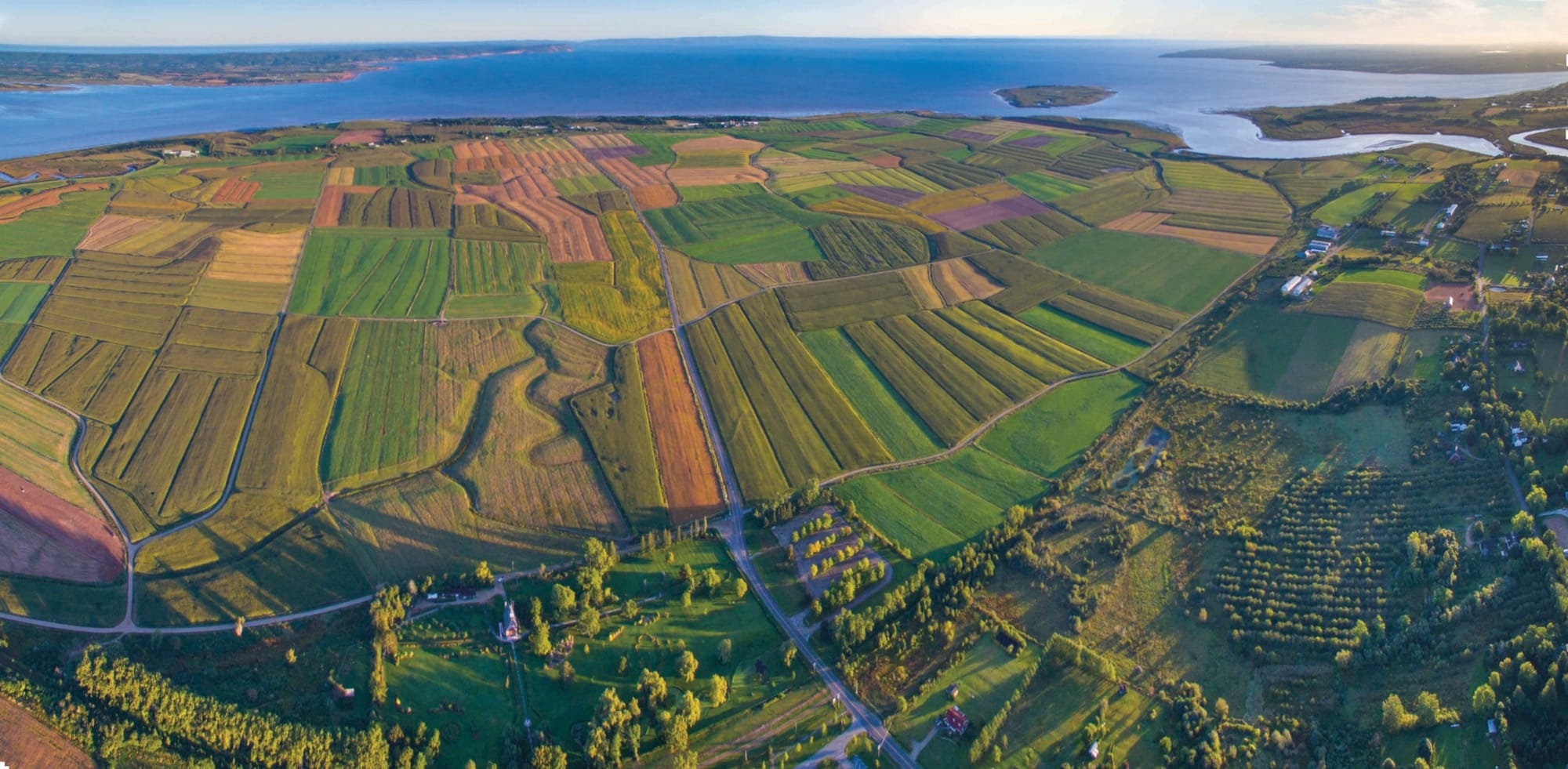
In 2006 a machinery operator unearthed a wooden sluice on the Grand Pré marsh. This turned out to be an aboiteau; it
"was dated to 1691 using dendrochronology, meaning it was put in place within the first decade after Grand Pré was settled. The sluice was found near the middle of the marsh, which is known to be where the Acadians began their land reclamation project. They then worked their way out, diking off the land section by section. By 1755, they had built nearly 19 miles of dike walls to reclaim nearly four square miles of tidal marsh and turned it into a network of highly productive fields."
Grand Pré in the Minas area was just one of many such settlements. Bordering just the Chignecto Basin there were 50,000 acres of tidal marshland. Estimates of how much land was reclaimed by dyking are approximate and vary between sources. It is often unclear if censuses were recording all arpents of cultivated land, i.e. land actually in crop at that time, or all cultivatable land on a farm; some fields were probably grazed at some times, planted/cultivated at others; not all dyked land was cultivated, and non-tidal/non-reclaimed land was also cultivated. There was no standard format for the censuses, they varied each from the other, and were conducted by different men. But there is no doubt that Acadian dyking was extensive and reclaimed large areas of land; this must have been the case to produce such excesses of grain that they could be exported in bulk. Remarkably:
- this was achieved in little more than a hundred years
- with a few hundred people initially, increasing to several thousand
- by hand, with no mechanical construction equipment (that we know of)
And it was achieved despite the long iced-up winters and harsh weather of the spring and autumn, which could sometimes get much worse. As examples of what may have happened in earlier years, Clark gives the storms of autumn 1759 which seriously damaged the dykes and of October 1869 (the Saxby Gale - see Sources) when water lay ten to thirteen feet deep over reclaimed land flooding 10,000 acres; he adds that "A gale of November 1901 had almost as great an effect". And in September 2022 a hurricane tracked to the east of the Bay of Fundy, causing widespread damage.
It may have seemed gloomy, what I wrote earlier about Pierre Doucet's old age. But it's easy to romanticise long lives, from a younger vantage point. My father Cleophas, Clifford or Cliff as he became, lived to 96, saw his brothers die before him, sisters, his wife, a daughter.
However, there soon came a time in Acadie when living to an old age was a sign of good fortune.
As with In Acadian Footsteps:1, this is a very slimmed down account of Acadia in the early 1700s, focussed on the generation after the founding generation of Pierre Doucet and his sisters, with just enough context to understand their lives in those extraordinary times and places, Chignecto-Beaubassin and Minas-Grand Pré as well as Annapolis Royal. The second and third generations flourished to an extraordinary extent, hence the detail and length in this account. They are people who deserve to be remembered.
Of the wider context, there is much more of interest in the Griffiths and Faragher books and others, noted in the Sources section of the previous Footsteps story, and more below. Not covered properly here, and will be in the next Footsteps story, is the fur trade, the saga of loyalty oaths, and the Mi'kmaq. As before, this is my particular Doucet story; other descendents will have their own stories, different lines of ancestry and different emphases and opinions.
In Acadian Footsteps:3 will describe what happened to my ancestor Mathieu's son Joseph, his brothers, sisters, children, grandchildren, and many other Acadians, the destruction that was inflicted on them, the human tragedy of the Acadie-that-was. The attempt to erase Acadie and 'Acadian'. Despite all the suffering, it failed! This will be hard to write.
It will be difficult to write in another way, with the sheer multiplicity of Doucets by the third and fourth generations, to do justice to them all in one article. If they had been left to follow the natural course of their lives, other families too, what a huge Acadian population there would be now.
Next:
3. - ?title to come
Joseph Doucet, 1713-1795
Anne Bourg, 1718-1803
Sources and Credits
In addition to those listed at the end of In Acadian Footsteps 1 :-
Gary Tucker's photographs convey with startling clarity the beauty and expanse of the Chignecto Bay marshlands; thanks to Gary for permission
https://garytuckerphoto.com/galleries
Parks Canada
https://parks.canada.ca/pn-np/ns/kejimkujik/culture/autochtone-indigenous/canot-canoe#project
Avon River Heritage and Culture Centre
http://www.avonriverheritage.com/mikmaq-birch-bark-canoes.html
The images in this Footsteps story may not show authentic Acadian/Mi'kmaq birch-bark canoes
Atlantic Bloodline, The Night The Atlantic Tried To Erase Everything (the Saxby Gale), https://www.facebook.com/profile.php?id=61583979749269
Nova Scotia Archives
https://archives.novascotia.ca/acadian/archives
Annapolis Heritage Society
https://annapolisheritagesociety.com/wp-content/uploads/2024/05/Acadian-walking-tour-map-English.pdf
Based on Labat's map, this lists the inhabitants of Port-Royal in 1710 providing a fascinating insight into daily life at that tumultuous time. Members of the Doucet families are shown as living at houses numbered 6, 10, 11, 19, 20 and 34 in the 'List of names and places, Port Royal, 1710' and on the map. For more on the Labat map see previous Footsteps article.
Steven A. Cormier, Acadians in Gray, Chapter 2.
http://www.acadiansingray.com
Chapter 2 of this epic work provides much more and interesting detail on the Acadian Baie settlements, best read with a good map to hand if unfamiliar with the geography, as in my case. I have not prolonged this family-focused Footsteps story by repeating what Steven Cormier has written so well.
Lisa Maguire, Beaubassin 1671: Part 1 - The Sluice Gate, Sculptors of the Great Marsh, April 2025
https://ancestory.substack.com/p/beaubassin-1671-part-1-the-sluice
This is one the best brief accounts of early Acadian life in Beaubassin, hopefully with more to follow
Isthmus of Chignecto
https://en.wikipedia.org/wiki/Isthmus_of_Chignecto
This well sourced article has detail on the wider international context of events at the de facto border between English and French-claimed territory, which Acadians were occupying.
Daniel Weiss, Paradise Lost, Archeology Magazine, March/April 2022 https://archaeology.org/issues/online/collection/acadia-paradise-lost/
Cumberland Basin
https://grokipedia.com/page/cumberland_basin_canada
The Atlas of Canada
https://atlas.gc.ca/toporama/en/index.html
Ta'n Weji-sqalia'tiek, Mi'kmaw Place Names
https://placenames.mapdev.ca
Acadian Historic Atlas
https://epe.lac-bac.gc.ca/100/205/301/ic/cdc/neo-ecossaise/en/index.htm
University of Ottawa, Archives Canadiennes, Généalogie des familles acadiennes: avec documents, 1906
https://archive.org/details/gnalogiedesf00gaud/page/n3/mode/2up
Library of Congress Geography and Map Division, Plan of the river of Annapolis Royal in Nova Scotia, 1732?
https://hdl.loc.gov/loc.gmd/g3422a.ct012051
Nicole Gallant-Nunes, Treasured Trees Genealogy Services
credit and huge thanks to Nicole for tracing my Doucet ancestors through the Acadian forests
Further reading and research:
Tantramar Heritage Trust, Atlas of the Acadian Settlement of the Beaubassin 1660 to 1775 (3 publications),
https://tantramarheritage.ca/publications/books/
Sherman Bleakney, Sods, Soil, and Spades, 2004
https://eventscalendar.smu.ca/.../detail/5401/1772143200000
Ian Louis Ross Doucet
2026